#BookReview Improvement by Joan Silber @AllenAndUnwinUK @ReadersFirst1

ImprovementAbout the Book

Reyna knows her relationship with Boyd isn’t perfect, yet she sees him through a three-month stint at Riker’s Island, their bond growing tighter. Kiki, now settled in the East Village after a youth that took her to Turkey and other far off places – and loves – around the world, admires her niece’s spirit but worries that motherhood to four-year old Oliver might complicate a difficult situation.

Little does she know that Boyd is pulling Reyna into a smuggling scheme, across state lines, violating his probation.  When Reyna takes a step back, her small act of resistance sets into motion a tapestry of events that affect the lives of loved ones and strangers around them.

A novel that examines conviction, connection, repayment, and the possibility of generosity in the face of loss, Improvement is as intricately woven together as Kiki’s beloved Turkish rugs, as colourful as the tattoos decorating Reyna’s body, with narrative twists and turns as surprising and unexpected as the lives all around us.

Format: Hardcover (240 pages)           Publisher: Allen & Unwin
Publication date: 7th February 2019 Genre: Contemporary Fiction

Purchase links*
Amazon.co.uk | Amazon.com | Hive (supporting UK bookshops)
*links provided for convenience, not as part of any affiliate programme

Find Improvement on Goodreads


My Review

Improvement unfolds in a series of interconnected stories focusing on different characters, starting with Reyna whose boyfriend, Boyd, is a prisoner in Rikers Island. When Reyna takes what might be considered a morally correct decision it sets off a chain of unintended consequences whose impact on other people will gradually be revealed.

In some cases, the connections between characters are tangential; the result of a chance moment in time. In others they are more direct – friends, lovers, business contacts. Moving backwards and forwards in time, I found it especially poignant when the reader possesses foreknowledge a character does not. We know why a call is not returned, nor ever likely to be.

Thanks to the skill of the author, all the characters seem totally real. They have flaws, they make poor decisions but they also try to do the correct thing, to right wrongs and make amends. Although, as one character remarks, “How much could ever be fixed?”

My favourite character was Reyna’s aunt, Kiki. Her colourful experiences when younger – “her old and fabled past” – take the reader on an enjoyable detour to Istanbul and the Turkish countryside.

In the book it seems to me ‘improvement’ takes many forms. For some it’s a better economic position or the rekindling of affection within a marriage. For others it’s finding a goal to work toward. As one character puts it, “The point was to ask for strength. Improvement wasn’t coming any other way.” Conversely, as Reyna notes sadly, for Boyd it is “the promise of criminal glory that was giving him his style back”.

Improvement invites us to consider the interconnectedness of the world we inhabit and the consequences of our actions on others. It also demonstrates the acute observational skills and deft touch that has made Joan Silber’s writing so admired.

I received a review copy courtesy of Allen and Unwin UK and Readers First.

In three words: Assured, insightful, intimate

Try something similar: From a Low and Quiet Sea by Donal Ryan

Follow my blog via Bloglovin


biophotoAbout the Author

Joan Silber is the author of eight books of fiction. Improvement was the winner of The National Book Critics Circle Award for Fiction and the PEN/Faulkner Award. It was listed as one of the year’s best books by the Washington Post, the Wall Street Journal, Newsday, the Seattle Times and BBC Culture. In 2018 she also received the PEN/Malamud Award for excellence in the short story. Her previous book, Fools, was longlisted for the National Book Award and a finalist for the PEN/Faulkner Award. Her other works include The Size of the World, finalist for the LA Times Fiction Prize, and Ideas of Heaven, finalist for the National Book Award and the Story Prize.

She lives in New York after college and teaches at Sarah Lawrence College and in the Warren Wilson College MFA Program. (Photo credit: author website)

Connect with Joan
Website


#BookReview The Mathematical Bridge by Jim Kelly @AllisonandBusby

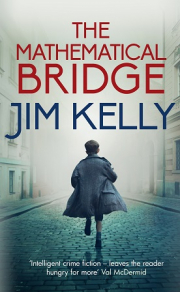
the mathematical bridgeAbout the Book

Cambridge, 1940. It is the first winter of the war and the snow is falling thick and fast. A college porter, crossing the ancient Mathematical Bridge on his nightly rounds, is startled to hear a child’s cries for help coming from the icy river below. Detective Inspector Eden Brooke is summoned by police whistle and commandeers a punt in a desperate attempt to save the child, but the flood carries the boy away into the night. By dawn there is no trace of the victim.

The boy was Sean Flynn, part of a group of Irish Catholic children evacuated from a poor London parish. When an explosion causes damage at a factory engaged in war work and the bombers leave an Irish Republican slogan at the scene, Brooke questions whether there could be a connection between the two events. As more riddles come to light, he begins to close in on a killer, but there is one last twist: it seems that Sean Flynn had his own startling secret.

Format: Hardcover (352 pp)                  Publisher: Allison & Busby
Publication date: 21st February 2019 Genre: Historical Fiction, Crime

Purchase Links*
Amazon.co.uk | Amazon.com | Hive (supporting UK bookshops)
*links provided for convenience, not as part of any affiliate programme

Find The Mathematical Bridge on Goodreads


My Review

In The Mathematical Bridge, the author once again creates a vivid sense of what it must have been like to live in wartime Cambridge with familiar views transformed by the addition of rooftop observation posts and searchlights to detect enemy bombers. Detective Inspector Eden Brooke’s home life reflects the daily experience of families during wartime. He and his wife, Claire, are awaiting news of their son serving with the British Expeditionary Force and his pregnant daughter, Joy, is anxiously awaiting news of her submariner husband. Alongside this uncertainty, there are long night shifts, blackouts, air raid warnings and rationing to contend with, not to mention the threat of attacks by the IRA. One of the many things I enjoyed about the book is this mixture of the personal and the political, the local and the global.

Another theme, as in the first book in the series, is that of darkness and light. Eden Brooke himself is the most obvious manifestation of this. The damage to his vision and the insomnia caused by his traumatic experiences in the desert during the First World War make the night time streets of Cambridge a sanctuary. It’s one he shares with fellow “nighthawks”, such as cafe owner Rose King, expert in circadian rhythms Aldiss, or night porter  Doric, ‘condemned to live life out of the light, at home in the shadowy world of the college after dark’. There are also some wonderfully atmospheric night time scenes such as the search of the drained River Cam.

However, although Brooke may welcome the darkness in a physical sense, his moral and professional impulse is to seek just the opposite. ‘Joining the Borough, on his return from the desert, had offered an opportunity to tilt the world towards light, and away from the darkness, even by small fractions of a degree.’

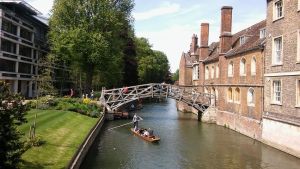
cambridge-1423972__480
The Mathematical Bridge, Cambridge

As in The Great Darkness, the author makes the reader feel they are alongside Brooke as he travels the streets of Cambridge in the course of his investigations, crossing the various bridges over the River Cam, including the famous Mathematical Bridge of the book’s title. And I’m sure I’m not the only reader who reacted with joy when they opened the book and found there was a map in the front.

In the enthralling final chapters, there are dramatic events, surprising revelations, split second life and death decisions to be taken and some poignant moments. At one point, Brooke observes, ‘He didn’t like the sense that fate was contriving a circular narrative, a story that was being drawn back to the beginning’. As a reader, I can only disagree (sorry, Eden) because I loved the way the various storylines were skilfully brought together. Oh, and a word of advice for Eden – listen to your wife when it comes to making assumptions about the identity of a murderer in future.

I loved The Great Darkness and this follow-up certainly didn’t disappoint. The Mathematical Bridge would be perfect for those mourning the demise of TV’s Foyle’s War or for fans of James Runcie’s ‘Grantchester Mysteries’ series. Readers who enjoyed The Great Darkness and have read, or are looking forward to reading, The Mathematical Bridge will be pleased to learn (as I was) that a third book in the series is due to be published early next year. It already has a place on my wishlist.

I received a review copy courtesy of Allison & Busby.

In three words: Atmospheric, compelling, assured

Try something similar: Nucleus (Tom Wilde #2) by Rory Clements (read my review here)


Jim KellyAbout the Author

Jim Kelly was born in 1957 and is the son of a Scotland Yard detective. He went to university in Sheffield, later training and working as a journalist on publications including the Financial Times. His first book, The Water Clock, was shortlisted for the John Creasey Award and he has since won a CWA Dagger in the Library and the New Angle Prize for Literature. He lives in Ely.

Website | Twitter