#BookReview Munich by Robert Harris

MunichAbout the Book

September 1938. Hitler is determined to start a war. Chamberlain is desperate to preserve the peace. The issue is to be decided in a city that will forever afterwards be notorious for what takes place there. Munich.

As Chamberlain’s plane judders over the Channel and the Fürher’s train steams relentlessly south from Berlin, two young men travel with secrets of their own. Hugh Legat is one of Chamberlain’s private secretaries; Paul Hartmann a German diplomat and member of the anti-Hitler resistance. Great friends at Oxford before Hitler came to power, they haven’t seen one another since they were last in Munich six years earlier. Now, as the future of Europe hangs in the balance, their paths are destined to cross again .

When the stakes are this high, who are you willing to betray? Your friends, your family, your country or your conscience?

Format: Hardcover (352 pages)                Publisher: Hutchinson
Publication date: 21st September 2017 Genre: Historical fiction

Find Munich on Goodreads

Purchase links*
Amazon UK | Hive (supporting UK bookshops)
*links provided for convenience not as part of an affiliate programme


My Review

Despite becoming a fan of Robert Harris’s writing since reading An Officer and A Spy, his 2017 novel Munich has been sitting on my bookshelf for quite a while. Including it in my 20 Books of Summer list was a deliberate ploy to make me finally read it, as well as acquiring the audio book version (narrated brilliantly by David Rintoul) so I could listen or read as the mood took me. How glad I am I did as I thought it was terrific.

Despite the fact we know from our history books the agreement reached at the Munich conference did not ultimately prevent the outbreak of war, the author still manages to create an atmosphere of tension and expectation. The book gives a fascinating, behind the scenes insight into the backroom going-ons on the British side: the careful drafting and re-drafting of papers and statements, the discussions with advisers, the telegrams to and fro from London. I particularly liked the scenes on the plane as Chamberlain and his team of diplomats fly to the conference. Surely only the British could have an in-flight meal sourced from a Fortnum & Mason hamper!

On the German side, I was transfixed by  the scenes on Hitler’s train as the Fuhrer and his entourage travel to Munich. It’s here that both German diplomat Paul Hartmann and the reader have their first face to face encounter with Hitler. For Hartmann, it is a pivotal moment. He also picks up a rather unwelcome fellow passenger who will dog his footsteps in the days to come.

Feted at the time (even in Germany, which annoyed Hitler intensely), Chamberlain was later accused of appeasing Hitler and the Munich agreement was regarded as a failure because it did not prevent the outbreak of war. In the author’s hands, the reader gets a more sympathetic and nuanced appraisal of Chamberlain. There is a touching scene in the garden of 10 Downing Street in which the reader gets a true sense of what lies behind Chamberlain’s steely determination to avoid war. And far from being a failure, the author subtly prompts the reader to consider that, in at least delaying the outbreak of war, the Munich agreement provided valuable time for Britain to rearm.

One of the questions at the back of my mind whilst reading/listening to the book was how much of the story was based on fact and how much the author’s imagination. That question was answered when I listened to this interview with Robert Harris recorded in 2017. In short, pretty much all of the events are based on documented fact. The only two fictional characters are Hugh Legat and Paul Hartmann, although even the latter is inspired by a real life figure. Legat and Hartmann allow the author to introduce an element of espionage to the plot, adding further tension as both are risking their careers, possibly their lives.

An autocratic leader with narcissistic tendencies who removes anyone who disagrees with him, surrounds himself only with people willing to do his bidding, acts on whim, has little time for detail and delivers rabble-rousing speeches in which he incites hatred of others. Just as well we no longer have individuals like that in positions of power in the world, isn’t it?

Munich is my favourite kind of historical fiction: based on fact but enhanced by the author’s imagination. I learned a lot from the book and was thoroughly entertained at the same time.

In three words: Fascinating, detailed, suspenseful

Try something similar: Hitler’s Secret by Rory Clements

Follow this blog via Bloglovin


About the Author

Robert Harris is the author of thirteen bestselling novels: the Cicero Trilogy – Imperium, Lustrum and DictatorFatherland, Enigma, Archangel, Pompeii, The Ghost, The Fear Index, An Officer and a Spy, which won four prizes including the Walter Scott Prize for Historical Fiction, Conclave, Munich and The Second Sleep. Several of his books have been filmed, including The Ghost, which was directed by Roman Polanski. His work has been translated into forty languages and he is a Fellow of the Royal Society of Literature. He lives in West Berkshire with his wife, Gill Hornby. His next book, V2, is coming out in Autumn 2020.

Connect with Robert
Website | Twitter | Facebook


#BookReview Paris Savages by Katherine Johnson @AllisonandBusby

Paris Savages twitter blog tourI’m thrilled to be joining my tour buddies, Adele at Kraftireader and Laura at Laura Patricia Rose, in hosting the first stop on the blog tour for Paris Savages by Katherine Johnson. The book will be published by Allison & Busby on Thursday 23rd July but is available to pre-order now.
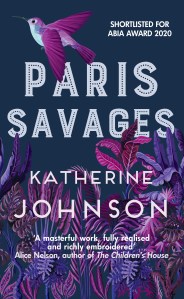
My thanks to Lesley at Allison & Busby for inviting me to take part in the tour and for my digital review copy via NetGalley. 


9780749026028 paris savages hbAbout the Book

Fraser Island, 1882. The population of the Badtjala people is in sharp decline following a run of brutal massacres. When German scientist Louis Muller offers to sail three Badtjala people – Bonny, Jurano and Dorondera – to Europe to perform to huge crowds, the proud and headstrong Bonny agrees, hoping to bring his people’s plight to the Queen of England.

Accompanied by Muller’s bright, grieving daughter, Hilda, the group begins their journey to belle-epoque Europe to perform in Hamburg, Berlin, Paris and eventually London. While crowds in Europe are enthusiastic to see the unique dances, singing, fights and pole climbing from the oldest culture in the world, the attention is relentless, and the fascination of scientists intrusive.

When disaster strikes, Bonny must find a way to return home.

Format: Hardcover, ebook (352 pages) Publisher: Allison & Busby
Publication date: 23rd July 2020           Genre: Historical fiction

Find Paris Savages on Goodreads

Pre-order/Purchase links*
Publisher | Hive (supporting UK bookshops)
*links provided for convenience not as part of an affiliate programme


My Review

In her Author’s Note, Katherine Johnson describes Paris Savages as “a work of imagination” inspired by a little-known true story. That story involves three Aboriginal people – Bonangera (known as Bonny), Dorondera and Jurano – members of the Badtjala tribe, who were taken from their home on K’gari (Fraser Island) to Europe as living exhibits in 1882-83.

Katherine also explains her choice not to assume Aboriginal viewpoints in telling the story. So, alongside the narrative told from the point of view of Hilda Muller, daughter of the German scientist who organises the trip, and excerpts from Hilda’s journal, a “ghost storyteller” provides the reader with an insight into Bonny’s experiences. Initially, I was unsure about this element of magic realism but I came to see it as a way of replicating, honouring even, the belief of the Badtjala people in spirit guides and an oral storytelling tradition.

For Hilda, the trip to Europe is a process of disillusionment as her trust in her father’s judgment and motives are tested. “Surely he would not have anything to do with a venture that collects people as curiosities and promises them ‘fancy articles’, as if they were children.” She is torn between her love for her father, still grieving the death of Hilda’s mother, Christel, her desire to support him in bringing to fruition her mother’s dream of a reserve for the threatened Badtjala people, and her doubts about the trip.

When they arrive in Europe, the initial excitement that greets them soon gives way to misgivings about how they are being represented in the displays organised for the paying public. They are exhibited as curiosities, forced to engage in often unrepresentative activities, or dance displays that ignore their traditional meaning. “That is where the interest lies. Natural. Exotic. Picturesque.” It poses the question, who are the savages? Those on display, or those who watch?

Alongside the “human zoos”, I’m sure I’m not the only reader to share Hilda’s growing sense of horror at the indignities and pseudo-scientific procedures to which the three Badtjala people are subjected. With a growing sense of guilt she wonders if she has led her ‘friends’, as she thinks of them, into a terrible trap.

Hilda becomes increasingly dismayed at the gulf between the enlightened views inherited from her mother and those of many of the supposedly educated individuals she encounters. She wonders, “Was she so different from most whites in her beliefs? Had her mother indeed been as alone in her opinions as she had said?” She recalls the words of her mother that “we do not need rulers and lengths of tape to see that our friends are as human as we are”.

At one point the ghost storyteller whispers to Bonny’s son back on K’gari, “Sorry, Little Bonny, if this story is becoming difficult for you to hear. It is becoming difficult, too, to tell.” The story of Bonangera, Dorondera and Jurano is a difficult one to read, especially as it is based on fact. I think we’d all like to imagine we have come a long way since the days when human beings were exhibited in zoos and freak shows. However, as recent events have demonstrated, ending inequality, valuing other cultures, and protecting the natural world are still live issues.

In highlighting the story of Bonangera, Dorondera and Jurano, Paris Savages not only provides a fascinating, if disturbing, insight into the past but is a timely reminder that challenges still remain in how we treat one another.

In three words: Fascinating, moving, thought-provoking,

Try something similar: Mr Peacock’s Possessions by Lydia Syson

Follow this blog via Bloglovin


Katherine Johnson author Paris SavagesAbout the Author

Katherine Johnson lives in Tasmania with her husband and two children. She is the author of three previous novels and her manuscripts have won Varuna Awards and the Tasmanian Premier’s Literary Prizes. She recently completed a PhD, which forms the basis of her latest novel, Paris Savages.

Connect with Katherine
Website | Twitter | Facebook | Instagram | Goodreads