Book Review – The Body in the Ice by A. J. MacKenzie #20BooksofSummer2025

About the Book

Christmas Day, Kent, 1796. On the frozen fields of Romney Marsh stands New Hall, silent, lifeless, deserted. In its grounds lies an unexpected Christmas offering: a corpse, frozen into the ice of a horse pond.

It falls to Reverend Hardcastle, justice of the peace for St Mary in the Marsh, to investigate. But with the victim’s identity unknown, no murder weapon and no known motive, it seems an impossible task. Working alongside his trusted friend Amelia Chaytor, and new arrival Captain Edward Austen, Hardcastle soon discovers that there is more to the mystery than there first appears.

An American family torn apart by war intent on reclaiming their ancestral home, a French spy returning to the scene of his crimes, ancient loyalties and new vengeance combine to make Hardcastle and Mrs Chaytor’s attempts to discover the secret of New Hall all the more dangerous.

Format: Hardcover (368 pages) Publisher: Zaffre
Publication date: 20th April 2017 Genre: Historical Fiction, Crime, Mystery

Find The Body in the Ice on Goodreads

Purchase The Body in the Ice from Amazon UK

My Review

I’m ashamed to say The Body in the Ice has been sitting unread on my bookshelf since I received a copy via Readers First back in 2017. I included it in my list for the 20 Books of Summer 2025 reading challenge precisely so it would not be in the same state next year.

The Body in the Ice is the second book in the series featuring Reverend Hardcastle and his friend, Mrs Amelia Chaytor. Although there are references to events in the first book, The Body on the Doorstep, I didn’t feel at a disadvantage by having not read it. Having said that it would have been nice to know a little more of Hardcastle’s back story, to fill out his own description of himself. ‘I have played at being a theologian, a scholar, a playwright, a duellist, a clergyman and a rake; often all at the same time. I have lived most of my life on a whim… I have been self-indulgent, vain and foolish; even, at times, quite wicked.’

The book includes a map of the area, a floor plan of New Hall and, helpfully, a family tree of the newly returned owners of New Hall, the Rossiters. But just why have they returned now? What is it about New Hall that means someone is prepared to kill to keep it a secret? That’s the conundrum Hardcastle is tasked with solving in his capacity as justice of the peace.

I think the authors really captured the remote beauty of Romney Marsh, especially in winter. The area has been the haunt of smugglers since the 13th century and their landing places, tunnels and hiding places feature in the story, as do the efforts of the ‘preventive’ men (Customs Officers and Excise Officers, separate entities at the time) to disrupt the smuggling operations.

I loved the element of humour, chiefly provided by the person of Calpurnia, the Reverend Hardcastle’s sister. A novelist, she has come to visit in order to gain inspiration for her next book. As she explains: ‘I need a harsh and forbidding landscape… I need to feel the salt wind on my cheek, I need to hear the wild storms rage. I need to know that the people around me are enduring lives of great hardship, battling against the unfeeling elements and the cruelty of wind and wave…’ (We get to hear a chapter from it which I’m guessing the authors had great fun writing.) And Calpurnia reveals she once gave writing advice to Captain Austen’s young sister during a visit to the Austen family’s home at Godmersham. I’ll let you join the dots…

Calpurnia’s presence is not entirely welcomed by Hardcastle who has become used to living on his own, indulging in a glass of port or brandy whenever he wants. As well as plenty of unwelcome advice, Calpurnia brings with her a huge Irish wolfhound named Rodolpho who seems the most cowardly dog on God’s earth. Actually Calpurnia makes some astute observations about the investigation and proves quite formidable during some of the dramatic scenes in the book.

The Body in the Ice is a really entertaining historical mystery with a plot that involves plenty of intrigue, a family feud, some false trails as well as nods to preoccupations of the time, such as the threat of invasion by France. Hardcastle and Amelia make a great team and there’s an interesting cast of other characters. I also enjoyed the detail of life in a small village where nothing stays a secret for long and it’s probably best not to ask where the brandy and tobacco came from.

My copy contained a ‘sneak preview’ of the next book in the series, The Body in the Boat, which was published in 2018. There have been no further books in the series but the authors have written a number of other series.

The Body in the Ice is book 6 of my 20 Books of Summer 2025.

In three words: Engaging, suspenseful, atmospheric
Try something similar: Lady Helena Investigates by Jane Steen

About the Authors

A. J. MacKenzie is the pseudonym of Marilyn Livingstone and Morgen Witzel, an Anglo-Canadian husband-and-wife team of writers and historians who live in Devon and do as much of their writing as possible on the beach or on the moors. They write non-fiction history and management books under their own names and since 2022 they have also begun writing under a second name, R. L. Graham

Connect with A. J. MacKenzie
Website | X/Twitter

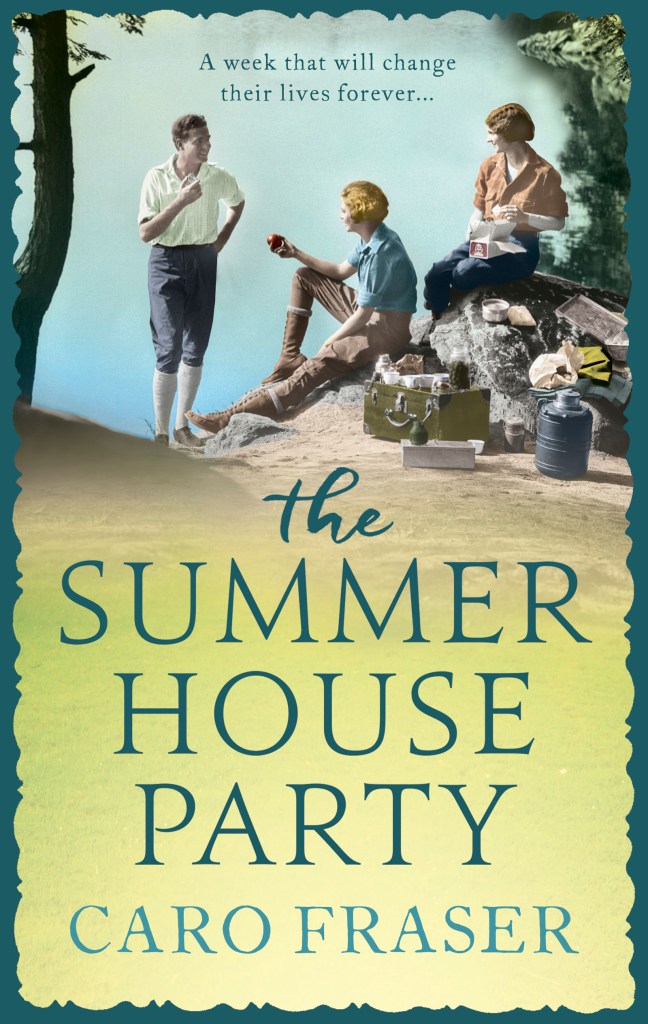
Book Review – The Summer House Party by Caro Fraser #20BooksofSummer2025

About the Book

In the gloriously hot summer of 1936, a group of people meet at a country house party. Within three years, England will be at war, but for now, time stands still.

Dan Ranscombe is clever and good-looking, but he resents the wealth and easy savoir faire of fellow guest, Paul Latimer. Surely a shrewd girl like Meg Slater would see through that, wouldn’t she? And what about Diana, Paul’s beautiful sister, Charles Asher, the Jewish outsider, Madeleine, restless and dissatisfied with her role as children’s nanny? And artist Henry Haddon, their host, no longer young, but secure in his power as a practised seducer.

As these guests gather, none has any inkling the choices they make will have fateful consequences, lasting through the war and beyond. Or that the first unforeseen event will be a shocking death.

Format: Hardback (512 pages) Publisher: Head of Zeus
Publication date: 6th April 2017 Genre: Historical Fiction

Find The Summer House Party on Goodreads

Purchase The Summer House Party from Bookshop.org [Disclosure: If you buy books linked to our site, we may earn a commission from Bookshop.org, whose fees support independent bookshops]

My Review

The Summer House Party is book 5 of my 20 Books of Summer 2025. Shamefully, it has been on my bookshelf since the publishers sent me a copy back in 2017. It was only once I started reading the book that I remembered I’d read the sequel, Summer of Love, in 2018. That book focuses on the post-war lives of the characters, including those who are only children in this book.

I remarked in my review of Summer of Love that there were spoilers from this book, even in the blurb, and I now realise why the consequences of some of the events in this book – including an extremely significant one – felt under-developed. Presumably, it was always intended there should be a sequel. I don’t think I would be alone in finding it frustrating for some things to be left hanging at the end of this book.

I confess that for a lot of the book I found very little to like about many of the characters. Their lives seemed very self-idulgent and remote from those of ordinary people. Diana’s hedonistic lifestyle is a whirlwind of cocktail parties, boozy lunches and night clubs. It’s all ‘simply too divine’. She’s pretty free with her sexual favours too. Conversely her brother Paul is a straightlaced and rather pompous individual who eulogizes male friendship, has a very dismissive attitude to women and expresses views which border on the anti-Semitic. Dan is a philanderer who views every woman as a potential conquest so his professions of love are rather difficult to believe. Meg comes across as very naive and eager to please. For some unfathomable reason, she idolises Paul. Sonia, wife of artist Henry Haddon, is the perfect hostess but has a strangely distant relationship with her young daughter Avril who is invariably consigned to the care of a nanny. Sonia seems unable to see that Avril’s frequent tantrums are a result of this neglect, especially since Avril’s father is usually cloistered away in his study.

The days consist of a seemingly endless round of cocktails, long lunches and idle chitchat with a few games of tennis thrown in. Events in Europe (this is 1936) seem far away with more concern given to the difiiculty of finding reliable servants than what may be on the horizon. The only concession to world events is Charles Asher’s announcement that he is off to fight in the Spanish Civil War, greeted with particular dismay by Paul. During the house party at Woodbourne House there’s a lot of flirtation and late night knocks at bedroom doors. The relationships that form that summer, including the love triangle that is at the heart of the book, have repercussions that persist for years.

Meg, finding herself in a rather sterile marriage, struggles with the competing demands of love and responsibility. Trying to ‘have her cake and eat it’ means deceiving those around her in order to find snatched moments of happiness, usually followed by intense feelings of guilt on her part. Despite the risk of discovery, she is unable to find the courage to commit wholly one way or the other. It’s a situation that cannot continue, with tragic consequences.

Once war breaks out, I found the characters became more appealing as we see other sides to their characters. Sonia discovers life can be lived without servants doing everything for you and rises to the challenge of keeping the household supplied with food. Woodbourne House becomes a place of refuge as German bombing raids on London intensify. Dan and Paul demonstrate courage whilst on active service. And Meg experiences first-hand what many in London are suffering leaving her with an intense feeling of displacement.

The book perfectly captures the milieu of upper class society in the years before World War Two, epitomised by the carefree atmosphere of a summer house party in an idyllic setting. The travails of the war years intervene bringing with them a sense that some social changes are irreversible (even if Sonia does still yearn for the days when a servant would draw her bath for her). The book demonstrates the very complicated nature of human relationships. Indeed, to quote from Sir Walter Scott’s poem Marmion, ‘Oh what a tangled we we weave, when first we practice to deceive’.

Caro Fraser sadly died in April 2020.

In three words: Romantic, engaging, evocative
Try something similar: The Light Years by Elizabeth Jane Howard

About the Author

Caro Fraser was the author of the Caper Court novels, based on her own experiences as a lawyer.

The daughter of George MacDonald Fraser, author of the Flashman novels, she died in April 2020.