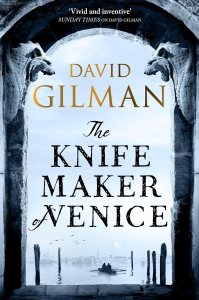
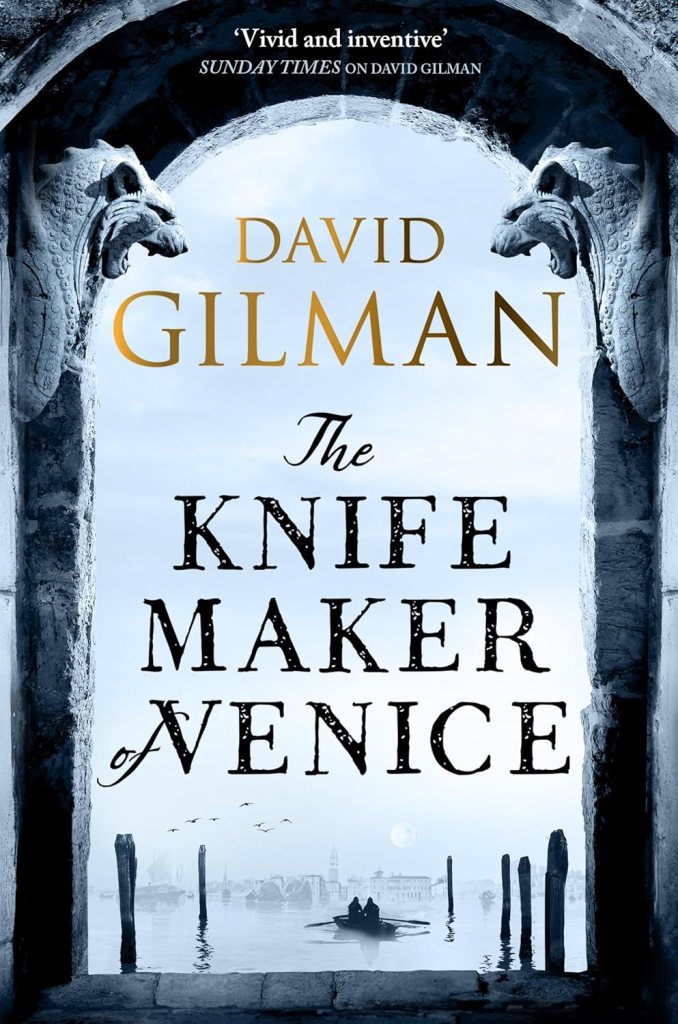
Book Review – The Knife Maker of Venice by David Gilman @HoZ_Books

About the Book

1604. As pirates seeking slaves to sell in the markets of North Africa terrorise the coasts of Europe, headstrong Richard Sheriff and his sister Elizabeth are torn from their Devonshire home and thrust into a waking nightmare.

Richard’s skills as a blacksmith see him fetch a high price, but the pirate captain has other plans for Elizabeth and once they are separated, Richard has no idea of his sister’s fate. They must both learn to survive on a deadly voyage into the unknown.

Sold into servitude in Venice: glittering, vicious city of secrets, he is apprenticed to a knife maker. Richard’s talents soon win him renown… but haunted by his sister’s absence, he vows never to stop looking for her, knowing she would do the same for him.

First he must survive that city of ghosts. Will the siblings live to see each other again, or will they join the myriads lost to Venice, where life is cheap, profit is all, and escape nigh-on impossible? 

Format: Hardback (512 pages) Publisher: Head of Zeus
Publication date: 13th August 2026 Genre: Historical Fiction

Find The Knife Maker of Venice on Goodreads

Preorder/Purchase The Knife Maker of Venice from Bookshop.org [If you buy books linked to this site, I may earn a commission from Bookshop.org, whose fees support independent bookshops]

My Review

David Gilman’s books have made numerous appearances on my blog. I’ve read several of his ‘Master of War’ series set in 14th century Europe (the most recent being Rage of Swords), thoroughly enjoyed his WW2 thriller Night Flight to Paris, and devoured his three thrillers featuring former member of the French Foreign Legion, Dan Raglan aka The Englishman, on whom I admit to having a literary crush. I’ve enjoyed every one of the books I’ve read and I’m pleased to say The Knife Maker of Venice continues that trend.

Following a raid by corsair John Challenor, Richard and Elizabeth find themselves aboard a ship sailing towards Tunis where Challenor hopes to sell the men, women and children he has captured as slaves. That’s if they survive the voyage and the terrible conditions below deck. Richard is consigned to the hold with the others but Elizabeth, with whom Challenor is besotted, is taken to his cabin. Surprisingly, he does not force himself upon her, clinging to the hope she will agree to be his wife. Having said that he’s not averse to using her brother as a bargaining chip.

Challenor has made plenty of enemies during his career. Not surprising since he’s no stranger to double-dealing. It leads to some dangerous naval encounters during which it’s only Challenor’s remarkable seamanship that keeps the vessel from being sunk or captured. It’s during one of these encounters that Richard makes a daring rescue unaware that in doing so he is setting in motion a train of events that will come back to haunt him.

The meticulousness of the book’s plotting becomes apparent once the action moves to Venice as we discover the relevance of certain events, some seemingly minor, that occurred earlier in the story.

As Richard and Elizabeth discover, Venice may be beautiful on the outside but it is a cesspit of intrigue, deception and cruelty on the inside. Activities that are officially illegal, such as slavery, persist with a blind eye turned as long as you possess sufficient wealth or influence. Power is the currency of the nobility. People who get in the way simply disappear. There’s a telling moment when Richard learns the true nature of the flickering lights he sees on the lagoon at night.

But at the same time, Venice is a place of superb craftmanship: exquisite glass, delicate lace and skilfully honed knives studded with precious gems. It’s Richard expertise at crafting the latter that brings him to the attention of a wealthy patroness. But he remains a slave, his freedom only to be attained on her death.

The pace really picks up in the final third of the book where the intrigue and deception I mentioned earlier comes to the fore with plenty of twists and turns and some narrow escapes. It’s at this point that relationships formed earlier in the story make the difference between life and death.

I loved Richard’s devotion to his sister, always mindful of his father’s last words to him, but I also admired Elizabeth’s resilience and instinct for survival which is really put to the test towards the end of the book.

The Knife Maker of Venice is a rich tapestry of a historical novel that combines fascinating period detail with thrilling action.

I received an advance reader copy courtesy of Head of Zeus via Goodreads. The Knife Maker of Venice is book 16 of my 20 Books of Summer.

In three words: Epic, suspenseful, action-packed
Try something similar: The Glassmaker by Tracy Chevalier

About the Author

David Gilman has enjoyed many careers, including paratrooper, firefighter and photographer. An award-winning author and screenwriters, he is the author of the critically acclaimed ‘Master of War’ series of historical novels, and was shortlisted for the Wilbur Smith Adventure Writing Prize for The Last Horseman. He was longlisted for the same prize for The Englishman, the first book featuring ex-French Foreign Legionnaire Dan Raglan. David lives in Devon.

Connect with David
Website | X/Twitter | Facebook

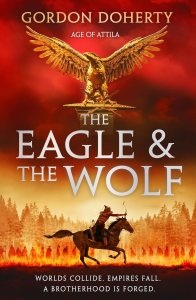
Book Review – The Eagle & the Wolf by Gordon Doherty @GordonDoherty @HarperCollins #20BOS26

About the Book

As Hun hordes and Germanic tribes maraud through Imperial lands, two legendary men – Attila the Hun and the “Last of the Romans” General Flavius Aetius find their fortunes entangled with the chaos.

Flavius Aetius, a noble Roman son, is an outsider in a savage land. He has been banished, given as hostage to the barbaric Huns and sent to the edge of the world.

What the Huns do not know, however, is that his father and mother have been murdered in a coup. He is an orphan, with no value at all. His life hangs on a lie.

In this new harsh world, he manages to find one grudging ally, a young boy named Attila.

A brotherhood is formed. One that, the shamans foretell, will shatter the world.

Format: Hardcover (448 pages) Publisher: HarperCollins
Publication date: 13th August 2026 Genre: Historical Fiction

Find The Eagle & the Wolf on Goodreads

Preorder/Purchase The Eagle & the Wolf from Bookshop.org [Disclosure: If you buy books linked to our site, we may earn a commission from Bookshop.org, whose fees support independent bookshops]

My Review

Gordon Doherty has become one of my go-to authors for exciting historical fiction set in the Roman age. I’ve read a number of the books in his ‘Legionary’ series, including the most recent and, sadly, the final instalment Devotio – as well as the ‘Rise of Emperors’ trilogy co-written with Simon Turney. What I’ve come to expect is action-packed stories rich in authentic historical detail. I’m happy to say The Eagle & the Wolf, the first in the new ‘Age of Attila’ series, delivers in all those respects.

I’m probably not alone in having learned about the Huns in history lessons without actually knowing much detail about how they lived. The author sets that right by piecing together the scant information that exists to provide the reader with fascinating detail about their culture, religous beliefs and lifestyle. For example, that at this time the Huns were not a homogeneous group but a collection of nomadic tribes each ruled by their own king.

In the first few weeks following his capture and arrival in the Hun camp, Flavius Aetius is a young man who feels alone in the world. He does not understand the Hun language, finds the food unpalatable, is alarmed at the strange physical appearance of the spiritual leaders of the tribe and is fearful there are some in the camp who know his secret, that he is not the valuable hostage they believe. He plans an escape only to realise the harsh landscape make that impossible. Gradually he is introduced to the ways of the tribe by a young man, Attila, who himself carries a burden. Cleverly, the author has Flavius discover some of the more lurid myths about the Huns are just that, myths. He develops a growing appreciation for their superb horsemanship and skill with bow, spear and lasso. Under Attila’s tutelage he starts to acquire these skills himself whilst also demonstrating his own gift for quick thinking.

Suddenly everything changes and it is now Attila who is uprooted from the tribe and sent to Rome while Flavius is forced to remain, the result of a betrayal by the last person he would have expected.

When they are renuited years later both Flavius and Attila have things they are prepared to risk everything to protect. Unfortunately, there are others who know that too. And although both men have gained valuable military knowledge, they’ve also learned neither the Huns nor the Romans has a monopoly on treachery. There are men on either side who are prepared to do anything to gain power and who will be utterly ruthless when it comes to dispatching their enemies, often in the most gruesome manner imaginable.

The book is set in a turbulent period in the history of the Roman Empire when it could no longer be regarded as a single entity, its decline very much apparent and the signs of its fall there to see. The author guides the reader through the complexities of the shifts of power and the forming and reforming of allegiances, some between former enemies.

The climax of the book takes place at the strategically important city of Arelate, under siege by the Visigoths for many months. Lifting the siege becomes both a military objective and a very personal mission for Flavius. He may have been brought up on Homer’s epic poem the Iliad rather than the Odyssey, but Flavius proves himself just as wily as the latter’s eponymous hero. Sometimes what looks to be the case really isn’t.

If you long for descriptions of the cut and thrust of battle this is one of the points in the book where you won’t be disappointed. Prepare yourself for the ‘thunderclap’ of shields clashing together and the ‘shriek’ of iron weapons meeting while arrows rain down and the Hun forces come together in their ‘whirling cyclone’ formation.

As always, there’s much to be learned from the Historical Notes and the Glossary. I can also recommend checking out the author’s Instagram reels.

Gordon describes The Eagle & the Wolf as ‘the first volume of what promises to be an epic saga’ and hopes we’ll stick around for volume two. I know I will.

I received an advance review copy courtesy of HarperCollins via NetGalley. The Eagle & the Wolf is book 14 of my 20 Books of Summer.

In three words: Epic, action-packed, authentic
Try something similar: Sword of the War God by Tim Hodkinson

About the Author

Gordon Doherty is a Scottish writer, addicted to reading and writing historical fiction. His love of history was first kindled by visits to the misty Roman ruins of Britain and the sun-baked antiquities of Turkey and Greece. His expeditions since have taken him all over the world and back and forth through time (metaphorically, at least), allowing him to write tales of the later Roman Empire, Byzantium, Classical Greece and even the distant Bronze Age. (Photo: Goodreads author page)

Connect with Gordon
Website | X | Instagram | Bluesky | Facebook | TikTok | YouTube