
On Tuesday evening I joined an enthusiastic audience of other historical fiction fans at Waterstones’ Reading Branch to hear historian and best-selling author, Alison Weir, talk about her latest book, Jane Seymour: The Haunted Queen (read my review here). It’s the third book in Alison’s Six Tudor Queens series.
The audience were treated to a fascinating talk by Alison about the book and the historical sources on which it is based, interspersed with readings from the book and accompanied by slides showing wonderful images of the people and places that feature in the book.
Please note, this summary is based on notes I took during the event and my own recollection. Any errors in recording views expressed during the discussion are my own.
Alison commenced her talk by describing Jane Seymour as an enigma and the subject of much debate by historians about whether she was the demure and willing instrument of her family or as ambitious as her father and brothers. Because of the lack of evidence of Jane’s own views, Alison confessed that as an historian she finds it impossible to reach a conclusion but as a novelist, well, she’s free to choose one or the other based on the clues that exist about Jane’s character.
I’m not going to list everything Alison covered in her talk because that would be both a spoiler for the book and might ruin the experience for those of you who may be lucky enough to hear her speak in the future. However, Alison did spend some time explaining the evidence she uncovered to support two new findings about Jane’s life and death, both of which have accepted as credible by other historians. (You can read more about this in the Historical Note at the end of the book.)
Alison’s own view of Jane’s character, based on everything she has read and learned from her research, is that of a thoughtful, caring woman, someone virtuous, gentle and gracious in character but who was not afraid to speak out on matters of principle. She also addressed the book’s sub-title ‘The Haunted Queen’. Admitting that she ‘can’t resist’ including some supernatural elements in her books, Alison mentioned visits she had made to locations in the book that to her had a distinctly spooky feeling and were often reputed to be haunted. She also pointed out that there is another ghost in the book – Jane Seymour herself. Henry VIII couldn’t bear anything to do with death and fled the scene of Jane’s death – Hampton Court – seeking refuge at Windsor. Henry would choose to be buried beside Jane.
The audience then had an opportunity to ask questions – and there were plenty of them! To summarise Alison’s answers:
- She believes Henry did love Jane more than Anne Boleyn, but not as passionately
- What surprised her most during her research was the two new findings mentioned previously
- Alison finds it difficult to choose between fiction and non-fiction but nothing for her beats the process of research, not knowing what you’re going to find and the thrill of coming across something new
- Her favourite Tudor Queen? No contest: Elizabeth I, because despite her difficult youth she was a true survivor
- Katherine of Aragon is the Queen who surprised her most because, based on her examination of relevant canon law, Alison believes Henry completely misunderstood the position and that his marriage to Katherine was actually lawful.
- Alison describes Henry as a monster on occasions but has some sympathy for the position he found himself in, without a male heir and fearful of civil war if he died without a clear line of succession.
- She also expressed sympathy for Mary, describing her as emotionally damaged due to having to declare her mother’s marriage invalid, thereby admitting her own bastardy. Her reign was a failure but she was dealt ‘a bad hand in life’.
- Ensuring a distinctive, authentic voice for each Queen can be a challenge but this is where Alison really welcomes the assistance of her editors.
- Alison does read historical fiction by other authors, although it is a little like a ‘busman’s holiday’. She most often finds herself returning to the authors of her youth, such as Anya Seton and Norah Lofts, who first inspired her love of history.
- Alison attributes the enduring popularity of the Tudor period to the fact that it was a time of dramatic events, dominant characters ‘you couldn’t make up’ and is when the first really good written records were available, including insights into the private lives of monarchs. Also the existence of such a magnificent visual record from portraits to palaces.
I tried to tempt Alison into revealing what revelations may be found in her next book, Anna of Kleve: The Princess in the Portrait (due to be published in May 2019) but she was understandably reluctant to do so. However, she did tease us by saying the book includes a thread of research that may have been overlooked to date. As well as completing the Six Tudor Queens series (and pondering whether there shouldn’t be a seventh book from Henry VIII’s point of view), Alison is working on a non-fiction series about England’s medieval Queens.
What came across to me is Alison’s passion for history, her love of research and the amazing amount of historical information she has at her fingertips. I know that the rest of the audience shared my appreciation of her ability to bring the past to life. The evening closed as it began with an opportunity to buy Alison’s book and get it signed.
Thanks to Events Manager, Cheryl, and her team of helpers for another superb evening of bookish chat. You can see some photographs from the evening here.
To find events at a Waterstones near you, click here:
 About the Book
Eleven days after the death of Anne Boleyn, Jane is dressing for her wedding to the King. She has witnessed at first hand how courtly play can quickly turn to danger and knows she must bear a son…or face ruin. This new Queen must therefore step out from the shadows cast by Katherine and Anne. In doing so, can she expose a gentler side to the brutal King?
Acclaimed, bestselling historian Alison Weir draws on new research for her captivating novel, which paints a compelling portrait of Jane and casts fresh light on both traditional and modern perceptions of her. Jane was driven by the strength of her faith and a belief that she might do some good in a wicked world.
History tells us how she died. This spellbinding novel explores the life she lived.
Format: Hardcover, ebook (502 pp.) Publisher: Headline
Published: 3rd May 2018 Genre: Historical Fiction
Purchase Links*
Amazon.co.uk ǀ Amazon.com ǀ Waterstones | Hive.co.uk (supporting UK bookshops) *links provided for convenience, not as part of any affiliate programme
 About the Author
Alison Weir is a British writer of history books for the general public, mostly in the form of biographies about British kings and queens.
She currently lives in Surrey, England, with her two children. Before becoming an author, Weir worked as a teacher of children with special needs. She received her formal training in history at teacher training college.
Connect with Alison
Website | Facebook | Twitter | Goodreads

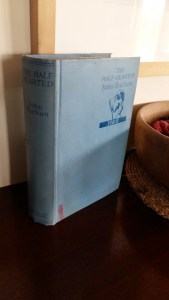 The Half-Hearted was written in 1899 and published in September 1900 by Isbister & Co Ltd. However, it had first appeared in serial form (in thirty-three parts) earlier that year in Good Words, a magazine also published by Isbister. Hodder & Stoughton published a new edition of The Half-Hearted in 1920.


