6 Degrees of Separation: From Dickensian London to the Teifi Valley #6Degrees  

It’s the first Saturday of the month so it’s 6 Degrees of Separation time!

Here’s how it works: a book is chosen as a starting point by Kate at Books Are My Favourite and Best and linked to six other books to form a chain. Readers and bloggers are invited to join in by creating their own ‘chain’ leading from the selected book.

Kate says: Books can be linked in obvious ways – for example, books by the same authors, from the same era or genre, or books with similar themes or settings. Or, you may choose to link them in more personal or esoteric ways: books you read on the same holiday, books given to you by a particular friend, books that remind you of a particular time in your life, or books you read for an online challenge. Join in by posting your own six degrees chain on your blog and adding the link in the comments section of each month’s post.   You can also check out links to posts on Twitter using the hashtag #6Degrees

This month’s starting book is, appropriately enough, A Christmas Carol by Charles Dickens. Click on the title to read the book description on Goodreads or my review, as appropriate.


A Christmas Carol is one of the best-loved of all Dickens’ works and reading it (or watching a film or TV adaptation of it) is definitely an annual tradition in our house.  Charles Dickens edited a weekly magazine, Household Words, published every Saturday from 1850 to 1859.  One of the authors who contributed to Household Words was Elizabeth Gaskell.  A number of the stories in her Gothic Tales appeared in Household Words, often at Christmas, including ‘Disappearances’, ‘The Old Nurse’s Story’ and ‘The Squire’s Story’.

Aside from her novels, Elizabeth Gaskell is probably best known for her biography of Charlotte Brontë, author of Jane Eyre.   Jane Eyre tells the story of a young governess hired by the brooding, proud Edward Rochester of Thornfield Hall to care for his ward Adèle.

A whole shelf of copies of Jane Eyre are to be found in the library of the house of the mysterious and reclusive author, Vida Winter, in The Thirteenth Tale by Diane Setterfield. In fact, the book Jane Eyre becomes the subject of a very strange test put to the narrator.

In The Thirteenth Tale, the narrator is charged by Miss Winter with writing a true account of her life, rather than just the stories she’s previously made up when asked questions.  Storytelling also plays a central role in States of Passion by Nihad Sirees (the chosen book in the November Reading In Heels subscription box).    A man stranded in the countryside during a raging storm seeks refuge in an isolated mansion inhabited by an elderly gentleman who starts to tell him a story of family secrets.

Mrs DanversThe only other occupant of the house is a servant who is unwelcoming at best.  A malevolent servant also features in Rebecca by Daphne du Maurier in the person of the housekeeper, Mrs. Danvers (memorably played in the original film version by Judith Anderson).

One of the key events in Rebecca is an inquest that takes place when a body is discovered following a storm.  An inquest into a body discovered by chance also features in None So Blind by Alis Hawkins.  The verdict (unsatisfactory as far as some are concerned) results in the main character and his assistant embarking on an investigation to try to uncover the truth of the cause of death and the possible perpetrator.

Next month’s starting book is The French Lieutenant’s Woman by John Fowles. Why not join in when Six Degrees returns on 5th January 2019.

Book Review: The Wooden Hill by Jamie Guiney

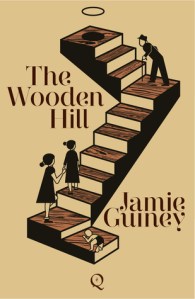
The Wooden HillAbout the Book

As we climb the wooden hill to bed each night we trace our life’s journey from birth, then each step toward death, the final sleep.

This collection of short stories, by Jamie Guiney, explores what it is to be human at every stage of life, from the imminence of a new birth in ‘We Knew You Before You Were Born’, through to adolescence and the camaraderie of youthful friendships as portrayed in ‘Sam Watson & The Penny World Cup’.

Ultimately, all of our lives stride towards old age and the certainty of death, as poignantly evoked in the title story, ‘The Wooden Hill’.

Format: Paperback (176 pp.)    Publisher: époque press
Published: 30th November 2018   Genre: Literary Fiction, Short Stories

Purchase Links*
Amazon.co.uk  ǀ  Amazon.com  ǀ Hive.co.uk (supporting UK bookshops)
*links provided for convenience, not as part of any affiliate programme

Find The Wooden Hill on Goodreads


My Review

Although I was drawn to some of the stories in this collection more than others (as is often the way with short story collections), I found something to admire in all of them: a thoughtful idea, a descriptive phrase, an imaginative metaphor or something that provoked a personal memory.  I also enjoyed the use of different points of view – first, second and third person – to provide variety.

If pushed to pick favourites, I’d probably go for the touching ‘We Knew You Before You Were Born’ and the deeply felt and lyrical ‘She Will Be My Joy’ – which just goes to prove what an incurable old romantic I am.  Other highlights:

  • ‘Peas’ – a Christmas Eve ritual, including Dad watching a film version of what sounds to me like A Christmas Carol (an annual favourite of mine)
  • ‘Sam Watson and the Penny World Cup’ – featuring the weekly ritual of ‘mushy tomato soup’ (it was tomato soup with baked beans in our house) followed by a visit to the local sweet shop, requiring the thoughtful allocation of pocket money worthy of a Chancellor of the Exchequer
  • ‘The Cowboy’ – in which what seems like a tall tale proves to be possibly dark reality
  • ‘Window’ – slight in length but full of impact with an unsettling atmosphere
  • ‘Ultreia’ – descriptive and reflective and which conjured up for me thoughts of The Pilgrim’s Progress
  • ‘Christmas’ – heart-warming but tinged with melancholy

I also enjoyed the imaginative use of language to describe objects, landscape and weather.   A few examples:

‘Night birthed its morning.’
‘The clothesline is dancing.  A tiny, imaginary tightrope walker is stepping amongst the pegs.’
‘Notice the awakening sky, its slow yawn into pastel blue, its broad halo of orange and yellow.’
‘It was a hot smudge of an afternoon…’
‘Winter’s raw exhale flogs his face and body.’   

Although the title of the collection evokes the childhood phrase ‘up the wooden hill to Bedfordshire’, the stories in The Wooden Hill are definitely not bedtime stories.  They explore all aspects of our lives from ‘cradle to grave’: coming to terms with confusing or unfamiliar feelings, testing boundaries, bonds of friendship and shared experiences, romantic and familial love, fear and loss.  The stories chart the steps we all take in life – tentative sometimes, requiring a firm hold of the banister on occasions or a gentle push from behind to get us to the next step.

I received an advance reader copy courtesy of publishers, époque press.

Follow my blog with Bloglovin

In three words: Intriguing, imaginative, thoughtful

Try something similar…Happiness is a Collage by Gita V. Reddy (read my review here)


Jamie GuineyAbout the Author

Jamie Guiney is a literary fiction writer from County Armagh, Northern Ireland. His debut short story collection The Wooden Hill is due for publication in 2018 with époque press. Jamie’s short stories have been published internationally and he has been nominated twice for the ‘The Pushcart Prize.’

Jamie is a graduate of the Faber & Faber Writing Academy and has twice been a judge for short story competition ‘The New Rose Prize.’ His work has been backed by the Northern Ireland Arts Council through several Individual Artist Awards.

Jamie favours the short story genre, believing it to be the closest written prose to the traditional art of storytelling. [Photo credit: Goodreads author page]

Connect with Jamie

Website  ǀ  Facebook  ǀ  Twitter  ǀ  Goodreads