On What Cathy Read Next last week
Blog posts
Monday – To celebrate the publication of her latest book Head on Backwards, Chest Full of Sand, I did a Q&A with author, Sandy Day.
Tuesday – This week’s Top Ten Tuesday topic was a freebie on the theme of love. My list was all about Love Islands.
Wednesday – WWW Wednesday is the opportunity to share what I’ve just read, what I’m currently reading and what I plan to read next…and have a good nose around to see what other bloggers are reading.
Thursday – I shared my review of Summerland by Lucy Adlington.
Friday – I published my review of 355: The Women of Washington’s Spy Ring by Kit Sergeant.
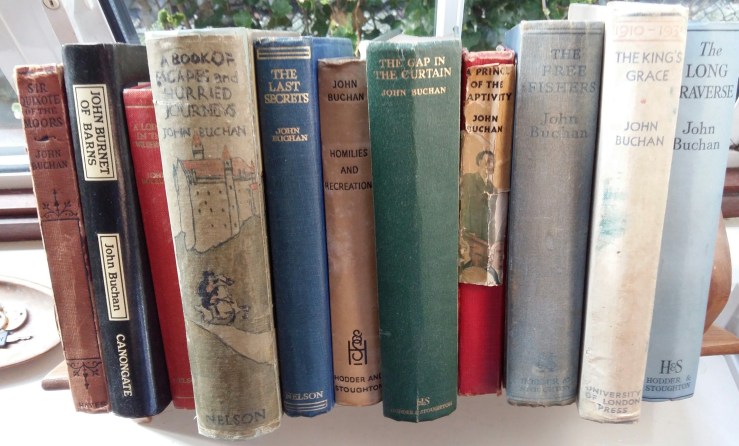
Saturday – My February Buchan of the Month is John Burnet of Barns and I shared an introduction to the book.
As always, thanks to everyone who has liked, commented on or shared my blog posts on social media this week.
New arrivals
A bumper crop of goodies this week! Books for blog tours (including one celebrating the Dylan Thomas Prize longlist), review copies and eARCs from NetGalley
The Far Field by Madhuri Vijay (paperback, courtesy of Midas PR and Grove Press)
In the wake of her mother’s death, Shalini, a privileged and restless young woman from Bangalore, sets out for a remote Himalayan village in the troubled northern region of Kashmir. Certain that the loss of her mother is somehow connected to the decade-old disappearance of Bashir Ahmed, a charming Kashmiri salesman who frequented her childhood home, she is determined to confront him. But upon her arrival, Shalini is brought face to face with Kashmir’s politics, as well as the tangled history of the local family that takes her in. And when life in the village turns volatile and old hatreds threaten to erupt into violence, Shalini finds herself forced to make a series of choices that could hold dangerous repercussions for the very people she has come to love.


On Earth We’re Briefly Gorgeous by Ocean Vuong (hardcover, courtesy of Midas PR and Jonathan Cape)
Poet Ocean Vuong’s debut novel is a shattering portrait of a family, a first love, and the redemptive power of storytelling.
On Earth We’re Briefly Gorgeous is a letter from a son to a mother who cannot read. Written when the speaker, Little Dog, is in his late twenties, the letter unearths a family’s history that began before he was born — a history whose epicenter is rooted in Vietnam — and serves as a doorway into parts of his life his mother has never known, all of it leading to an unforgettable revelation. At once a witness to the fraught yet undeniable love between a single mother and her son, it is also a brutally honest exploration of race, class, and masculinity. Asking questions central to our American moment, immersed as we are in addiction, violence, and trauma, but undergirded by compassion and tenderness, On Earth We’re Briefly Gorgeous is as much about the power of telling one’s own story as it is about the obliterating silence of not being heard.
With stunning urgency and grace, Ocean Vuong writes of people caught between disparate worlds, and asks how we heal and rescue one another without forsaking who we are. The question of how to survive, and how to make of it a kind of joy, powers the most important debut novel of many years.
 The Lost Lights of St. Kilda by Elisabeth Gifford (hardcover, courtesy of Corvus and Readers First)
When Fred Lawson takes a summer job on St Kilda in 1927, little does he realise that he has joined the last community to ever live on that desolate, isolated island. Only three years later, St Kilda will be evacuated, the islanders near-dead from starvation. But for Fred, that summer is the bedrock of his whole life…
Chrissie Gillies is just nineteen when the researchers come to St Kilda. Hired as their cook, she can’t believe they would ever notice her, sophisticated and educated as they are. But she soon develops a cautious friendship with Fred, a friendship that cannot be allowed to develop into anything more…
Years later, to help deal with his hellish existence in a German prisoner of war camp, Fred tells the tale of the island and the woman he loved, but left behind. And Fred starts to wonder, where is Chrissie now? And does she ever think of him too?
 The Philosopher’s Daughters by Alison Booth (eARC, courtesy of RedDoor Press and Random Things Tours)
A tale of two very different sisters whose 1890s voyage from London into remote outback Australia becomes a journey of self-discovery, set against a landscape of wild beauty and savage dispossession.
London in 1891: Harriet Cameron is a talented young artist whose mother died when she was barely five. She and her beloved sister Sarah were brought up by their father, radical thinker James Cameron. After adventurer Henry Vincent arrives on the scene, the sisters’ lives are changed forever. Sarah, the beauty of the family, marries Henry and embarks on a voyage to Australia. Harriet, intensely missing Sarah, must decide whether to help her father with his life’s work or devote herself to painting.
When James Cameron dies unexpectedly, Harriet is overwhelmed by grief. Seeking distraction, she follows Sarah to Australia, and afterwards into the Northern Territory outback, where she is alienated by the casual violence and great injustices of outback life.
Her rejuvenation begins with her friendship with an Aboriginal stockman and her growing love for the landscape. But this fragile happiness is soon threatened by murders at a nearby cattle station and by a menacing station hand seeking revenge.
 The Truth Must Dazzle Gradually by Helen Cullen (eARC, courtesy of Michael Joseph and NetGalley)
When we met we were such untethered spirits floating through the world, as if one of us might drift away if we didn’t hold hands tightly. We were imperfect people, who fitted perfectly together.
On an island off the west coast of Ireland, the Moone family gather, only to be shattered by tragedy. Murtagh Moone is a potter and devoted husband to Maeve, an actor struggling with her most challenging role yet as mother to their four children. Now Murtagh must hold his family close as we bear witness to their story before that night.
We return to the day Maeve and Murtagh meet, outside Trinity College in Dublin, and watch how one love story gives rise to another. As the Moone children learn who their parents truly are, we journey onwards with them to a future that none of the Moones could predict.
Except perhaps Maeve herself.
The Walls We Build by Jules Hayes (eARC, courtesy of Rachel’s Random Resources)
Three Friends…Growing up together around Winston Churchill’s estate in Westerham, Kent, Frank, Florence and Hilda are inseparable. But as WW2 casts its menacing shadow, friendships between the three grow complex, and Frank – now employed as Churchill’s bricklayer – makes choices that will haunt him beyond the grave, impacting his grandson’s life too.
Two Secrets…Shortly after Frank’s death in 2002, Florence writes to Richard, Frank’s grandson, hinting at the darkness hidden within his family. On investigation, disturbing secrets come to light, including a pivotal encounter between Frank and Churchill during the war and the existence of a mysterious relative in a psychiatric hospital.
One Hidden Life…
How much more does Florence dare reveal about Frank – and herself – and is Richard ready to hear?
Set against the stunning backdrop of Chartwell, Churchill’s country home, comes a tragic story of misguided honour, thwarted love and redemption, reverberating through three generations and nine decades. (Cover reveal 29th February)
 Containment (Sam Shephard #3) by Vanda Symons (eARC, courtesy of Orenda Books and Random Things Tours)
Chaos reigns in the sleepy village of Aramoana on the New Zealand coast, when a series of shipping containers wash up on the beach and looting begins.
Detective Constable Sam Shephard experiences the desperation of the scavengers first-hand, and ends up in an ambulance, nursing her wounds and puzzling over an assault that left her assailant for dead.
What appears to be a clear-cut case of a cargo ship running aground soon takes a more sinister turn when a skull is found in the sand, and the body of a diver is pulled from the sea … a diver who didn’t die of drowning…
As first officer at the scene, Sam is handed the case, much to the displeasure of her superiors, and she must put together an increasingly confusing series of clues to get to the bottom of a mystery that may still have more victims…
On What Cathy Read Next this week
Currently reading


Planned posts
- Blog Tour/Book Review: Real Life by Adeline Dieudonne
- Top Ten Tuesday: Book Hangovers
- Waiting on Wednesday
- Audiobook Review: Heaven, My Home by Attica Locke
- Book Review: Stasi Winter by David Young