Arthur D. Hittner’s novel Artist, Soldier, Lover, Muse, set in the art world of pre–war New York City, is unfortunately still languishing in my review pile (although it is gradually getting closer to the top!) A while back, Arthur was kind enough to write a fascinating guest post about the challenge of capturing in words the inspiration that drives the creative process of an artist. Arthur has recently published a new book, The Caroline Paintings, also set in the art world, and I’m pleased to be able to bring you an extract from the book. If you like the sound of it, you can find purchase links further down this post.
Follow my blog with Bloglovin
Extract from The Caroline Paintings by Arthur D. Hittner
Chapter Two
Longmire, Virginia
September, 1968.
No one ever accused Caroline McKellan of reticence. She marched right up to the studio door and rapped loudly, like the wolf in the nursery rhyme. Irritated at the interruption, the artist sighed. He deposited his brush in the paint-spattered coffee can he’d used for decades, rose as quickly as his arthritic knees would allow, and opened the creaky wooden door.
“Caroline?” he stammered. The visit from his young next-door neighbour was unexpected; she’d been in grade school the last time she’d appeared at his door. Wearing cowboy boots, a tight pair of blue jeans, and a low-cut sweater, her lips painted a lush ruby red, she looked every bit of her sixteen years – and then some.
“Hi, Mr. Elliott,” she said breezily, whisking into his studio as if entering her own living room.
Caroline McKellan had known Grant Elliott all of her life. Growing up on the small Virginia farm that had been in her family for generations, her parents had often hosted intimate dinners with their famous neighbours, Becky and Grant Elliott, whose eighteenth-century fieldstone farmhouse stood a mere two hundred yards from their own, nestled in the ancient ridges of the Shenandoah Valley in the rural climes of northern Virginia.
The McKellans traced their ancestry back to a hardy couple of Scottish descent who’d emigrated on the eve of the Revolutionary War, settling in Longmire, on the very plot of land on which their early nineteenth-century farmhouse now stood. They’d been there ever since, passing the farm down, as was custom, to the eldest son. But the enduring chain of patrilineal descent had come to a crushing halt.
“To what do I owe the honour?” Grant inquired, a smile spreading across his well-chiseled face. Tall, broad-shouldered, and ruggedly handsome, he looked more like the Marlboro Man than a world-famous artist. But his advancing arthritis, the deepening lines on his face, and the random specks of grey intruding upon his unruly mantle of black hair bore testimony to his fifty-eight years.
“I’d like to be your muse, Mr. Elliott,” she said bluntly.
Her boldness amused him. “My muse?” He laughed heartily. “It’s not that simple.” She stared at him, undaunted, her eyes blazing with determination.
Ever since she was a child, Caroline had reveled in her proximity to the artist celebrated for his poignant studies of the denizens of the Shenandoah Valley, ordinary people to whom the verdant valley was a cherished birthright. When she was eight, Grant had produced sketches of each of her parents, presenting them as framed gifts to the family that Christmas. Four years later, he’d contributed another portrait to the family collection, a sketch of her brother done from a photograph. But he’d never drawn Caroline.
[…]
“I’m deadly serious,” she said defiantly, challenging the artist’s resistance. “I know you want to paint me, you said so at dinner!” She deposited herself on the timeworn seat of an old Windsor chair, her outline silhouetted by the dim northern light filtering through the bay window of the once dilapidated outbuilding that the Elliotts had refitted as a studio.
Caroline was right. Grant Elliott would have liked nothing more than to paint the precocious sixteen-year-old. A tinderbox of beauty, grief, and anger and rebellion, she was captivating and provocative. He’d struggled to wrest his eyes from her two nights earlier, when the McKellans hosted the Elliotts for dinner. It was his first glimpse of Caroline in more than a year and the changes were startling. She’d grown into a beautiful young woman: tall, lithe and brash, with piercing blue eyes, porcelain skin and a luxurious mane of strawberry blond hair. In passing dinner conversation he’d mentioned his interest in painting her, but his hosts were decidedly cool to the notion. He’d pursued it no further.
But to Caroline, Grant’s remark was a summons – an invitation to pursue her covert ambition. After all, she figured, she had nothing left to lose.
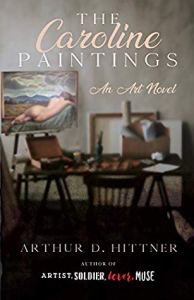 About the Book
A Florida retiree, dabbling in the art market, acquires the contents of a storage locker in a foreclosure sale. Included is a cache of unsigned paintings of a beautiful young woman by a supremely talented hand. Who is she, who’s the artist, and what gave rise to these stunning works? By what tortuous path did they find their way into an abandoned storage unit and who’ll prevail in the ensuing struggle for their possession?
The answers are revealed in the art-sleuthing novel, The Caroline Paintings, a bittersweet, fifty-year tale of art, love, duplicity, perseverance, and discovery featuring a troubled teenage runaway, a tormented artist, an illegitimate son, an unscrupulous attorney, a beer-guzzling widower, and a quirky Harvard art professor.
Inspired by the saga of the Helga Pictures by Andrew Wyeth, and in the tradition of art-centred fiction such as The Last Painting of Sara de Vos, Girl with a Pearl Earring, and The Art Forger, The Caroline Paintings is a must-read for lovers of art and partisans of historical and contemporary fiction.
Format: Paperback, ebook (225 pages) Publisher: Apple Ridge Fine Arts
Published: 1st January 2020 Genre: Historical Fiction, Art
Purchase Links*
Amazon.co.uk ǀ Amazon.com
*links provided for convenience, not as part of any affiliate programme
Find The Caroline Paintings on Goodreads
 About the Author
Arthur D. Hittner, author of the art-related historical novels, The Caroline Paintings and Artist, Soldier, Lover, Muse, and the humorous baseball novel Four-Finger Singer and His Late Wife, Kate.
He is also the author of Honus Wagner: The Life of Baseball’s ‘Flying Dutchman’ (McFarland, 1996), winner of the Seymour Medal awarded by the Society of American Baseball Research for the best book of baseball history or biography published in 1996, At the Threshold of Brilliance: The Brief but Splendid Career of Harold J. Rabinovitz (The Rabinovitz Project, 2014), a biography and catalogue raisonne of a newly rediscovered master of American art of the Depression era, and the irreverent travelogue, Cross-Country Chronicles: Road Trips Through the Art and Soul of America.
Mr. Hittner has also written about fine art subjects for Maine Antique Digest, Fine Art Connoisseur and Antiques & Fine Art and has served as a Trustee of the Danforth Museum of Art and the Tucson Museum of Art.
Connect with Arthur
Website ǀ Goodreads

 Top Ten Tuesday is a weekly meme created by The Broke and the Bookish and now hosted by Jana at That Artsy Reader Girl.


