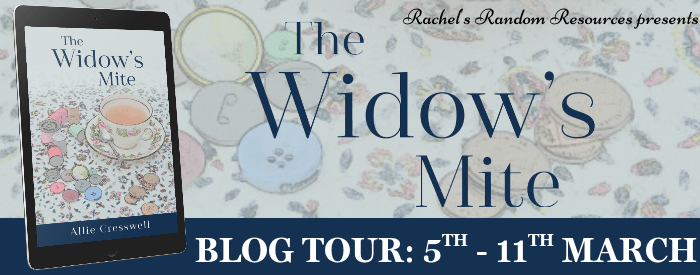
#BlogTour #BookReview The Widow’s Mite by Allie Cresswell @Alliescribbler

The Widows MiteWelcome to today’s stop on the blog tour for The Widow’s Mite by Allie Cresswell. Do check out the posts by my tour buddies, Nicola at Short Book and Scribes and Em at Radzy Writes.

My thanks to Rachel at Rachel’s Random Resources for inviting me to take part in the tour and to the author for my review copy.


The+Widow's+Mite+By+Allie+CresswellAbout the Book

Minnie Price lives in an impressive, gated mansion on a superior street in an affluent area of town. But in spite of the apparent comfort of her surroundings she has barely enough to keep body and soul together. She has retreated to a single room where she subsists on things bought as cheaply as possible or – better still – picked up for nothing. Her friends and neighbours are oblivious to her plight, too occupied with their do-goodery to see the need underneath their noses, while her unfeeling step-children do all they can to wrest from Minnie the little that she has.

Then one day, a caller arrives with what seems to be a life-line; a fund of money left behind by Minnie’s late husband of which her step-children know nothing. It is hers – legitimately hers – if only she can jump through the complex logistical hoops to release it.

Format: ebook (317 pages)                    Publisher:
Publication date: 6th February 2020 Genre: Contemporary Fiction

Purchase links*
Amazon.co.uk| Amazon.com
*links provided for convenience, not as part of any affiliate programme

Find The Widow’s Mite on Goodreads


My Review

The Widow’s Mite is the follow-up to The Hoarder’s Widow but you needn’t worry if, like me, you haven’t read the first book as The Widow’s Mite works perfectly well as a standalone read.

The Hoarder’s Widow introduced the reader to recently widowed Maisie Wilde, coping with the impact of the death of her husband, Clifford. She reappears in The Widow’s Mite and the book continues her story alongside that of Minnie Price, also recently widowed.  The author shows real insight into the little things that can trigger moments of grief following a bereavement – an object, an anniversary, a familiar scent or a reminder of places visited together.

Besides both being widows what Minnie and Maisie have in common is, with a few notable exceptions, rather unpleasant grown-up children. Poor Minnie particularly suffers in this regard and, like me, you may give a little cheer when comeuppance seems possible. However, the two women’s financial positions couldn’t be more different.  Maisie has been left well-provided for; Minnie most definitely has not leaving her prey to unscrupulous individuals.  Again, the author is particularly good at depicting the frugality to which Minnie is driven and exploring with compassion Minnie’s feelings about the actions she takes as a result.

Although their stories are told in alternating chapters – Minnie’s in the past tense and Maisie’s in the present tense – it is through mutual friends that they eventually come together.  There are some great characters among those friends and some fun moments during their trips together.

The Widow’s Mite demonstrates you can never know what’s going on behind closed doors but that there is always room in the world for generosity.

In three words: Engaging, poignant, insightful
Follow my blog via Bloglovin


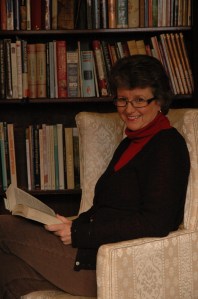
The Widows Mite AuthorAbout the Author

Allie Cresswell was born in Stockport, UK and began writing fiction as soon as she could hold a pencil. She did a BA in English Literature at Birmingham University and an MA at Queen Mary College, London.

She has been a print-buyer, a pub landlady, a book-keeper, run a B & B and a group of boutique holiday cottages. Nowadays Allie writes full time having retired from teaching literature to lifelong learners.

She has two grown-up children, two granddaughters, two grandsons and two cockapoos but just one husband – Tim. They live in Cumbria, NW England. The Widow’s Mite is her tenth novel.

Connect with Allie
Website | Twitter | Facebook
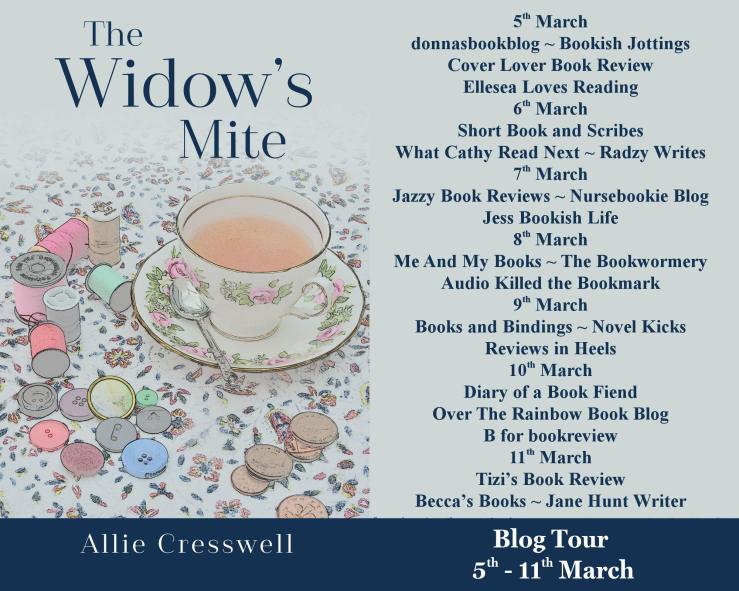
The Widow's Mite Full Tour Banner

#BookReview The Lost Lights of St Kilda by Elisabeth Gifford @CorvusBooks

20200214_130225About the Book

When Fred Lawson takes a summer job on St Kilda in 1927, little does he realise that he has joined the last community to ever live on that desolate, isolated island. Only three years later, St Kilda will be evacuated, the islanders near-dead from starvation. But for Fred, that summer is the bedrock of his whole life…

Chrissie Gillies is just nineteen when the researchers come to St Kilda. Hired as their cook, she can’t believe they would ever notice her, sophisticated and educated as they are. But she soon develops a cautious friendship with Fred, a friendship that cannot be allowed to develop into anything more…

Years later, to help deal with his hellish existence in a German prisoner of war camp, Fred tells the tale of the island and the woman he loved, but left behind. And Fred starts to wonder, where is Chrissie now? And does she ever think of him too?

Format: Hardcover (288 pages)      Publisher: Corvus
Publication date: 5th March 2020 Genre: Historical Fiction

Purchase links*
Amazon.co.uk| Amazon.com | Hive (supporting UK bookshops)
*links provided for convenience, not as part of any affiliate programme

Find The Lost Lights of St Kilda on Goodreads


My Review

I absolutely loved Elisabeth Gifford’s last book The Good Doctor of Warsaw, so I approached her latest novel with eager anticipation; I was not disappointed. The Lost Lights of St Kilda is undoubtedly the best book I’ve read so far this year.

I confess I’d always thought St Kilda was an island but, as I learned from the book (and from the maps that form the gorgeous endpapers), it is in fact a group of islands. Hirta is the main island and the only one inhabited in 1927, when part of the book is set. However, to avoid confusion I’m going to refer to it, like the blurb does, as St Kilda.

I loved the descriptions of St Kilda and the details of the islanders’ life – “a daily struggle against nature”. (I wasn’t so sure about the island cuisine – ‘boiled oats with a salted puffin for flavour’ anyone?) I vaguely knew about the evacuation of the islanders but nothing of their history before that or the hardship of life there battling illness, cut off from the outside world for weeks at a time by storms, and living a hand to mouth existence from farming and the hunting of seabirds involving perilous climbs along cliff ledges. The sense of isolation is overwhelming. “Imagine a hill farm of some four square miles dropped in the middle of an Atlantic swell that even the sturdiest boats would think twice to sail and you have the situation of St Kilda.”

Moving between different timelines and points of view, each strand of the story – Chrissie’s life on St Kilda and Fred’s wartime experiences – would be enthralling enough in their own right. Woven together by the skilful hands of the author (much like a bolt of St Kildan tweed) they are simply wonderful.

Storytelling is a major element of the book, reflecting the oral tradition of passing down tales and legends from generation to generation; tales that are linked to the landscape, the sea and the weather. Chrissie gradually recounts her own story of growing up on St Kilda and her childhood friendship with laird’s son, Archie. Although used to being an object of fascination for summer visitors to the island, the St Kildans cannot know the chain of events that will be set in train by the return to the island of Archie and his friend, Fred, years later.

Fred develops an interest in recording the islanders’ stories and, through his study of geology, in telling the story of the island, created as it was by a volcanic eruption. As time goes by, that’s not Fred’s only interest. “All the heart and the beauty and the magic of that place distilled into the girl that was Chrissie.” Memories of his time on the island, and of Chrissie, will come to be a beacon of light in times of darkness and danger, giving him the courage and energy to battle on.

The Lost Lights of St Kilda is wonderfully romantic without being sentimental and a beautifully crafted depiction of a (now lost) community and way of life. It’s a story of love, betrayal, endurance and faith. “For what is faith but the sure hope of things that will come but are not yet seen.” I loved it and I’m sure all fans of historical fiction will too.

I received a review copy courtesy of Corvus and Readers First.

In three words: Romantic, emotional, compelling

Try something similar: The Watch House by Bernie McGill or The Winter Soldier by Daniel Mason


FB_IMG_1581621051683About the Author

Elisabeth Gifford grew up in a vicarage in the industrial Midlands. She studied French literature and world religions at Leeds University. She has written articles for the Times and the Independent and has a Diploma in Creative Writing from Oxford OUDCE and an MA in Creative Writing from Royal Holloway College. She is married with three children and lives in Kingston upon Thames. (Photo/bio credit: publisher author page)

Connect with Elisabeth
Website | Twitter | Facebook | Goodreads