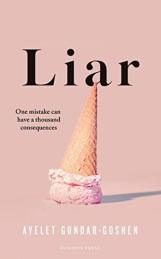
#BookReview Liar by Ayelet Gundar-Goshen, trans. by Sondra Silverston

LiarAbout the Book

Nofar is just an average teenage girl – so average, she’s almost invisible. Serving customers ice cream all summer long, she is desperate for some kind of escape. One afternoon, a terrible lie slips from her tongue. And suddenly everyone wants to talk to her: the press, her schoolmates, and the boy upstairs – the only one who knows the truth.

Then Nofar meets Raymonde, an elderly woman whose best friend has just died. Raymonde keeps her friend alive the only way she knows how – by inhabiting her stories. But soon, Raymonde’s lies take on a life of their own.

Format: Paperback (288 pages)        Publisher: Pushkin Press
Publication date: 28th March 2019 Genre: Contemporary Fiction, Literary Fiction, Literature in Translation

Find Liar on Goodreads

Purchase links
Bookshop.org
Disclosure: If you buy a book via the above link, I may earn a commission from Bookshop.org, whose fees support independent bookshops

Hive | Amazon UK
Links provided for convenience only, not as part of an affiliate programme


My Review

I alternated between reading the paperback edition published by Pushkin Press and listening to the Audible Studios audiobook narrated by Ajjaz Awad.

The author is clearly fond of similes; in fact, so fond that waiting for them at the end of a sentence became somewhat distracting at times. Depending on your point of view, the examples that follow are imaginative, laboured or simply perplexing.

‘She shrank like a caterpillar on its back’
‘Nofar’s guilt, like a Persian cat, rubbed her legs fleetingly, sat for a brief moment on her lap, then moved onward.’
‘Smiles have a way of catching a person’s eye, like a red balloon gliding in the sky and drawing the glances of people below.’
‘
Her thoughts, like pizza-delivery boys on their motorcycles, reached the most remote streets.’
‘Love is a very delicate thing, the truth can trample it like a hippopotamus running wild.’
‘The words were like a can of petrol thrown on the small ball of fire in her stomach.’
‘Her face was red and swollen, but to Lavi she looked like a wonderful grapefruit.’

I wasn’t entirely convinced by the introduction of a secondary storyline and a new character, Raymonde, in part two of the book. Although consistent with the theme of the book – that lies take on a life of their own and are difficult to take back – I struggled with the nature and context of her deception. It was more deliberate and studied than Nofar’s spur-of-the-moment outburst. I suppose it could be argued that, in sharing the stories of her dead friend, Raymonde was at least ensuring they would be heard.

I also found it hard to identify with the characters in the book or become engaged in the central relationship between Nofar and Lavi, which seemed a little on the creepy side to me. Although never stated, the book is  set in Tel Aviv but I didn’t get a particularly strong sense of place; much of the action is confined to Nofar’s family’s apartment or the dingy alley beside the ice cream parlour where she works. The exception was a night time scene in which Nofar looks out over the city from the roof of the family’s apartment.

I felt the novel worked best as an exploration of lies and their consequences. Pretty much all the characters in the book lie in one way or another. Some are motivated by a desire for attention or sympathy, others to show off or to make believe they’re living a different, more exciting life. Their lies range from the ‘white lie’ to out-and-out deceit or, as in Nofar’s case, to false accusation. The book also demonstrates the way lies can take on a life of their own, make the teller vulnerable to manipulation and unwittingly compromise the integrity of others.

In three words: Thought-provoking, intimate, discursive

Try something similar: Belladonna by Anbara Salam

Follow this blog via Bloglovin


About the Author

USE-THIS_ayelet_gundar©alon_siga-copyAyelet Gundar-Goshen is an award-winning novelist, and a clinical psychologist based in Israel. Her novels One Night, Markovitch and Waking Lions, both published by Pushkin Press, have been translated into 14 languages.

She is an occasional correspondent for the BBC, TIME magazine and Israeli media. (Photo credit: Publisher author page)

About the Translator

Sondra Silverston has lived in Israel since 1970. Her translations include fiction by contemporary Israeli authors Amos Oz, Eshkol Nevo, Savyon Liebrecht, Aharon Megged, and Ayelet Gundar-Goshen, as well as the fiction and essays of Etgar Keret.

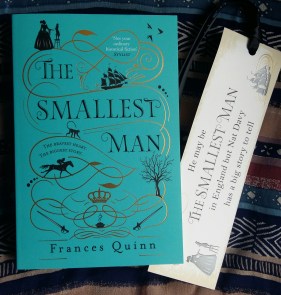
#BookReview The Smallest Man by Frances Quinn @SimonSchusterUK

The Smallest Man PBAbout the Book

My name is Nat Davy. Perhaps you’ve heard of me? There was a time when people up and down the land knew my name, though they only ever knew half the story.

In 1625, they gave me as a gift to the new queen of England, and called me the queen’s dwarf – but I was more than that. I was her friend, when she had no one else, and later on, when the people of England turned against their king, it was me who saved her life. When they turned the world upside down, I was there, right at the heart of it, and this is my story.

Format: Paperback (376 pages)    Publisher: Simon & Schuster
Publication date: 22nd July 2021 Genre: Historical Fiction

Find The Smallest Man on Goodreads

Pre-order/Purchase links
Bookshop.org
Disclosure: If you buy a book via the above link, I may earn a commission from Bookshop.org, whose fees support independent bookshops

Hive | Amazon UK
Links provided for convenience only, not as part of an affiliate programme


My Review

Although inspired by the true story of Jeffrey Hudson, court dwarf to Queen Henrietta Maria, in her author’s note Frances Quinn emphasises that The Smallest Man is ‘a novel, not a fictionalized biography’ and that Nat Davy is a ‘figment of her imagination’. Oh, but what a wonderful figment of the imagination he is!

I defy anyone not to be moved by young Nat’s gradual realisation that he’s not like other boys, his attempts to make himself taller, or his desire to prove he can be just as useful on the family farm as his brother Sam. The revelation that, to certain members of his family, his only value is as a ‘freak’ is heart-breaking to witness.

Although in hindsight a lucky break, initially Nat’s time at Court sees him viewed merely as a plaything, just one more item of curiosity in a trophy cabinet, and a pawn in the power play between the Duke of Buckingham, Queen Henrietta Maria and King Charles. However, Nat’s keen intelligence means he’s soon alert to the politics, hypocrisy and hidden agenda that proliferate in the Royal Court. I loved seeing his empathy for the lonely and isolated Queen and his attempts to help counter those trying to weaken her influence on the King. And I’m sure I can’t be the only reader who was cheering Nat on as he takes steps, with the help of his friend Jeremiah, to face down the bullies who torment him.

Those who love to immerse themselves in the detail of historical events will particularly enjoy part two of the book in which Nat witnesses first-hand the ravages of the civil war and accompanies the Queen in her desperate attempts to obtain men and arms for the King’s cause. Along the way, Nat discovers that he is valued as a person, not just a plaything, and he is even able to use his stature to advantage.

In the final part of the book, as the reign of King Charles comes to its bloodthirsty end, the bonds of friendship are tested but emerge strengthened and the author gives Nat the possibility of a life he had always dismissed as a hopeless dream.

If you’ll forgive the frivolity, the wise advice his mother gives the young Nat – “I want you to remember something, Nat. You’re small on the outside. But inside you’re as big as everyone else. You show people that and you won’t go far wrong in life” – brought to mind the song from the 1952 film Hans Christian Andersen, starring Danny Kaye.

🎶Thumbelina, Thumbelina tiny little thing
Thumbelina dance, Thumbelina sing
Thumbelina what’s the difference if you’re very small?
When your heart is full of love you’re nine feet tall 🎶

(I apologise to those of a certain age who now won’t be able to get that tune out of their head for the rest of the day.)  On a more serious note, you can find an image of the painting by Van Dyck that features in the book here.

For me, the best historical fiction combines authentic period detail, a compelling story and characters who leap off the page, letting you experience life in earlier times through their eyes. The Smallest Man delivered on all those fronts as far as I was concerned. It’s a story about appreciating the loneliness of those regarded as ‘different’, treasuring the gift of friendship and looking beneath what is on the surface. Lessons that stand the test of time I think.

In three words: Engaging, tender, assured

Try something similar: The Honey and the Sting by E. C. Fremantle

Follow this blog via Bloglovin


Frances Quinn Author picAbout the Author

Frances Quinn read English at King’s College, Cambridge, and is a journalist and copywriter. She has written for magazines including Prima, Good Housekeeping, She, Woman’s Weekly and Ideal Home. She lives in Brighton with her husband and two Tonkinese cats. The Smallest Man is her first novel.

Connect with Frances
Twitter