
About the Book
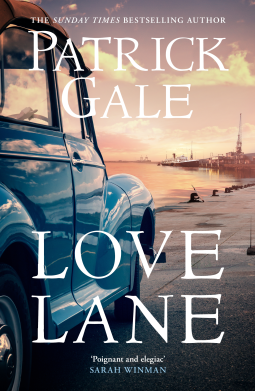
When veteran Canadian wheat farmer, Harry Cane is obliged to sell up and sail home to an England transformed by two world wars, his arrival triggers unwelcome self-examination for the family he abandoned, and for whom he has never been more than a distant myth.
His daughter feels duty bound to take him in but is riven with doubt and ambushed by a long buried anger she has never before expressed. Harry’s effect on the next generation is less predictable, and enables his granddaughter to deal with an unspeakable trauma, while her gentle husband feels seen for who he truly is.
Can Harry stay and make a new life before it’s too late, or will he find himself cast out again, punished for having witnessed and understood too much?
Format: Hardcover (304 pages) Publisher: Tinder Press
Publication date: 26th March 2026 Genre: Historical Fiction
Find Love Lane on Goodreads
Purchase Love Lane from Bookshop.org [Disclosure: If you buy books linked to our site, we may earn a commission from Bookshop.org, whose fees support independent bookshops]
My Review
A Place Called Winter has stayed with me despite the fact I read it nearly ten years ago now. Love Lane is described as not so much a sequel to A Place Called Winter as ‘an adjacent novel’, able to be enjoyed by readers who have not read the earlier book. I also think you could still enjoy A Place Called Winter even after reading Love Lane because it will fill in gaps in Harry’s early life only briefly mentioned in this book.
Love Lane picks up Harry’s story several decades on from A Place Called Winter. His life in Canada has not turned out how he – and I suspect many readers – might have wanted. The passion that once fuelled a relationship has flickered and died. Yet the nature of that relationship has left him vulnerable and as a result he has no option but to sell his farm for much less than it is worth. The arrival of a letter from England from his daughter Phyllis (known as Betty) offers an opportunity to reconnect with the family he left behind all those years ago.
Rather than describe events solely through Harry’s eyes, the story unfolds from the perspective of four members of his family: Betty, his son-in-law Trevor, his grand-daughter Pip and her husband Mike. This works briiliantly because it enables us to see the things that other characters don’t, the things they choose to – or have to – hide. The latter is particularly the case for Trevor whose role as Prison Governor means he has to witness things no one would willingly choose to see but the details of which he cannot share with anyone.
Although not always centre stage, Harry is a constant presence. Indeed a key element of the book is how his family react to his arrival, to this person who’s connected to them by blood or marriage but at the same time is a stranger, not to mention a person quite different from what they had expected. This is especially the case for Betty. Harry’s quiet contribution is his way of sensing others’ troubles and seeing beyond the face they present to others. After all, he know what it is to keep secrets, to have to hide parts of yourself from the outside world.
The author writes with real compassion for his characters, revealing to us their hopes and fears, their doubts and disappointments, and the difficult choices that confront all of us from time to time, including the things we must relinquish for those we love. Some of these are heartbreaking. For me there is a fine line between poignancy and sentimentality but the author manages to navigate this perfectly. There is emotion but it’s there for a purpose because it originates from genuine human feelings.
The book captures the peripatectic nature of working for the Prison Service, moving from one Governor’s residence to another with the burden of organising a new household every time falling on Betty. I also loved the social history aspect of the book, brought home through little details such as Betty’s recommended food for teething babies or Pip being expected to account for each item of daily household expenditure.
A talented musician as well as an author, in an interview for The Cusp magazine Patrick revealed that while writing A Place Called Winter he listened to a lot of Shostakovich’s String Quartets whereas Love Lane was written to the accompaniment of Sibelius, perhaps because of its sense of ‘haunting introspection’. He reflects, “Love Lane is an adagio. It’s not slow, but it has a sort of thread of sadness running through it.” I think that analogy is spot on. So sit back and enjoy the beautiful melody that is Love Lane.
In three words: Tender, insightful, poignant
Try something similar: A Thousand Moons by Sebastian Barry
About the Author

Patrick Gale was born on the Isle of Wight. He spent his infancy at Wandsworth Prison, which his father governed, then grew up in Winchester before going to Oxford University. He now lives on a farm near Land’s End.
One of this country’s best-loved novelists, his most recent works are the Costa-shortlisted A Place Called Winter and the Sunday Times top ten bestseller, Take Nothing With You and Mother’s Boy. His original BBC television drama, Man in an Orange Shirt, won an International Emmy Award for Best Movie/Miniseries.
Connect with Patrick
Website | Facebook | X | Instagram

 What Cathy Read Next...