
About the Book
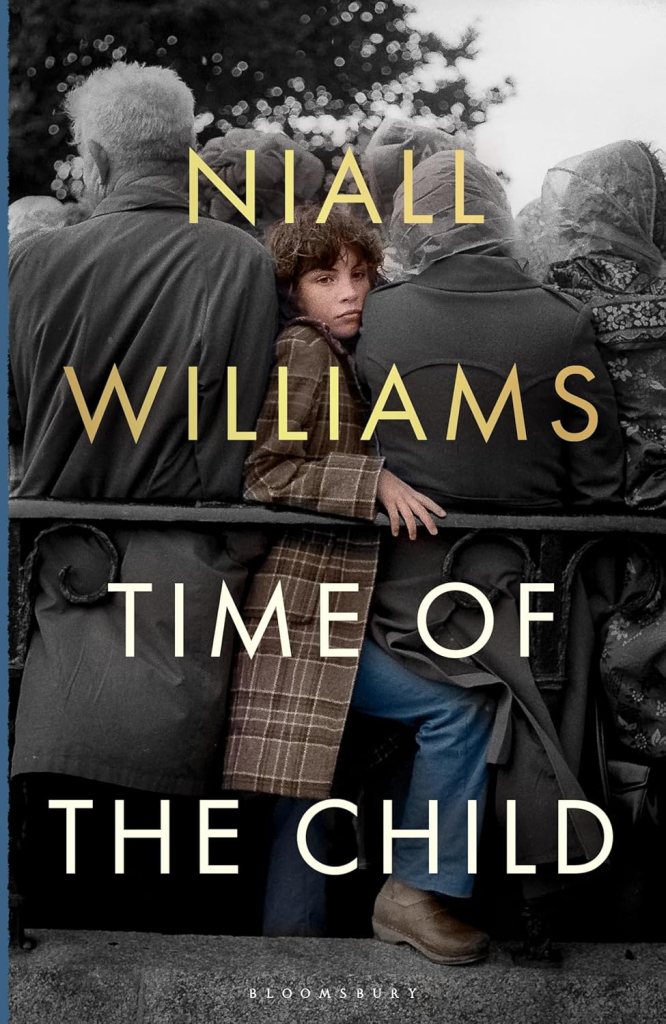
Doctor Jack Troy was born and raised in the little town of Faha, but his responsibilities for the sick and his care for the dying mean he has always been set apart from his community. A visit from the doctor is always a sign of bad things to come.
His youngest daughter, Ronnie, has grown up in her father’s shadow, and remains there, having missed her chance at real love – and passed up an offer of marriage from an unsuitable man.
But in the advent season of 1962, as the town readies itself for Christmas, Ronnie and Doctor Troy’s lives are turned upside down when a baby is left in their care. As the winter passes, father and daughter’s lives, the understanding of their family, and their role in their community are changed forever.
Format: Hardcover (304 pages) Publisher: Bloomsbury
Publication date: 24th October 2024 Genre: Historical Fiction
Find Time of the Child on Goodreads
Purchase Time of the Child from Bookshop.org [Disclosure: If you buy books linked to our site, we may earn a commission from Bookshop.org, whose fees support independent bookshops]
My Review
Having read and enjoyed This Is Happiness it was a joy to return to the Irish village of Faha in Time of the Child, one of the five books shortlisted for the Winston Graham Historical Prize 2026. I definitely think Time of the Child could be enjoyed without having read the earlier book.
Although Jack Troy may appear distant and someone who rarely shows emotion, inside we see a man struggling to come to terms with the death of his wife and another woman he cared about, and guilt that he may have stood in the way of his daughter’s happiness. Time after time, I found myself inwardly urging Jack to express his thoughts out loud and not keep them to himself, particularly when it came to his daughter. Tell her how much you appreciate her, tell her you’re sorry…
As we learn, Jack Troy does not have a heart of stone, as outward appearances would suggest, he has a heart as big as anyone. We see his compassion in the way he cares for the ailing Doady and her husband Ganga who grasps at any sign she might be improving despite there being none. (Both Doady and Ganga had starring roles in the previous book.) And we see it again in his tender dealings with Father Tom who is exhibiting signs of confusion.
The discovery of an abandoned baby gives Jack the opportunity to demonstrate his compassion once again. His dilemma is how to explain the presence of a baby in his household, a baby whom his daughter has grown to love. He cannot disappoint her again by allowing the baby to be taken into the care of the authorities. The solution: keep it a secret. The problem: Faha is not a place where it’s easy to keep a secret. In fact, it’s almost impossible. And actions can have unintended consequences.
A warm, wry humour runs through the book, such as the scene in which the curate, Father Coffey, has his first encounter with Napoleon brandy. And the author’s flair for the colourful is in evidence when describing the travelling traders who set up at Faha’s Christmas Fair.
‘There was Noone the knife-sharpener who looked like Douglas Fairbanks in The Corsican Brothers; McGreal, the pots-and-pans man, wire wool extra; a Dodd from the north who sold old brushes, and his own version of Chimno, Soot-Go he called it; Mrs Peggy who sold men’s underpants three-in-the-pack, and socks, five-in-the-pack, all grey, Good enough to wear to your own funeral, neither of which were bought by men, whose socks and underpants never surrendered, but by wives and mammies who had seen the toenail and blast damage.’
At the same time there are intensely moving moments, especially towards the end of the book. So as not to give anything away I’ll just say ‘Father Tom’, ‘crying baby’ and ‘Christmas box’.
Religion plays a strong part in the lives of Faha’s inhabitants and there are moments where the prose is psalm-like. ‘[He] drew back the curtain for the universal remedy of daylight, but the dark was still on the land and in the bare trees and on the river beyond, and dawn’s mercy unavailable.’
At its heart, the book is about a man trying to do his best and ‘the always inconvenient actuality of love’. Time of the Child is the perfect Christmas story, showing the best of human nature: generosity of spirit, a sense of community and being true to your values. Whether you celebrate Christmas or not, I think these are things to which we can all aspire.
I received an advance review copy courtesy of Bloomsbury via NetGalley.
In three words: Tender, poignant, uplifting
Try something similar: Small Things Like These by Claire Keegan
About the Author

Niall Williams was born in Dublin. He is the author of nine novels, including History of the Rain, which was longlisted for the Booker Prize and Four Letters of Love, which will soon be a major motion picture starring Pierce Brosnan, Helena Bonham Carter and Gabriel Byrne. His most recent novel, This Is Happiness, was nominated for the Irish Books Award and the Walter Scott Prize, and was one of the Washington Post‘s Books of the Year. He lives in Kiltumper in County Clare, Ireland.
Connect with Niall
Website | Goodreads

 What Cathy Read Next...
Sounds good Cathy.
LikeLike