
About the Book

There is no land without blood , and I water this land with the blood of my men.
Ruth’s family were in Budapest when the Nazis came.
Now Ruth is in Palestine, amid the bare hills inland from Haifa, breaking the rocky soil of an unyielding land before it breaks her.
With her comrades, her fellow kibbutzniks, she will build a better world. There will be green grass, orange trees and pomegranates, a land that is their own and no one else’s.
So they till their fields, dig their wells, build their homes and forge a new way of living, fiercely proud of their shared pursuit of a dream.
But as one generation begets another, the dream unravels, twisted into a dark tapestry of secrets and lies; sacrificed for revenge, forbidden love and murder.
Format: Hardback (400 pages) Publisher: Head of Zeus
Publication date: 14th September 2023 Genre: Historical Fiction
Find Adama on Goodreads
Purchase links
Bookshop.org
Disclosure: If you buy a book via the above link, I may earn a commission from Bookshop.org, whose fees support independent bookshops
Hive | Amazon UK
Links provided for convenience only, not as part of an affiliate programme
My Review
Until I read other reviews of the book, I didn’t realise Adama was the second in a trilogy, the follow-up to Maror. However, I don’t think it’s essential to have read the earlier book although it would probably be helpful to fill in any gaps in your knowledge about the foundation of the state of Israel. Big gaps, in my case.
Having read the chapter that opens part one of the book, you might be forgiven for thinking – as I did – that Adama was a thriller not a work of historical fiction. In fact, you’d be partially right because throughout the book there is intrigue, betrayal and drama as well as a moving story charting the experiences of generations of one family. It made it a page-turner for me.
Following the death of her mother, Hanna finds a box containing old photographs and documents that sees her embark on a search for information about Esther’s past and her family history. It also provides a distraction from the recent breakdown of a relationship. Thereafter the book moves back and forth over the decades recounting events in the life of Ruth, her family, her lovers and other members of her kibbutz with the full picture only gradually emerging.
At times, Ruth’s utter commitment to preserving the kibbutz seems to border on obsession, especially as it becomes clear what she has been prepared to do to in order to protect it. She’s courageous but also single-minded, even ruthless. For her, the end justifies the means. At one point Ruth says, ‘I gave up everything for this land… I sacrificed’. But others’ sacrifice is giving up their lives. Their stories are dramatic, powerful and sometimes harrowing.
The book depicts Israel’s often violent struggle for survival including the brutality of British occupation during which refugees attempting to cross to Palestine from Europe in small boats were intercepted and sent to camps in Cyprus. (Plus ça change, plus c’est la même chose.)
I had a vague concept of what a kibbutz was but had no idea of the extent of their collective nature when they were first established. ‘They believed in sharing – land, crops, property and love. The kibbutz was going to be a new way of life… No more jealousy and no more ownership of things, but somewhere where things could be finally different.’ One example of that difference is that children lived separately from their parents (who had no financial responsibility for them) and were raised and educated communally. The book explores the conflict between the natural instincts of motherhood and commitment to the principles of the kibbutz. Ruth’s sister, Shosana, provides a counterpoint to Ruth’s unwavering beliefs. Initially a place of refuge for Shosana after her experiences during the Second World War, the kibbutz becomes a source of savagery.
By the end of the book, Hanna may not have learned everything she hoped but author leaves the reader with a striking image of the characters they have come to know.
The publisher’s description of Adama as a ‘sweeping historical epic’ is spot on. At the moment, it looks a dead cert to be among my books of the year and it has made me keen to explore the author’s backlist, including reading Maror.
I received a digital review copy courtesy of Head of Zeus via NetGalley.
In three words: Powerful, gripping, moving
About the Author
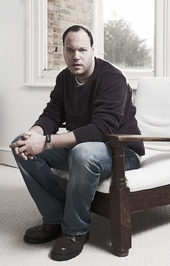
Lavie Tidhar was born just ten miles from Armageddon and grew up on a kibbutz in northern Israel. He has since made his home in London, where he is currently a Visiting Professor and Writer in Residence at Richmond University. He won the Jerwood Fiction Uncovered Prize for Best British Fiction, was twice longlisted for the International Dublin Literary Award and was shortlisted for the CWA Dagger Award and the Rome Prize. He co-wrote Art and War: Poetry, Pulp and Politics in Israeli Fiction, and is a columnist for the Washington Post. (Photo: Goodreads author page)
Connect with Lavie
Website | Twitter


So, the Kibbutz of that era is quite different than it is today. I actually lived on one, and my husband helped start one back in the 70s. As for that business of the kids living communally, it caused quite a stir back in the day when a large group of members wanted to end the children’s housing and move to family accommodation. It caused a rift so bad that many members left their kibbutzim and started their own kibbutzim with family accommodations instead of children’s housing. The two factions still thrive to this day – separate but equal, for the most part, and they don’t fight anymore. A friend of mine (who is 90 years old) was the first born child of his kibbutz. When they moved him to the children’s house, his parents weren’t even allowed to visit with him. His mother got SO upset by this that she basically kidnapped him and took him to Romania (where she had grown up). This was not long before WWII. While there they were brunt of a couple of antisemitic incidents. These caused my friend (who was just a little boy) to have nightmares, and he began begging her to go back to his father (whom she had left on the kibbutz). So, she moved them back. A year or so after they left, there was a pogrom on that same village where most of the Jews there were murdered!
LikeLike
Thank you for this fascinating insight
LikeLiked by 1 person