
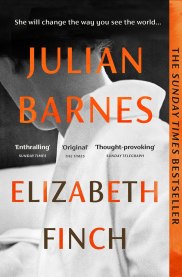
 About the Book
Elizabeth Finch was a teacher, a thinker, an inspiration.
Neil is just one of many who fell under her spell during his time in her class. Tasked with unpacking her notebooks after her death, Neil encounters once again Elizabeth’s astonishing ideas on the past and on how to make sense of the present.
But Elizabeth was much more than a scholar. Her secrets are waiting to be revealed . . . and will change Neil’s view of the world forever.
Format: Paperback (192 pages) Publisher: Viking
Publication date: 23rd February 2023 Genre: Contemporary Fiction, Literary Fiction
Find Elizabeth Finch on Goodreads
Purchase links
Bookshop.org
Disclosure: If you buy a book via the above link, I may earn a commission from Bookshop.org, whose fees support independent bookshops
Hive | Amazon UK
Links provided for convenience only, not as part of an affiliate programme
My Review
This was a book club pick and I’ll be honest, based on the lukewarm reviews, it’s one I probably wouldn’t have prioritised to read despite the fact I enjoyed the author’s earlier book, The Sense of an Ending.
The first part of the book introduces us to the rather intimidating, intellectually rigorous Elizabeth Finch. As she states to her students, ‘I am not employed to help you… I am here to assist you to think and argue and develop minds of your own’. Her credo can perhaps be summed up as ‘question everything’. Her heroes, if she would ever have such a thing, are those willing to challenge established beliefs. ‘Apostates are the representatives of doubt, and doubt – vivid doubt – is the sign of an active intelligence.’
Intellectually, Neil is in awe of Elizabeth and he retains his admiration for her even after she is no longer his teacher. They start to meet regularly for lunch, always arranged with Elizabeth’s trademark precision. He is eager to please her and rejoices when their discussions over lunch leave him feeling cleverer: ‘I knew more, I was more cogent’.
The book’s second section consists of a lengthy essay on the life of Julian the Apostate, the last pagan Emperor of Rome. Is the choice of subject matter, I wondered, evidence of the author’s own interest in this historical figure, a mere coincidence that they share a first name or something intended to have more significance? Written by Neil, the essay is based on Elizabeth’s notebooks and other papers which he has inherited following her death. In doing so, he believes he’s carrying out her wishes, that gifting him her library and a reading list was ‘the clearest of signals’. It’s also perhaps his way of demonstrating that, having drifted from job to job and had a number of failed relationships, he is not after all ‘King of the Unfinished Projects’ as he has been dubbed by one of his daughters. However, in constructing the essay based on Elizabeth’s notes, does Neil end up writing a simulacrum rather than something original based on his own ideas and sources. Surely even Elizabeth’s ideas should be questioned?
Neil remains curious, almost obsessively so, about Elizabeth’s life. Although referencing lines from one of C. P. Cavafy’s poems – ‘From what I did and what I said, Let them not seek to find who I was’ – in fact that’s effectively what Neil sets out to do. He questions Elizabeth’s brother, Christopher, about her childhood and her relationship with their parents, whilst at the same time persisting in declaring he is not writing her biography. Anna, one of his former classmates, has her own theory about the reasons for his curiosity. Tantalisingly, Neil never gets to the bottom of several mysteries about Elizabeth’s life but very likely she would have hated it if he’d done so. And perhaps we can never really know another person.
Elizabeth Finch is a novel of ideas rather than plot but the more I reflected on it the more I appreciated its subtleties.
In three words: Thoughtful, nuanced, philosophical
 About the Author
Julian Barnes is the author of thirteen novels, including The Sense of an Ending, which won the 2011 Booker Prize for Fiction, and Sunday Times bestsellers The Noise of Time and The Only Story. He has also written three books of short stories, four collections of essays and three books of non-fiction, including the Sunday Times number one bestseller Levels of Life and Nothing To Be Frightened Of, which won the 2021 Yasnaya Polyana Prize in Russia. In 2017 he was awarded the Légion d’honneur.
Connect with Julian
Website | Facebook


Hm… this doesn’t sound half bad, actually. I enjoyed his Noise of Time a lot. I also read his Sense of Ending but it left so little of an impression on me that I don’t remember any of it.
LikeLike