
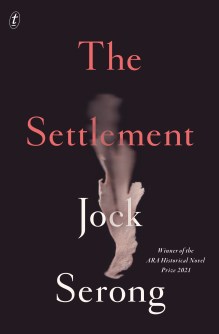
 About the Book
On the windswept point of an island at the edge of van Diemen’s Land, the Commandant huddles with a small force of white men and women.
He has gathered together, under varying degrees of coercion and duress, the last of the Tasmanians, or so he believes. His purpose is to save them—from a number of things, but most pressingly from the murderous intent of the pastoral settlers on their country.
The orphans Whelk and Pipi, fighting for their survival against the malevolent old man they know as the Catechist, watch as almost everything about this situation proves resistant to the Commandant’s will. The wind, the spread of disease, the strange black dog that floats in on the prow of a wrecked ship…
But above all the Chief, the leader of the exiles, before whom the Commandant performs a perverse, intimate dance of violence and betrayal.
Format: ebook (320 pages) Publisher: Text Publishing
Publication date: 30th August 2022 Genre: Historical Fiction
Find The Settlement on Goodreads
Purchase link
Amazon UK
Link provided for convenience only, not as part of an affiliate programme
My Review
The Settlement is one of the books on the longlist for the Walter Scott Prize for Historical Fiction 2023. It’s probably not a book I would have come across had it not appeared on the list. In the Acknowledgments section, the author refers to The Settlement as the third book in a trilogy – the previous books being (I think) Preservation and The Burning Island. As I didn’t discover this until I finished it, I can say with confidence that The Settlement can be read as a standalone.
I think we’re probably all aware of terrible injustices perpertrated on indigenous people over the centuries, particularly as a result of colonialism. (Arguably, they are still going on today.) In The Settlement the author focuses on one particularly heinous one, the true story of the forced resettlement of tribespeople from their traditional homeland in van Diemen’s Land (the colonial name for Tasmania) to Flinders Island by George Augustus Robinson. Many of the events are drawn from Robinson’s own journal in which he recorded in meticulous detail events on the island.
Ostensibly aimed at protecting the tribespeople from murder by white settlers, the purpose of his so-called ‘Friendly Mission’ is to ‘Christianise and civilise’ them. Leaving aside the possibility that this is driven by genuine religious zeal (which actually doesn’t make it any more forgiveable) he believes success will bring him political advancement. What the book also reveals is Robinson’s involvement in frankly quite disgusting acts of desecration, purportedly in the name of science. And the settlement turns out to be a place of disease and death for many of the tribespeople with the area of the graveyard set aside for them soon overflowing. As one character remarks, ‘This place eats human lives’.
The only character with any redeeming features is the Storekeeper. (A clever feature of the book is that the non-indigenous characters are referred to only by the role they perform in the settlement – the Surgeon, the Commandant, the Overseer, etc – whereas the indigenous people retain their given names.) But even the Storekeeper turns a blind eye for a long while to the evil taking place. Some of this involves the utterly vile Catechist, a violent and perverted individual who may even not be who he professes to be. The Storekeeper distracts himself with rum and by spending hours building a wall until he cannot stand by any longer. Cleverly, the wall also acts as a metaphor for the colonialist’s desire to demonstrate proprietorship of land by creating artificial boundaries. ‘The wall, indeed all of the settlement’s fences, were lines that followed no contour in nature: in fact, they fought the contours, dividing one man’s ground from another’s, and some creatures from others. The old people, who’d lived in the other world, must have been baffled. Offended, even, since drawing lines on the land was where it all started.’
At the heart of the book is a betrayal, the breaking of a promise to Mannalargena, the leader of the tribe, that they will eventually be returned to their traditional homelands. History tells us Robinson’s enterprise ultimately resulted in failure; The Settlement graphically reveals the human cost of that failure. However, two acts of resistance introduced into the novel stand as examples of the fight against oppression.
In three words: Uncompromising, intense, compelling
Try something similar: Mr Peacock’s Possessions by Lydia Syson
 About the Author
Jock Serong’s novels have received the ARA Historical Novel Prize, the Colin Roderick Award, the Ned Kelly Award for First Fiction and, internationally, the inaugural Staunch Prize (UK) and the Historia Award for Historical Crime Fiction (France). He lives with his family on Victoria’s far west coast. (Photo: Goodreads author page)

 What Cathy Read Next...
You’ve made this seem like a powerful read. I’ll look out for it.
LikeLike
I heard Jock Serong talk at a writer’s festival not that long ago and it was fascinating! I must read him at some point.
Thanks for sharing this review with the Historical Fiction Reading Challenge.
LikeLike