
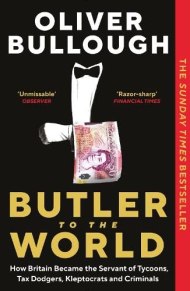
 About the Book
How did Britain become the servant of the world’s most powerful and corrupt men?
In Butler to the World, Oliver Bullough reveals how, despite priding itself on values of fair play and the rule of law, the UK took up its position at the elbow of the worst people on Earth: oligarchs, kleptocrats and gangsters.
From the birth of tax havens in the 1950s, moving from the British Virgin Islands to Gibraltar and Mayfair, this is a damning portrait of global finance and politics in the UK today – and an incendiary reminder that it doesn’t have to be this way.
Format: Paperback (304 pages) Publisher: Profile Books
Publication date: 19th January 2023 Genre: Nonfiction
Find Butler to the World on Goodreads
Purchase links
Bookshop.org
Disclosure: If you buy a book via the above link, I may earn a commission from Bookshop.org, whose fees support independent bookshops
Hive | Amazon UK
Links provided for convenience only, not as part of an affiliate programme
My Review
Subtitled ‘How Britain became the servant of tycoons, tax dodgers, kleptocrats and criminals’, the author’s view of the UK’s approach over the decades can probably be summed up as ‘Take the money and look the other way’. Using the analogy of the way a butler solves problems for his master by fair means or foul regardless of the consequences for others – as P. G. Wodehouse’s Jeeves does for Bertie Wooster – the author presents a series of case studies showing how Britain has facilitated the use of tax havens, complex financial structures and tax loopholes to allow shady individuals to squirrel money away. In other words, how Britain, including its overseas territories, has become a ‘butler to the world’ and how successive governments have been good on rhetoric but poor on action when it comes to tackling global financial corruption.
He identifies the start of this as the Suez Crisis in the 1950s which was, he argues, a sign of Britain’s waning influence in the world. Added to this was the loss of income following the independence of its former colonies. As he observes, ‘The banker to the world transformed into a pauper; the global currency limping from one crisis to the next’. It was necessary to replace the lost revenues and a small circle of people within the City of London’s financial instititions came up with ways to do it that took advantage of a regulatory regime which pretty much relied on ‘chaps doing the right thing’. Except it turns out they didn’t. Instead they looked for any way they could to keep money from around the world flowing into their coffers and stop anyone else finding out about it, especially the taxman, their defence being ‘If we don’t do it, someone else will’. It’s the same instinct that still drives those on the political right to call for more deregulation not less.
The author is clearly an expert on his subject but I confess that some of the detail in a few of the case studies, especially those involving arcane financial products and obscure company structures, went rather over my head. The chapters I found most absorbing were ‘Rock Solid’ which describes how Gibraltar became rich by establishing itself as the online gambling centre of the world and ‘Down the Tubes’ in which the author explains how a Ukranian tycoon with possible links to the world’s most notorious mobster managed to manoeuvre his way into the heart of the British establishment, including being sold one of London Underground’s ‘ghost stations’ by the Ministry of Defence.
In the chapter ‘Giving Evidence’, the author describes the UK’s woeful record on tackling money laundering, leaving him to conclude that what measures are in place are designed to give the impression of extreme activity while actually doing nothing.
The new paperback edition has an introduction written after Russia’s invasion of Ukraine, in which the author scathingly describes Britain’s then prime minister Boris Johnson as ‘a butler’s butler: a politician who had suppressed a report into Russian interference in UK politics; who had welcomed billionaires to London; whose government had established a special “VIP lane” for well-connected individuals to use when selling goods to the government during the pandemic; who had merrily befriended oligarchs; and who had, before becoming prime minister, earned a six-figure sum writing a column for a newspaper owned by tycoons who owned their own tax haven’. Ouch. The author concludes change is unlikely to come from politicians or civil servants, which means it’s up to us. Reading a book like this is perhaps a good start.
Butler to the World is an impeccably researched, no holds barred exposé of the way Britain has become, in the author’s words, a global enabler of skulduggery. It left me feeling simultaneously informed and appalled but unfortunately not entirely surprised.
In three words: Authoritative, polemical, insightful
 About the Author
Oliver Bullough is the author of the financial exposé Moneyland, a Sunday Times bestseller, and two celebrated books about the former Soviet Union: The Last Man in Russia (shortlisted for the Dolman Prize) and Let Our Fame Be Great (shortlisted for the Orwell Prize and winner of the Cornelius Ryan Award). His journalism appears regularly in the Guardian, The New York Times and GQ. (Photo: Twitter profile)
Connect with Oliver
Twitter

 What Cathy Read Next...
Although this won’t necessarily an easy read, your review sells it as an important one, even though it will clearly feed the prejudices I already have about the deleterious state of our nation at the hands of (some of) our politicians – the ones who hold the power.
LikeLike
Yes, I’m afraid it will probably confirm what you’d always expected but perhaps not appreciated the scale of or how imbedded it is.
LikeLiked by 1 person
😦
LikeLike
Excellent review, Cathy. I’m sure I’ll get around to this eventually but I’ve spent so much of the past few years in a fury about the state of our country that I’m not sure it would be good for me right now.
LikeLike
It definitely won’t do anything to reduce your state of fury…
LikeLiked by 1 person