
 Welcome to today’s stop on the blog tour for Sell Us The Rope by Stephen May. My thanks to Ceris at Sandstone Press for inviting me to take part in the tour and for my digital review copy via NetGalley.
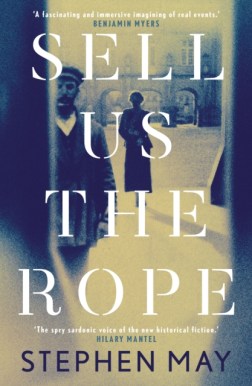 About the Book
May 1907. Young Stalin – poet, bank-robber, spy – is in London for the 5th Congress of the Russian Communist Party.
As he builds his powerbase in the party, Stalin manipulates alliances with Lenin, Trotsky, and Rosa Luxemburg under the eyes of the Czar’s secret police.
Meanwhile he is drawn to the fiery Finnish activist Elli Vuokko and risks everything in a relationship as complicated as it is dangerous.
Format: Paperback (288 pages) Publisher: Sandstone Press
Publication date: 1st March 2022 Genre: Historical Fiction
Find Sell Us the Rope on Goodreads
Purchase links
Bookshop.org
Disclosure: If you buy a book via the above link, I may earn a commission from Bookshop.org, whose fees support independent bookshops
Hive | Amazon UK
Links provided for convenience only, not as part of an affiliate programme
My Review
Sell Us The Rope is an inventive, very clever play on actual historical events. The 5th Congress of the Russian Communist Party really did take place in London in 1907 and Joseph Vissarionovich Stalin, the man we would later come to know simply as Stalin but who at the time preferred to be known as Koba, did attend along with other famous Communist party members such as Lenin (referred to as Ulyanov in the book), Trotsky, Maxim Gorky and Rosa Luxemburg. The Conference itself was dominated by internal wrangling and a conflict between the Bolshevik and Menshavik wings of the party over its future direction, however it’s not necessary to know any of this to enjoy the book which is much more about the characters than the politics.
The young Stalin we meet in the book is a wily, formidably determined figure, propelled by a sense of destiny. ‘His country will always need him, there will always be a national emergency.’ The son of a violent father, there are already signs of the inner ruthlessness and capacity for violence that will later be unleashed on the world. ‘Anyone can learn to kill. It’s learning to live with having killed that is the difficult part.’ It’s clear that Koba has already learned to live with it and lots of other things besides. He definitely has a short fuse, having to be restrained from assaulting a journalist who attempts to take a photograph of him quite soon after his arrival in London.
It would probably be overstating it to say we a ‘softer’ side to Koba in the book but his relationship with Finnish activist, Elli Vuokko, does show he has a capacity for affection, albeit it represents a betrayal of his wife. And the way Koba befriends young Arthur Bacon, the son of the owner of his lodgings, is rather touching, even if Arthur does appear to be an entrepreneur, perhaps even a capitalist, in the making.
It was interesting to witness Koba’s and Elli’s impressions of London as they walk the streets of the city. They are appalled by the poor housing, poverty and the lack of sanitation they see and the city’s downtrodden population. ‘The under-sized, misshapen people, the tired and skinny livestock. The children still, dead-eyed and sullen, or, alternatively, running and pushing or shrieking like supercharged geese through the crowds.’ Elli is particularly conscious of the demeanour of the women she sees. ‘They are so wan, so many with a curious bluey-yellow patina to the skin, so many with a haunted look. So many muttering to themselves. So many coughing.’ Asked what’s the matter with them, Koba replies, ‘Work. Children. Degradation. All three.’
In case you’re getting the impression the book is a depressing read, I can assure you there are plenty of moments of, often deadpan, humour. For example, Koba’s reaction to an English cup of tea: ‘I think I can’t drink this grandmother’s piss’. Or when describing Rosa Luxemburg: ‘Elli could listen to her talk about anything for hours. Which is probably just as well’. Or when lured to alternative lodgings by the prospect of a flushing toilet, Koba and his companions are disappointed to learn they may only flush it once a day, at 10pm to be precise – except in case of ‘special need’. Asked to elaborate, Arthur explains, ‘Da says if it’s proper disgusting, you can pull the handle’.
For those who crave an element of intrigue there is Koba’s sparring with agents of the Okhrana, the Tsar’s secret police, who are attempting to use their hold over him to force him to denounce influential members of the Communist party who threaten their interests. But perhaps it’s not so easy to get one over on Koba?
The author’s historical note provides fascinating background detail. I was surprised by how many of the characters, including ones I had thought might be the product of the author’s imagination, were actually drawn from real life, such as Arthur Bacon who really did run errands for Stalin. The same goes for many of the locations, some of which still exist albeit in a different form. By the way, for those wondering about the book’s title, let Koba explain. ‘You know the old saying that when it comes time to hang the capitalists, they will sell us the rope.’
Sell Us The Rope is a rather chilling insight into the complicated and violent history of Russia, especially given current events. However, as a work of fiction it’s a wonderfully immersive read, full of atmosphere and with a delicious thread of dark humour.
In three words: Witty, clever, spirited
Try something similar: Sergeant Salinger by Jerome Charyn
Follow this blog via Bloglovin
 About the Author
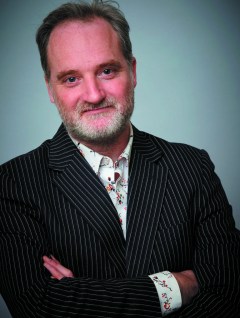
Stephen May is the author of five novels including Life! Death! Prizes! which was shortlisted for the Costa Novel Award and The Guardian Not The Booker Prize. He has also been shortlisted for the Wales Book of the Year and is a winner of the Media Wales Reader’s Prize. He has also written plays, as well as for television and film. He lives in West Yorkshire.
Connect with Stephen
Website | Twitter

 What Cathy Read Next...
I am not sure I have heard of a book with Lenin as the main character!
LikeLike