
 About the Book
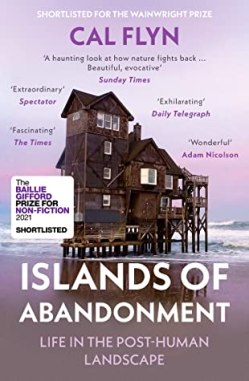
This is a book about abandoned places: ghost towns and exclusion zones, no man’s lands and fortress islands – and what happens when nature is allowed to reclaim its place.
In Chernobyl, following the nuclear disaster, only a handful of people returned to their dangerously irradiated homes. On an uninhabited Scottish island, feral cattle live entirely wild. In Detroit, once America’s fourth-largest city, entire streets of houses are falling in on themselves, looters slipping through otherwise silent neighbourhoods.
This book explores the extraordinary places where humans no longer live – or survive in tiny, precarious numbers – to give us a possible glimpse of what happens when mankind’s impact on nature is forced to stop. From Tanzanian mountains to the volcanic Caribbean, the forbidden areas of France to the mining regions of Scotland, Flyn brings together some of the most desolate, eerie, ravaged and polluted areas in the world – and shows how, against all odds, they offer our best opportunities for environmental recovery.
By turns haunted and hopeful, this luminously written world study is pinned together with profound insight and new ecological discoveries that together map an answer to the big questions: what happens after we’re gone, and how far can our damage to nature be undone?
Format: Paperback (384 pages) Publisher: William Collins
Publication date: 23rd December 2021 Genre: Nonfiction
Find Islands of Abandonment: Life in the Post-Human Landscape on Goodreads
Purchase links
Bookshop.org
Disclosure: If you buy a book via the above link, I may earn a commission from Bookshop.org, whose fees support independent bookshops
Hive | Amazon UK
Links provided for convenience only, not as part of an affiliate programme
My Review
Once again, this is a book I probably would not have chosen to read were it not for being a book club pick. I’ll freely admit I read very little non-fiction and although I’d like to think I’m environmentally aware it isn’t something I’ve studied in any detail. However, as is often the case, I found much of interest in the book.
Flyn argues that the abandonment by humans of some places in the world – either because of conflict, economic or environmental change – means we are in the midst of ‘a huge, self-directed experiment in rewilding’. Abandonment is rewilding, she maintains, because as humans draw back nature inevitably reclaims the space vacated. Some of the most powerful examples of that for me were the sections of the book in which the author visits the demilitarized zone between the Greek and Turkish occupied parts of Cyprus, and the so-called ‘Zone Rouge in Verdun, France, the site of the trenches in the First World War.
Although the author also explores the issue of urban blight, such as the abandoned neighbourhoods of parts of Detroit, the sections featuring the natural world were much my favourite parts of the book as these seemed to me to illustrate most strongly the ‘post-human’ element of the book’s subtitle. I learned an awful lot from the book. For example, that certain plants can act as ‘bio-indicators’ of minerals in the soil and that there exist ‘hyperaccumulating’ plants that can absorb metals. I was also enthralled by the section of the book which examines the ability of certain animals to develop the capacity to survive in conditions that would once have killed them, or as the author puts it, ‘the ability to adapt to a befouled and ruinous world, and even thrive in there’.
As a journalist of some repute, it’s not surprising that the author has a real ways with words especially when it comes to describing nature. So we have ‘gnomish razorbills’, ‘spaniel-eyed’ baby seals and ‘buxom puffins’ who make the Forth Islands of Scotland their home. Or later when, near the spoil heaps known as the Five Sisters in West Lothian in Scotland, the author observes the first bumblebees of the year blundering by and ‘revving their engines’.
I was struck also by the author’s sensitivity to the ‘ghosts’ of long abandoned places that she visits, the traces left by their former occupants. For example, when visiting an abandoned church in Detroit she writes, ‘You can feel it in the air: the emotional trace of past epiphanies, crises of faith. Funerals and christenings, confirmations, the comings of age.’
Although the author generally succeeds in conveying complex scientific information in an accessible way, I did find some parts of the book a more challenging read than others. The author’s scholarly approach is exemplified by the footnotes and the index and comprehensive notes section at the end of the book.
Cal Flyn observes at the beginning of the book that its subject matter might make it seem all about darkness but, she argues, it is in fact a story of ‘redemption’. I think that statement is justified by many of the examples in the book although I was still left with the overwhelming feeling that human activity has pushed the planet close to the point of no return.
In three words: Detailed, passionate, thought-provoking
Try something similar: Entangled Life by Merlin Sheldrake
Follow this blog via Bloglovin
 About the Author
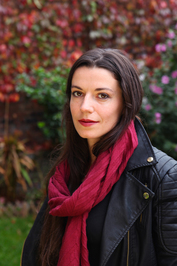
Cal Flyn is an award-winning writer from the Highlands of Scotland. She writes literary nonfiction and long form journalism.
Her first book, Thicker Than Water, about frontier violence in colonial Australia, was a Times book of the year. Her second book, Islands of Abandonment – about the ecology and psychology of abandoned places – is out now. It has been shortlisted for a number of prizes including the Wainwright Prize for writing on global conservation, the British Academy Book Prize and the Baillie Gifford Prize for nonfiction.
Cal’s journalistic writing has been published in Granta, The Sunday Times Magazine, Telegraph Magazine, The Economist and others. She is the deputy editor of literary recommendations site Five Books, and a regular contributor to The Guardian. Cal was previously writer-in-residence at Gladstone’s Library and at the Jan Michalski Foundation in Switzerland. She was made a MacDowell fellow in 2019, and shortlisted as Sunday Times Young Writer of the Year in 2022. (Photo/bio: Author website)
Connect with Cal
Website | Twitter | Instagram

 What Cathy Read Next...