

Sick Heart River is the final book (for 2018) in my John Buchan reading project, Buchan of the Month. Appropriately perhaps, it was also Buchan’s last novel. In fact, he finished it only a fortnight before his death and it was published posthumously. It also happens to be one of my favourite of his novels. The ending always leaves me slightly teary.
To find out more about the project and my reading list for 2018, click here. Buchan of the Month will return in 2019 with a new selection of books by John Buchan, both fiction and non-fiction. If you would like to read along with me you will be very welcome. Just leave a comment on the challenge post when it’s published in the New Year.
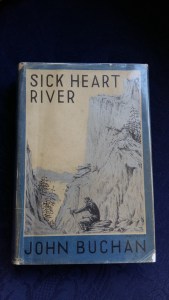 What follows is an introduction to Sick Heart River. It is also an excuse to show a picture of my lovely edition of the book complete with dust jacket. I will be posting my review of the book later in the month.
John Buchan (by then Lord Tweedsmuir) started writing Sick Heart River in the Autumn of 1939. His private secretary, Mrs. Killick, wrote to Susan, Lady Tweedsmuir, “His Excellency is writing a very odd book…so unlike him, so introspective.” As Kate Macdonald has remarked, ‘Sick Heart River was Buchan’s farewell to his writing career, written at the end of his life’. David Daniell, who has written extensively on John Buchan’s life and work, describes Sick Heart River as ‘a moving novel…deeply meditative’.
On 5th February 1940, Buchan told his sister Anna, ‘I have finished my novel [Sick Heart River] and my autobiography [Memory Hold-the-Door]’. The following day, Buchan suffered the cerebral thrombosis that ultimately proved fatal and he died on 12th February. Sick Heart River was published in the UK by Hodder & Stoughton in 1941. In the US it was published under the title, Mountain Meadow.
Sick and fearing he has not long to live, Sir Edward Leithen embarks on what he believes may be his last mission: tracking down and restoring to health Francis Galliard, a young Canadian banker who has gone missing in the wilds of northern Canada. Leithen’s quest takes him – and the reader – on a journey from New York, to a farmhouse in Quebec, by air across the Barrens to the Arctic shore of Canada and to the country west of the Mackenzie River in a search for the mysterious Sick Heart River.
The latter parts of Leithen’s journey mirror that taken by Buchan to the north of Canada in 1937 whilst he was Governor General of that country. During this trip, in scenes reminiscent of the book, Buchan met French missionaries working with the Hare Indians, a tribe ravaged by tuberculosis. Buchan’s first biographer, Janet Adam Smith, notes, ‘It is plain how much Buchan put into the novel of his experience in Canada, particularly Quebec and the North’. Adam Smith also argues that in Sick Heart River, Buchan makes Leithen more like himself than in any of the earlier books in which he’d featured, such as The Power House and John Macnab. She notes: ‘Leithen’s body – lean and getting leaner, needing sleep and waking tired, active in spite of pain – is Buchan’s.’
Janet Adam Smith reports that by 1960 the Hodder & Stoughton edition of Sick Heart River had sold around 96,000 copies. In the US, it sold over 20,000 copies in hardback and a further 300,000 copies when published in paperback.
Sources:
David Daniell, The Interpreter’s House: A Critical Assessment of the Work of John Buchan (Nelson, 1975)
Kate Macdonald, John Buchan: A Companion to the Mystery Fiction (McFarland, 2009)
Janet Adam Smith, John Buchan: A Biography (OUP, 1985 [1965])

 What Cathy Read Next...