About the Book
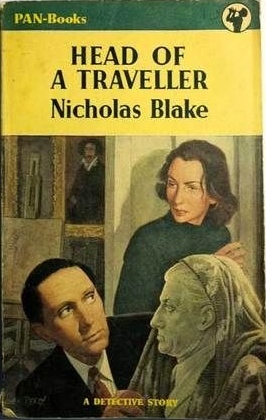
Staying with a friend in Oxfordshire, poet turned amateur detective Nigel Strangeways pays a visit to Robert Seaton, a distinguished British poet whom Nigel greatly admires but whose reputation has been on the decline of late. Seaton proves to be an irascible, temperamental man, and his unconventional household, featuring a resentful daughter and mute dwarf servant, simmers with tension.
When a headless corpse is found floating in the river by the Seaton’s house just a few weeks later, the poet becomes the prime suspect. But whose body is it?
Format: Paperback (219 pages) Publisher: Pan
Publication date: 1955 [1949] Genre: Crime
Find Head of the Traveller on Goodreads
Purchase Head of a Traveller from Bookshop.org [Disclosure: If you buy books linked to our site, we may earn a commission from Bookshop.org, whose fees support independent bookshops]
My Review
Head of a Traveller by Nicholas Blake (the pen name of Cecil Day Lewis) was the book I read for the 1949 Club hosted by Karen at Kaggsy’s Bookish Ramblings and Simon at Stuck in a Book. Handily it was also a book on my second Classics Club list, the only one in fact originally published in 1949. My copy is a battered Pan Books reprint.
Head of a Traveller is the ninth book in Nicholas Blake’s Nigel Strangeways crime mystery series. Strangeways is the epitome of the amateur sleuth who always seems to have some connection to the location where a murder has taken place and whose presence and attempts to solve the crime the police don’t seem to mind. Helpfully Nigel is friendly with a senior police officer, Superintendent Blount, with whom he has worked on previous cases.
You certainly need your wits about you to follow the plot which turns as much as anything on the minute by minute whereabouts and activities of characters on the night of the murder, suitably against the backdrop of a violent thunderstorm. Even Strangeways has to sit down and try to construct a timeline based on the suspects’ statements and sightings by other witnesses.
Each of the main characters appear to possess the motive, means and opportunity to have committed the murder. I think it’s safe to say you’ll probably suspect each of them at some point. However, increasingly the evidence seems to point in one direction in particular although it’s one Strangeways resists because of a personal connection to the individual.
Eventually, as in many classic murder mysteries, the solution reveals itself by quite a small thing. Feel entitled to congratulate yourself if you spotted it.
What spoiled the book for me was the inclusion of a character with dwarfism, the family’s servant Finny Black, who is also non-verbal and has kleptomania. There was no obvious reason why the character had to be a person with dwarfism to fulfil their role in the story and the grotesque way the character was described – ‘a demented and gibbering dwarf’ or ‘his little hideous face’ – I found offensive. Even taking into account the date the book was written I wondered why the author chose to include this unpleasant trope.
Several elements of the book, especially some of the attitudes, now seem dated but leaving this aside Head of a Traveller is an ingenious, intricately plotted murder mystery.
About the Author
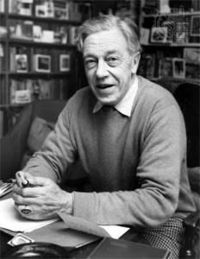
Nicholas Blake is the pseudonym of poet Cecil Day-Lewis (1904-1972). He was born in Ireland in 1904, the son of the Reverend Frank Cecil Day-Lewis and his wife Kathleen. His mother died in 1906, and he and his father moved to London, where he was brought up by his father with the help of an aunt. He spent his holidays in Wexford and regarded himself very much as Anglo-Irish, although when the Republic of Ireland was declared in 1948 he chose British citizenship.
He was married twice, to Mary King in 1928 and to Jill Balcon in 1951, and during the 1940s he had a long love affair with novelist Rosamond Lehmann. He had four children from his two marriages, with actor Daniel Day-Lewis, documentary filmmaker and television chef Tamasin Day-Lewis and TV critic and writer Sean Day-Lewis being three of his children.
He began work as a schoolmaster and, during World War II, worked as a publications editor in the Ministry of Information. After the war he joined Chatto & Windus as a senior editor and director, and then in 1946 he began lecturing at Cambridge University. He later taught poetry at Oxford University, where he was Professor of Poetry from 1951-1956, and from 1962-1963 he was the Norton Professor at Harvard University.
In 1935 he began his career as a thriller writer under the pseudonym Nicholas Blake with A Question of Proof which introduced his amateur sleuth Nigel Strangeways, reputedly modelled on W. H. Auden. The Strangeways series totalled sixteen novels, the final one being The Morning After Death, published in 1966. He also wrote four detective novels which did not feature Strangeways.
He continued to write poetry and became Poet Laureate in 1968, a post he held until his death in 1972. He was also awarded the CBE. (Photo/bio: Goodreads author page)