
I recently read a great review of The Antipodeans by Greg McGee and shared it on social media. The publishers Lightning Books, the fiction imprint of Eye Books, were kind enough to get in touch and offer me a review copy. Unfortunately, it’s going to be a while until The Antipodeans reaches the top of my review pile but in the meantime I’m delighted to bring you an extract from the book. It’s from a scene that is a pivotal meeting for two characters in the book. I hope you can see just what has got me so excited about reading it.
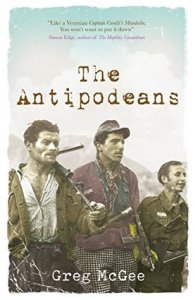 About the Book
Three Generations. Two Continents. One Forgotten Secret.
2014: Clare and her father travel to Venice from New Zealand. She is fleeing a broken marriage, he is in failing health and wants to return one last time to the place where, as a young man, he spent happy years as a rugby player and coach. While exploring Venice, Clare discovers there is more to her father’s motives for returning than she realised and time may be running out for him to put old demons to rest.
1942: Joe and Harry, two Kiwi POWs in Italy, manage to escape their captors, largely due to the help of a sympathetic Italian family who shelter them on their farm. Soon they are fighting alongside the partisans in the mountains, but both men have formed a bond with Donatella, the daughter of the family, a bond that will have dramatic repercussions decades later.
Praise for The Antipodeans
‘The Antipodeans is a gripping, skilfully constructed novel that knows more than any single novel has a right to know about the hazards of both love and war, loyalty and betrayal, Italian politics over the past eighty years and, oh yes, rugby.” Charles Lambert, author of The Children’s Home
“Like a Venetian Captain Corelli’s Mandolin, The Antipodeans lifts the lid on the violent, messy recent history of a part of Europe which is now a tourist mecca and tells a rich, intense story of decades-old wrongs of the heart. It does it with such humanity, you won’t want to put it down.” Simon Edge, author of The Hopkins Conundrum
“A truly engrossing and superbly woven tale, The Antipodeans is a spellbinding read. Bravissimo!” Ian Thornton, author of The Great and Calamitous Tale of Johan Thoms
Format: ebook, paperback (352 pp.) Publisher: Eye Books/Lightning Books
Published in the UK: 4th December 2017 Genre: Literary Fiction, Historical Fiction
Purchase Links*
Publisher website ǀ Amazon.co.uk ǀ Amazon.com ǀ Hive.co.uk (supporting UK bookshops) *links provided for convenience, not as part of any affiliate programme
Find The Antipodeans on Goodreads
Extract from The Antipodeans by Greg McGee
Chapter 8 – Gemona, 1943
When Joe regained consciousness, he could hear a voice through the lingering fog. He lay there listening. His body felt heavy but comfortable. Warm. He couldn’t feel his ankle. If the sounds were German, he wouldn’t open his eyes, he’d let himself drift off again without attracting attention. But there was no mistaking the Italian, even though it was too low to distinguish many words. It was a woman’s voice and Joe thought he might somehow be back in hospital with the suore. When he ventured a glance, there was only a young woman in quarter profile looking down at something, her head bowed and angled towards the low light, her lips moving. Joe strained to see the baby Jesus in her lap. When he lifted his head, her serious hazel eyes left the book she’d been reading and he realised she wasn’t a heavenly illusion. Beyond her was a very ordinary room: one curtained window, rough plastered walls and wooden furniture, a small table with a bowl on it, and two straight-backed wooden chairs facing his bed, the closer of which she was sitting on.
‘Eccolo!’ she called out to someone. Here he is. He understood that.
Presently, her face was replaced by a man’s, older, perhaps her father’s, a big forehead pressing creases around the same widely spaced eyes. He could understand the man’s carefully enunciated Italian. ‘Come stai?’ How are you?
Joe tried to say something, but initially no sound came.
The man said ‘Permesso’, put a callused hand to the back of Joe’s head and lifted it to a long-necked bottle. He drank as much water as he could.
Finally he croaked ‘Bene’, his voice giving the lie. He felt the weakness and lassitude that he’d known in the Benghazi hospital and then in the drain of urine and shit. He shivered. How had he got from there to here? How long had he been here? Maybe the room was a cell, but the three people now in the room — the man and young woman had been joined by another woman, older, perhaps the mother — seemed more like a family than jailers. He must have been looking alarmed. The man put a finger to his lips, said, ‘Stai tranquillo.’ Joe could see his relief when he indicated he’d understood.
‘Dove sono?’ he asked. Where am I?
‘Lei parla italiano?’ asked the younger woman.
‘Un pochino,’ he said, a little, though he hoped it was better than that. The man told him he was safe, for now. He should rest, he’d been very sick, he should sleep.
He must have. The next time he woke, there was just her. She was sitting in the chair, again reading, but ready this time for his return, her face front on, looking down. He had time to take her in, dark lashes above broad cheekbones, and below them, down almost to her jaw, the scars of what must have been smallpox. The curtain was drawn back a little, letting in daylight, giving the tresses that framed her face a copper sheen. When she sensed his eyes on her, she looked up and smiled at him and called softly — ‘È ritornato.’
The older man and woman came back into the room. ‘Sei inglese?’ the man asked.
‘Neozelandese,’ Joe croaked.
They stood there looking at him, a grave little circle. This must be the family who lived through the wooden door that adjoined the stable he’d hidden in. Joe’s ankle had deteriorated to the point where he could no longer put any weight on it and Harry had left him propped against the main entrance to the stable while he crept to the door at the far end. When he came back he said there were people in there, they had to be quiet.
The man was holding out his hand to Joe. ‘Mi chiamo Bepi,’ he said.
‘Piacere,’ said Joe, grateful that this big square hand had found him. So far the family had not betrayed him, were giving him food and shelter, but he knew the Germans would still be looking for him and wondered if he should tell them his name. They had found him covered in shit, freezing, cleaned him, warmed him. Whatever happened, they had saved him. ‘Mi chiamo Joseph,’ he said.
‘Joseph?’ said Bepi, then pointed to himself. ‘Giuseppe! Joseph, Giuseppe!’ The coincidence seemed to give him huge pleasure. He introduced his wife, Nina, and daughter, Donatella.
‘Piacere, Signora, Signorina,’ said Joe.
Bepi explained with much gesticulation that the Germans had completed their rastrellamento of their house and stable, tipping over beds, stabbing the hayloft with bayonets, without finding him. After they’d gone, Bepi had gone down to check they’d latched the stable door behind them and had noticed the build-up of urine in the drain. He couldn’t make out what the obstruction was in the darkness so he put his foot on it. Bepi mimicked a low moan or groan and stepped back, startled. ‘Che cosa è?’ What is it?
Harry had been right. He’d left Joe where the Germans wouldn’t find him, but someone else would. What happened now?
Bepi seemed to understand his anxiety. ‘Stai tranquillo,’ he repeated. ‘Noi,’ he said, indicating the three of them, ‘Noi siamo amici. Capito?’
Joe understood. We are friends. He was safe, for the moment.
He must have fallen asleep again in front of them. When he next woke, it was dark and he was alone. He was busting and pulled back the covers and laboured into a sitting position. The privy would be outside, if he could find his way there. He could flex the ankle when it had no weight on it so he tried to stand up. The blood immediately filled the damaged tissue so that he almost swooned with the pain and sank back onto the bed and waited for the throbbing to subside. He’d seen a basin at the end of the bed: he’d use that.
Bepi had been reassuring, but he had no idea that there had been two of them out there being hunted by the Germans. Where was Harry? If he’d been caught, Joe’s refuge here was on borrowed time. They were after them both: one would not be enough. They’d come back here to where Harry had left him, find him right next door to the cow byre. And then Joe himself would not be enough: this little family would also suffer.
He consoled himself with the thought that Harry was the bravest man he knew. The Germans were brutal and efficient but it would take them a long time to break Harry, even if they caught him. Harry had always been intent on escape, and finally he’d managed it, although it’d taken him the best part of a year to do it. He wouldn’t have been retaken easily.
 About the Author
Greg’s early success as a playwright launched a career as a successful writer over a wide variety of genres. His work is known for its hard-hitting observations about society in his native New Zealand. His first play was largely written in London in the late seventies, after he abandoned a novel. Foreskin’s Lament (1980) drew on the rugby culture of the period to comment more broadly on national codes and values. The play had influence far beyond the usual realm of theatre audiences and has become a New Zealand classic. His television writing has won numerous awards. BBC audiences may remember a four-part series starring Frank Findlay, Erebus: The Aftermath.
He has written crime fiction under the pseudonym Alix Bosco, and won the 2010 Ngaio Marsh Award for Best Crime Fiction with Cut & Run. He has also ghost-written biographies for former All Blacks captain Richie McCaw (published in the UK as The Real McCaw) and for New Zealand cricket captain, Brendon McCullum. During his university years he played rugby to the highest level, and was a Junior All Black and twice an All Blacks trialist. These days, he plays golf and walks the dog.
His novel The Antipodeans was published in 2015 and long-listed in the 2016 Ockham New Zealand Book Awards for fiction. It spent 49 weeks in New Zealand’s bestseller charts. It will be published in the UK by Lightning Books in 2018. The Antipodeans was written during his tenure of the Katherine Mansfield Menton Literary Fellowship in 2013.
Connect with Greg


Hope you enjoy it when you get round to reading it! I loved it!
LikeLiked by 2 people
Brilliant extract!
LikeLiked by 1 person