

Throwback Thursday is a weekly meme originally created by Renee at It’s Book Talk. It’s designed as an opportunity to share old favourites as well as books that we’ve finally got around to reading that were published over a year ago.
Today I’m revisiting a book I reviewed early on in my blogging ‘career’ – Shelter by Sarah Franklin. First published in hardback July 2017, it was recently published in paperback with an evocative new cover. A perfect excuse to grab a copy if you haven’t already read this fabulous book!
You can read my original review below and also my interview with Sarah about Shelter here.
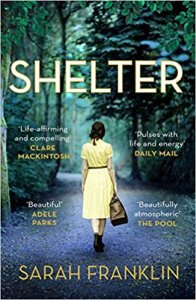 About the Book
Early Spring, 1944. In a clearing deep within an English forest two lost souls meet for the first time. Connie Granger has escaped the devastation of her bombed out city home. She has found work in the Women’s Timber Corps, and for her, this remote community must now serve a secret purpose. Seppe, an Italian prisoner of war, is haunted by his memories. But in the forest camp, he finds a strange kind of freedom. Their meeting signals new beginnings. In each other they find the means to imagine their own lives anew and to face that which each fears the most.
But outside their haven, the world is ravaged by war and old certainties are crumbling. Both Connie and Seppe must make a life-defining choice which threatens their fragile existence. How will they make sense of this new world, and find their place within it? What does it mean to be a woman, or a foreign man, in these days of darkness and new light? A beautiful, gentle and deeply powerful novel about finding solace in the most troubled times, about love, about hope and about renewal after devastation. It asks us to consider what makes a family, what price a woman must pay to live as she chooses, and what we’d fight to the bitter end to protect.
Format: Hardcover, ebook, paperback (432 pp.) Publisher: Bonnier Zaffre
Published: Hardcover 27th July ‘17, Paperback 31st May ’18 Genre: Historical Fiction
Purchase Links*
Amazon.co.uk ǀ Amazon.com | Hive.co.uk (supporting local UK bookshops)
*links provided for convenience, not as part of any affiliate programme
Find Shelter on Goodreads
My Review
All her life Connie’s had the urge to break away, to explore what life has to offer away from the streets and factories of Coventry. She doesn’t know what form this new life will take or how she’s going to do it. What she does know it that she’s got to do it. Spirited, determined and reckless, the Second World War brings Connie the opportunity to seek what she’s looking for but the price for that opportunity is a high one. Forced by circumstances to be totally self-reliant and desperate to leave bad memories behind, she joins the Women’s Timber Corps and finds herself posted to The Forest of Dean to train as a ‘lumberjill’.
Chance brings together Connie and Seppe, an Italian POW, who is trying to escape his own demons. Thoughtful and sensitive, Seppe is initially cowed by his traumatic relationship with his violent father whose malevolent presence seems able to reach even into the confines of the POW camp. ‘The spikes of his father’s rancour were undimmed by the flimsy paper. A spiral of venom rose from the lines, the sheen of anger, pride and sheer vicious temper bitter in Seppe’s mouth.’
Despite being haunted by guilt and by what he witnessed during the war, Seppe gradually grows in inner strength as he finds acceptance from the local community. For Connie and Seppe, the forest provides shelter from the outside world – quite literally at times. However, for those born and bred in the forest, the war, and those it brings in its wake, is an unwanted incursion into their lives. ‘Those evacuees are still out here, causing chaos in the school. And…we’ve got Yanks in the forest, whole regiments of them…The other big change is that we’ve got POWs up at Broadwell.’
The war is also a threat to the very existence of the forest itself with the constant demands for timber to support the war effort. ‘The forest itself warned them of loss even as they chopped it down. Bloody great gaps staring at them in the very woods that had sheltered them all their lives, and people pulled from this life into a new world that swallowed them up.’
I loved the way the author made the forest another character in the story with almost human qualities: ‘Amos pushed in amongst the branches until they almost held him in an embrace.’ I thought the author struck a good balance between historical fact about wartime events and the story of Connie, Seppe and the other inhabitants of The Forest of Dean. Sometimes events erred slightly on the side of convenience but I think we must allow an author some artistic licence and, who knows, sometimes things are just meant to be. Finally, I always admire an author who is brave enough not to spell out the conclusion of a book but to let the reader imagine it for themselves.
I thought this was an outstanding debut. Shelter has an authentic period atmosphere with wonderful characters who take you on an intense but heart-warming journey. I received an advance reader copy courtesy of NetGalley and publishers, Bonnier Zaffre, in return for an honest review.
In three words: Intimate, atmospheric, emotional
Try something similar…Miss Boston and Miss Hargreaves by Rachel Malik (read my review here)
 About the Author
Sarah Franklin grew up in rural Gloucestershire and now lives with her family between Oxford and London. She has written for the Guardian, Psychologies magazine, The Pool, the Sunday Express and the Seattle Times. Her creative non-fiction has been published in anthologies in the USA and appeared on radio affiliates there. Sarah is founder and host of popular Oxford literary night, Short Stories Aloud, a Senior Lecturer at the Oxford International Centre for Publishing Studies, and a judge for the Costa Short Story Award. She was awarded a mentorship under the Jerwood/Arvon scheme to work on her debut novel, Shelter, which will be published by Bonnier Zaffre in July 2017.
Connect with Sarah

 About the Book
 What Cathy Read Next...