
 I’m delighted to be hosting today’s stop on the blog tour for The Girl in the Pink Raincoat by Alrene Hughes. My thanks to Florence and Blake at Head of Zeus for inviting me to participate in the tour.
I’m thrilled to bring you a Q&A with Alrene in which she discusses, amongst other things, the surprising facts that can turn up during research for her books and the importance of the right notebook!
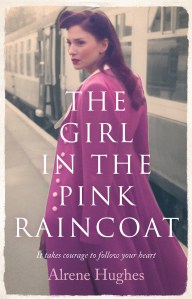 About the Book
When a factory girl and a Jewish businessman fall in love it seems that the whole world is against them.
Manchester, 1939. On the eve of war Gracie Earnshaw is working in Rosenberg’s Raincoat factory – a job she hates – but her life is about to be turned upside down when she falls in love with Jacob, the boss’s charismatic nephew.
Through Jacob, with his ambitions to be a writer, Gracie glimpses another world: theatre, music and prejudice. But their forbidden romance is cut short when Jacob is arrested and tragedy unfolds.
Gracie struggles with heartbreak, danger and old family secrets, but the love of her first sweetheart comes back to her in an unexpected way giving her the chance of a new life and happiness.
Format: Hardcover, ebook (368 pp.) Publisher: Head of Zeus
Published: 12th July 2018 Genre: Historical Fiction
Purchase Links*
Publisher | Amazon.co.uk ǀ Amazon.com ǀ Hive.co.uk (supporting UK bookshops)*links provided for convenience, not as part of any affiliate programme
Find The Girl in the Pink Raincoat on Goodreads
Interview with Alrene Hughes, author of The Girl in the Pink Raincoat
Welcome, Alrene. Without giving too much away can you tell me a bit about The Girl in the Pink Raincoat?
It’s set in Manchester during WW2. Gracie Earnshaw is working in Rosenberg’s Raincoat factory – a job she hates – but her life is about to be turned upside down when she falls in love with Jacob, the boss’s charismatic nephew. Through Jacob, with his ambitions to be a writer, Gracie glimpses another world: theatre, music and prejudice. But their forbidden romance is cut short when Jacob is arrested and tragedy unfolds. Gracie struggles with heartbreak, danger and old family secrets, but the love of her first sweetheart comes back to her in an unexpected way giving her the chance of a new life and happiness.
How did you get the idea for the story?
To begin with, I wanted to write about Manchester where I live and I like to write about WW2 because the period gives rise to a lot of drama that can change the characters’ lives. Gracie came to me very quickly, a factory girl who was good fun and loved telling stories, but there was something else about her… I knew she wouldn’t stay in the raincoat factory, but her journey had so many twists, none of which I could have envisaged when I set out to write her story.
How did you approach your research for the book? Do you enjoy the process of research?
I had already written three WW2 novels set in Belfast, where I grew up, and I learned then that thorough, well-written, non-fiction accounts of a city at war are a god-send to a novelist. Then there are the books about the home-front and cultural life in the city. Once the novel is underway the internet really comes into its own for the fine detail: what the interior of a particular dance hall looked like; what date a certain film or song came out. Yes I do like researching, but in the end you just have to get on with writing the book!
What was the most surprising fact you came across during your research?
I came across an account of an internment camp housing enemy aliens – initially German and Austrian citizens and later Italians. The surprise was that the camp, in a disused cotton mill, was five minutes from my house! It is still standing and is now a business centre. The tragic story of the camp, and the subsequent sinking of the SS Arandora Star carrying the internees to Canada, is at the heart of the novel.
Your Martha’s Girls trilogy was also set in WW2. What attracts you to this period of history?
When I decided to write my first novel I searched for a story and took the usual advice – write about what you know. That led me to an old family scrapbook full of concert programmes, old photographs and mementoes. My mother and her sisters were talented singers in the style of the Andrews Sisters and as members of ENSA they entertained in military camps, concert and dance halls. I ended up writing a trilogy allowing the readers to see the entire war through the eyes of Martha and her daughters. What kept me going was the commitment to my family and the joy of recreating their lives, with several imaginative additions. And somewhere along the way I got hooked on the era.
When those books were finished it seemed the most natural thing to move the setting to Manchester and start again with new characters, completely fictional this time, in The Girl in the Pink Raincoat.
Do you have a favourite place to write or any writing rituals?
I’m lucky enough to have a room where I write overlooking the garden. Actually, that’s not quite true; I also spend a lot of time staring out the window wondering where on earth the story is going, then there’s the temptation to Google in the name of research, not to mention several other displacement activities. I also spend time in Greece and in the lazy afternoons I can usually write for 4-5 hours at a time with no interruptions or no internet.
I haven’t got any writing rituals, but I like to have an A4 notebook with a nice cover for each novel to work out planning, ideas for chapters, things to go back and change later, keep a daily record count…
What’s your favourite and least favourite thing about the writing process?
I love it when, in the course of writing, a sudden thought occurs to me that’s so much better than I originally intended. Often, as I write towards the end of a chapter there’s a real sense of achievement when it comes together and that full stop at the end is the time to smile and know it’s going to be fine.
Least favourite thing – when I could happily throw the laptop out of the window. That’s the time to shut it down and sleep on it. More often than not, it doesn’t look so bad in the morning.
Which authors do you admire and enjoy reading?
I read all sorts of books and don’t often go back to authors. But I would say that I’ve always liked Anita Shreve for her insight into the complexity of love. A critic described her as ‘a supremely elegant anatomist of the human heart.’ That’s the kind of book for me.
What are you working on next?
I’m working on another WW2 family saga/historical romance set in Manchester. It focuses on a young married woman who has led a sheltered life, but when her husband is killed in the blitz she has to face both grief and the need to earn a living. Circumstances lead her to join the police where she comes into contact with the harsh reality of life for women and her own longing to fall in love again.
Thank you, Alrene, for those fascinating answers to my questions. Your many fans will be delighted to hear you’re already working on the next book.

About the Author
Alrene Hughes grew up in Belfast and has lived in Manchester for most of her adult life.
She worked for British Telecom and the BBC before training as an English teacher. After teaching for twenty years, she retired and now writes full-time.
Connect with Alrene
Website ǀ Facebook ǀ Twitter ǀ Goodreads


 What Cathy Read Next...