

As a long time admirer of the stage and screen actor Anthony Quayle, I’m thrilled to be co-hosting today’s stop on the blog tour for his novel, Eight Hours From England, alongside my tour buddies Richard at Cafe Thinking and David at Fully Booked. Huge thanks to Anne at Random Things Tours for finding a space for me on the tour and for organising my review copy.
First published in 1945, Eight Hours From England is one of the books in the Imperial War Museum’s Wartime Classics series, launched in September 2019 to mark the 80th anniversary of the outbreak of the Second World War. You can find out more about the initiative and the other books in the series at the bottom of this post.
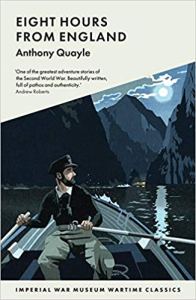 About the Book
Autumn 1943. Realising that his feelings for his sweetheart are not reciprocated, Major John Overton accepts a posting behind enemy lines in Nazi-occupied Albania. Arriving to find the situation in disarray, he attempts to overcome geographical challenges and political intrigues to set up a new camp in the mountains overlooking the Adriatic.
As he struggles to complete his mission amidst a chaotic backdrop, Overton is left to ruminate on loyalty, comradeship and his own future.
Based on Anthony Quayle’s own wartime experiences with the Special Operations Executive (SOE), this new edition of a 1945 classic includes a contextual introduction from the Imperial War Museum which sheds new light on the fascinating true events that inspired its author.
Format: Paperback (212 pp.) Publisher: Imperial War Museum
Publication date: 5th September 2019 Genre: Fiction, WW2
Purchase Links*
Amazon.co.uk | Hive (supporting UK bookshops)
*links provided for convenience, not as part of any affiliate programme
Find Eight Hours From England on Goodreads
My Review
The poignant opening scene of the book sees John Overton and Ann (the woman he loves but whom he fears may not return those feelings) gathered around the wireless set to hear Chamberlain’s speech declaring war with Germany. Returning from service three years later, Overton’s feelings are unchanged but his declaration of love receives a lukewarm reception. Accepting a mission overseas, in his desire to make a ‘gift’ to Ann of his service, he is posted – more by chance than anything else – to Albania as ‘agent, saboteur, and general fanner of the flames of revolt’.
Arriving in Albania, the comment by the officer Overton relieves – “I wish you joy of the damned place” – is not exactly encouraging but turns out to be no jest. Overton finds himself in the midst of a civil war in which, for the different factions, fighting each other often takes precedence over fighting the Germans. He also finds the task he has been given – to engage the help of the Albanians to kill Germans – conflicts with the intelligence gathering objectives of other officers with whom he must work but doesn’t command.
Over the next few months, Overton finds himself near the end of his resources on many occasions and is candid about the mental and physical toll of the responsibility of command. For example, when news of a German patrol nearby reaches the base he admits, ‘I didn’t want to cope with this situation; I didn’t want to have to take decisions; I only wanted to go to sleep. Was this fear, I wondered?’
Even in the darkest situations, Ann, the woman he left behind in England, dominates Overton’s thoughts: “She is never very far away, living always in my brain, in my blood.” I found it touching that at one point as they scramble to evacuate the camp, one of the few possessions he takes with him is a ‘precious’ photograph of her. Even in situations where he believes he is facing death, his thoughts turn to Ann. “All the while I felt no fear at all – only a great, great sadness, an intolerable regret that now Ann would never know what it was I had been trying to say to her…’ (I have to say this reader had the uncharitable thought that Ann didn’t deserve such a man.)
The book displays some evocative writing such as this passage describing Overton’s long, tedious flight to Cairo en route to his mission. ‘Through a night and two days the plane drew an aerial furrow halfway round a continent smoking with war, but no sound of the fury reached us in the sky. There, detached and sealed in our flying cylinder, life was aseptic, commonplace, an alternation of waking, sleeping and joyless eating of sandwiches. In the night great cities passed below, but they were only a cluster of lights to help navigation or a significant darkness where lights should have been.’
Some of Quayle’s descriptions of the landscape of Albania and the inclusion of biblical references put me in mind of the writing of one of my favourite authors, John Buchan. There are also some great action scenes, such as when Overton and his comrades battle the elements to bring ashore stores and ammunition and evacuate wounded in small boats at dead of night or when they are forced to cross the mountains in darkness using treacherous paths, completely reliant on their local guides.
I liked the fact that at certain points the actor within the author reveals himself. For example, when being given his initial orders by a young lieutenant-colonel, Quayle has Overton think, ‘I had a strong feeling that the colonel was playing a part, the part of a “man behind the scenes” in a spy film, the man in the darkened room who at the end of the interview says: “You have an important mission ahead of you…a dangerous mission.” (Here the character usually rises to his feet and holds out his hand.) “Goodbye to you…” (pregnant pause) “…and good luck!” It was so much a performance that I found myself watching it in a detached way.’ And wouldn’t you know it, at the end of the scene, Quayle has the colonel rise, hold out his hand to Overton and say, ‘”Goodbye to you”. A pregnant pause. “And good luck!”‘
Some readers may struggle with the complexity of the political situation described in the book but, as confirmed in Alan Jeffreys’ introduction, it is an accurate representation of the difficulties faced by real life counterparts of Overton, including Anthony Quayle himself. What I particularly admired about the book is that, although it is a fictionalized account, it’s not romanticized in any way. The reader is there with Overton and his comrades in the cold and the wet as they battle fatigue and illness, struggle with the inhospitable terrain and live in constant fear of betrayal or discovery by the Germans.
Eight Hours From England is a book that will be most appreciated by those with an interest in the Second World War, especially the exploits of the SOE, and those who want an insight into the off-screen and off-stage life of Anthony Quayle. Fortunately, I tick both of those boxes so in describing my feelings about the book I can’t do better than echo the thoughts of Louis de Bernieres, quoted on the cover: ‘I loved this book, and felt I was really there’. The book certainly left me with renewed respect for the bravery of those who served in the Second World War and, in particular, those who risked their lives on a daily basis in the SOE. It also left me, if it were possible, with even more admiration for Anthony Quayle.
What a great endeavour the Imperial War Museum have undertaken in bringing forgotten wartime classics such as Eight Hours From England to the attention of the wider reading public. Having read some glowing reviews of the other titles in the series, I’m looking forward to reading them as well.
In three words: Compelling, inspiring, immersive
Try something similar: Monopoli Blues by Tim Clark and Nick Cook (read my review here)
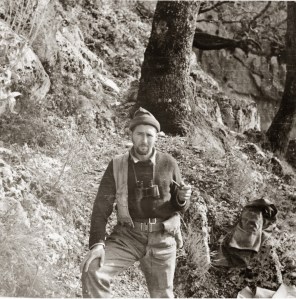 About the Author
Anthony Quayle (1913 – 1989) was best known as a British actor and theatre director, receiving both Academy Award and Golden Globe nominations and featuring in a number of successful films such as Lawrence of Arabia and Ice Cold in Alex. During the Second World War, Quayle served in the Royal Artillery, and later joined the Special Operations Executive (SOE), whence he was deployed behind enemy lines in Albania.
About The Imperial War Museum Wartime Classics series
Originally published to considerable acclaim, these titles were written either during or just after the Second World War and are currently out of print. Each novel is written directly from the author’s own experience and takes the reader right into the heart of the conflict. They all capture the awful absurdity of war and the trauma and chaos of battle as well as some of the fierce loyalties and black humour that can emerge in extraordinary circumstances. Living through a time of great upheaval, as we are today, each wartime story brings the reality of war alive in a vivid and profoundly moving way and is a timely reminder of what the previous generations experienced.
The remarkable IWM Library has an outstanding literary collection and was an integral part of Imperial War Museums from its very beginnings. Alan Jeffreys, (Senior Curator, Second World War, Imperial War Museums) searched the library collection to come up with these four launch titles, all of which deserve a new and wider audience. He has written an introduction to each novel that sets them in context and gives the wider historical background and says, ‘Researching the Wartime Classics has been one of the most enjoyable projects I’ve worked on in my years at IWM. It’s been very exciting rediscovering these fantastic novels and helping to bring them to the wider readership they so deserve’.
Each story speaks strongly to the IWM’s remit to tell the stories of those who experienced conflict first hand. They cover diverse fronts and topics: preparations for D-Day and the advance into Normandy; the war in Malaya; London during the Blitz; and SOE operations in occupied Europe. Each author – three men and a woman – all have fascinating back stories. These are Second World War novels about the truth of war written by those who were actually there.
The other three titles in the series are:
From the City, From the Plough by Alexander Baron – A vivid and moving account of preparations for D- Day and the advance into Normandy. Published in the 75th anniversary year of the D-Day landings, this is based on the author’s first-hand experience of D-Day and has been described by Antony Beevor as ‘undoubtedly one of the very greatest British novels of the Second World War.’
Alexander Baron was a widely acclaimed author and screenwriter and his London novels have a wide following. This was his first novel.
Trial by Battle by David Piper – A quietly shattering and searingly authentic depiction of the claustrophobia of jungle warfare in Malaya described by William Boyd as ‘A tremendous rediscovery of a brilliant novel. Extremely well-written, its effects are both sophisticated and visceral. Remarkable’, by VS Naipaul as ‘one of the most absorbing and painful books about jungle warfare that I have read’ and by Frank Kermode as ‘probably the best English novel to come out of the Second World War.’
David Piper was best known as director of the National Portrait Gallery, the Fitzwilliam Museum in Cambridge and the Ashmolean Museum in Oxford. The novel is based on his time serving with the Indian Army in Malaya where he was captured by the Japanese and spent three years as a POW. His son, Tom Piper, was the designer of the hugely successful Blood Swept Lands and Seas of Red installation of ceramic poppies at the Tower of London to commemorate the First World War.
Plenty Under the Counter by Kathleen Hewitt – a murder mystery about opportunism and the black market set against the backdrop of London during the Blitz. Andrew Roberts: ‘With a dead body on the first page and a debonair RAF pilot as the sleuth, this stylish whodunit takes you straight back to Blitzed London and murder most foul. Several plausible suspects, a femme fatale, witty dialogue, memorable scenes and unexpected twists – it boasts everything a great whodunit should have, and more.’
Kathleen Hewitt was a British author and playwright who wrote more than 20 novels in her lifetime. She was part of an artistic set in 1930’s London which included Olga Lehman and the poet Roy Campbell.




 What Cathy Read Next...