
About the Book
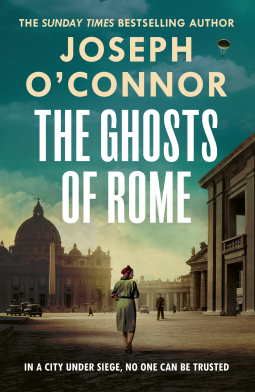
February 1944. Six months since Nazi forces occupied Rome. Inside the beleaguered city, the Contessa Giovanna Landini is a member of the band of Escape Line activists known as ‘The Choir’. Their mission is to smuggle refugees to safety and help Allied soldiers, all under the nose of Gestapo boss Paul Hauptmann.
During a ferocious morning air raid a mysterious parachutist lands in Rome and disappears into the backstreets. Is he an ally or an imposter? His fate will come to put the whole Escape Line at risk.
Meanwhile, Hauptmann’s attention has landed on the Contessa. As his fascination grows, she is pulled into a dangerous game with him – one where the consequences could be lethal.
Format: Hardcover (384 pages) Publisher: Harvill Secker
Publication date: 30th January 2025 Genre: Historical Fiction
Find The Ghosts of Rome on Goodreads
Purchase The Ghosts of Rome from Bookshop.org [Disclosure: If you buy books linked to our site, we may earn a commission from Bookshop.org, whose fees support independent bookshops]
My Review
The Ghosts of Rome is the second book in the author’s Rome Escape Line trilogy. I loved My Father’s House but, if that’s possible, I loved this one even more. As before, the book has a wonderful cast of characters. (Many of them were real people who committed acts of the utmost bravery as part of the actual Choir.)
The author brings each character brilliantly to life, in particular through the invented transcripts of interviews recorded twenty years after the events, allowing us to hear the distinctive voices the author has created for them. For example, the acerbic wit and Irish lilt of diplomat’s wife, Delia Kiernan (my favourite) or the Cockney accent and sardonic asides of John May.
As the book opens, Gestapo chief Paul Hauptmann is under increasing pressure from Berlin to bring an end to the activities of ‘The Choir’ and capture the escaped Allied prisoners hidden in places across Rome and in the Vatican City itself. Not only is his career on the line but the lives of his wife and daughters too, removed for ‘safe keeping’ by Himmler. Increasingly he tries to justify his own actions: the brutal interrogation of prisoners, the meticulous drawing up of death lists for savage reprisals. ‘Important to push away weakness. Too far along the road. Sometimes a man of peace must perform terrible duties, he tells himself. I had to do what I did, there was no other choice.’ And he has become obsessed with one particular member of the Choir, Contessa Giovanna Landini (known as Jo to her comrades).
Having taken possession of her palazzo, he wanders its corridors admiring her furniture, selecting paintings he thinks Hitler might appreciate, examining her extensive wardrobe and choosing gowns to send to his wife Elise in a vain attempt to win back her favour. (He’s almost certain she’s being unfaithful.) He raids the Contessa’s wine cellar, listens to her records, examines her books and takes midnight strolls in her garden. ‘She feels close to him here – every garden is a portrait of its owner.’ Most creepily of all, he takes to sleeping in her bed.
For The Choir, operating the escape line has become a cat and mouse game but one in which there are thousands of Nazi cats for every mouse. No mercy is shown to those who harbour escapees, there are tempting rewards for those prepared to inform and harsh reprisals on the population of Rome for German soldiers killed in acts of resistance. Add to this Allied bombing raids, food and fuel shortages, and Rome has become a very uncomfortable place in which to live.
The Choir’s missions outside the Vatican have become increasingly dangerous and the burden of responsibility for so many lives is huge. There are escapees hidden in every nook and cranny of Rome: abandoned buildings, crawl spaces, cellars, tunnels, even catacombs. It weighs on all the members of The Choir, but particularly on Monsignor Hugh O’Flaherty whom the others look to for guidance. He is physically and mentally exhausted, and finding less and less solace in prayer. ‘Pallid, puff-eyed, watchful, uncombed, he has started to acquire the aura of a man who lives in shadow.’ No wonder, with a bounty on his head. As he confides to Jo, ‘I’m lately on a mission into a shadowy old dungeon – my head – to rescue a beaten-down prisoner – my soul.’
Like My Father’s House, the book combines thrilling action scenes that are full of tension with wonderful writing. There’s also an intriguing sub-plot involving an injured airman that explores the sort of moral dilemmas members of The Choir face. Is saving the life of one man worth endangering the lives of others, including your comrades? Can you live with yourself if you turn away and do nothing?
By the end of the book we know, sadly, there are characters we won’t meet again. But the work must go on because the Nazis are not yet defeated and a savage beast is often most dangerous when cornered.
I found The Ghosts of Rome an utterly compelling historical thriller, full of tension and authentic detail. Although I shall be sorry for the series to end, at the same time I cannot wait for the final book.
In three words: Gripping, suspenseful, immersive
About the Author

Joseph O’Connor’s fiction has been published in forty languages. His twenty books include eleven novels, among them the million-selling Star of the Sea, Ghost Light, Shadowplay and My Father’s House, a Washington Post Book of the Year. His work has been shortlisted for the LA Times Book Award, twice for the Whitbread/Costa and twice for the Walter Scott Prize for Historical Fiction and has won the Nielsen Bookscan Golden Book Award, France’s Millepages, Italy’s Premio Acerbi and Premio Napoli, an American Library Association Award, the American Ireland Fund Literary Award, the Hennessey Writer of the Year and Hall of Fame Awards, the Eason/An Post Novel of the Year Award, a Cullman Fellowship at the New York Public Library, the Irish PEN Award for Outstanding Achievement and the Prix Madeline Zepter for European Novel of the Year. He is Frank McCourt Chair of Creative Writing at the University of Limerick.
Connect with Joseph
Website




 What Cathy Read Next...