#BookReview The Consequences of Fear (Maisie Dobbs #16) by Jacqueline Winspear @AllisonandBusby

The Consequences of Fear Blog Tour Twitter Graphic

I’m delighted to welcome you to the first stop on the blog tour for The Consequences of Fear by Jacqueline Winspear. My thanks to Christina at Allison & Busby for inviting me to take part in the tour and for my digital review copy via NetGalley.


The Consequences of FearAbout the Book

London, September 1941. Freddie Hackett, a message runner for a government office, witnesses an argument that ends in murder. Hiding in the doorway of a bombed-out house, Freddie waits until the coast is clear. But when he arrives at his next delivery address, he’s shocked to come face-to-face with the killer.

Dismissed by the police when reporting the crime, Freddie turns to private investigator Maisie Dobbs. While Maisie believes the boy and wants to help, she must exercise caution given her work with the French resistance. When she spots the killer in a place she least expects, she soon realises she’s been pulled into the orbit of a man who has his own reasons to kill – reasons that go back to the last war.

Format: Hardcover (352 pages)       Publisher: Allison & Busby
Publication date: 23rd March 2021 Genre: Historical Fiction, Mystery, Crime

Find The Consequences of Fear (Maisie Dobbs #16) on Goodreads

Purchase links
Bookshop.org
Disclosure: If you buy a book via the above link, I may earn a commission from Bookshop.org, whose fees support independent bookshops

Hive | Amazon UK
Links provided for convenience only, not as part of an affiliate programme


My Review

I was a late arrival at the party when it comes to Jacqueline Winspear’s hugely popular series, my first introduction being The American Agent, the fifteenth outing for the intrepid and resourceful Maisie Dobbs. Ardent fans of the series will have been eagerly anticipating Maisie’s next adventure but even if – like me – you’re a recent convert, or indeed if The Consequences of Fear will be your first foray into Maisie’s world, I guarantee you’ll quickly be drawn into the story.

Although there are brief references to Maisie’s previous cases and it may take a bit of time to sort out the various members of her extended family, The Consequences of Fear can definitely be enjoyed by readers new to the series. Those familiar with her previous adventures will be pleased to see the return of characters such as Billy Beale, Maisie’s assistant in her private investigation business, intelligence chief Robert MacFarlane and Anna, her adopted daughter. Not forgetting, of course, Maisie’s ‘gentleman friend’, Mark Scott.

As well as the ever reliable Billy, Maisie has a number of resources to call upon to help with her investigation, including her friends Priscilla and Gabriella. As Maisie observes, ‘She had her worker bees, valuable contacts who would seek whatever information she needed, buzzing around their gardens of endeavour until they found the pockets of intelligence she had requested.’ Unfortunately, being one of Maisie’s ‘worker bees’ can sometimes be a risky business. And when all else fails, Maisie can call on her memories of the wise advice of her former mentor, Maurice Blanche.

The book’s title is cleverly explored in various ways. For example, as one character remarks early on in the book, “where secrets reside, so does fear – it’s the unknown.” It transpires there are indeed secrets to be revealed some of which go longer back in time than anyone might imagine. Whilst fear can be ‘the scariest of emotions…a seed in the fertile seed of doubt’, it can also bring much-needed alertness. ‘Fear had to be handled with care, managed so it became a tool, not a weight.’

Increasingly, Maisie feels the tension between the important but secret work she undertakes alongside the cases that come to her private investigation business, and her new caring responsibilities. It doesn’t help that her secret work involves potentially life or death decisions about others, or that Mark Scott’s equally confidential work takes him away frequently. Naturally, like the rest of the population, she’s also concerned about her family’s safety –  the threat of further bombing raids and the possibility of invasion. ‘She realised that she had never trusted the world to keep herself or those she loved safe.’ It all leads at one point to Maisie concluding, “I think I’ve had enough”.

By the end of the book, I think even new readers will have come to the conclusion that Maisie doesn’t easily give in to fear when it comes to pursuing her investigations. But what about fear of commitment in her personal relationships? Should Maisie heed the advice that ‘Love is always worth the leap’? (I know my answer in Maisie’s case!)

The backdrop of wartime of London is vividly evoked: checking the blackout curtains as darkness falls, listening to the rumble of bombers overhead, navigating streets of bombed out houses, seeing young boys like Freddie Hackett running through the dark streets carrying messages between Air Raid Precautions depots.

The book’s conclusion sees scenes of both sorrow and joy, and – tantalizingly – a world on the brink of a new phase of the war.  As a now committed Maisie fan, I say roll on the next book!

In three words: Gripping, intriguing, atmospheric

Try something similar: The Mathematical Bridge by Jim Kelly

Follow this blog via Bloglovin
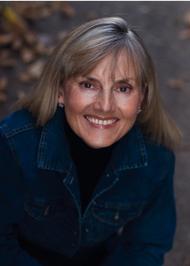

Jacqueline WinspearAbout the Author

Jacqueline Winspear was born and raised in Kent and emigrated to the USA in 1990. She has written extensively for journals, newspapers and magazines, and has worked in book publishing on both sides of the Atlantic. Her acclaimed Maisie Dobbs crime series, set in the aftermath of WWI, is beloved by readers worldwide.  (Photo/bio credit: Publisher author page)

Connect with Jacqueline
Website | Facebook | Goodreads

#BookReview Where Stands A Wingèd Sentry by Margaret Kennedy @KateHandheld

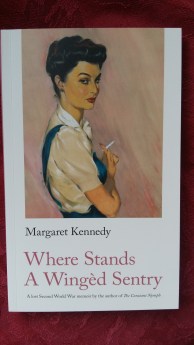
When Stands A Winged SentryAbout the Book

‘Most people knew in their hearts that the lid had been taken off hell, and that what had been done in Guernica would one day be done in London, Paris and Berlin.’

Margaret Kennedy’s prophetic words, written about the pre-war mood in Europe, give the tone of this riveting 1941 wartime memoir: it is Mrs Miniver with the gloves off. Her account, taken from her war diaries, conveys the tension, frustration and bewilderment of the progression of the war, and the terror of knowing that the worst is to come, but not yet knowing what the worst will be.

English bravery, confusion, stubbornness and dark humour provide the positive, more hopeful side of Kennedy’s experiences, in which she and her children move from Surrey to Cornwall, to sit out the war amidst a quietly efficient Home Guard and the most scandalous rumours.

Find Where Stands A Wingèd Sentry on Goodreads

Format: Paperback (280 pages)        Publisher: Handheld Press
Publication date: 23rd March 2021  Genre: Memoir, NonFiction

Purchase links
Publisher | Hive
Links provided for convenience only, not as part of an affiliate programme


My Review

In her introduction to the book, Faye Hammill, Professor of English at the University of Glasgow, describes Where Stands A Wingèd Sentry as an extraordinary record of the terrifying months from May to September 1940 when fears of invasion were rife. Originally published in the US in 1941 by Yale University Press, it has never until now been published in the UK.

Where Stands A Wingèd Sentry is Margaret Kennedy’s own day by day account of what she herself describes as her  ‘inner battle’, involving everything from resolving everyday domestic challenges to difficult decisions about the safety of her family.   Although written with one eye on posterity, Margaret’s journal also seems to have been a sounding board for her concerns and worries.  Frequently she lists the pro’s and con’s of things such as asking the doctor for sedatives to help her sleep, or the morality of taking advantage of evacuating her children to Canada.   In fact, when she does later go to the doctor about her sleep problems, his advice to her is to stop reading the newspapers but if she has to then only to read The Times, and that listening to the wireless four times a day as she does is ‘three times too often’. I think those of us living through the current pandemic can have some sympathy with that, although at least Margaret didn’t have to cope with 24-hour news and social media.

There are welcome moments of humour, many of them provided by the redoubtable Nanny Ross whose habit of mispronouncing words frequently creates confusion. For example, ‘Nanny says that an Abbess is threatening to swallow the whole of Europe’. I chuckled too at the author’s observation about Cotter, the gardener who presides over their garden with ruthless efficiency, ‘It’s my belief that he was born giving instructions to the midwife’.  And Margaret is less than impressed with some of the invasion precautions they are encouraged to take such as, if leaving a car unattended, not just taking out the ignition key but, in her words pretty well disembowelling it, because ‘the Germans know all about hairpins’.

One of the many things I loved about the book is the persistent sense of defiance and fortitude. I found this remarkable given the author did not know at the time whether the war would end in victory or defeat. For example, at one point she writes: ‘But every month, every week, day, hour and minute that we manage to hold on brings it [Hitler’s downfall] that much nearer.  Every day will show the world more clearly what Nazism really is, and open the eyes of those still blind, and convince people that any sacrifice is better than submission’.

There is a message of hope for the future as well. Writing in August 1940 in a chapter titled ‘Owed By So Many To So Few’, the author’s fervent wish is: ‘By the grace of God we may emerge from this ordeal a more admirable society than we were when we went in’. But she’s also clear-eyed about the perilous situation the country faces. ‘We are not giving in. We are just going on fighting… Nobody can let us down any more, because we are fighting alone… Hitler may win; I suppose the odds are still heavily on his side. But, please God, we’ll give him such a pounding before he does that he’ll never be the same man after it’. Positively Churchillian, isn’t it? And at the start of the Blitz, despite the fact her husband is working in London, Kennedy observes, ‘Hitler made a mistake when he bombed Buck House [Buckingham Palace] …Buck House and Limehouse are the two places where he won’t find quitters’.

The book contains some wonderful descriptive writing. I was particularly taken with a scene in which Margaret walks to the top of nearby Holmbury Hill. ‘You look south there for miles and miles across Surrey and Sussex, over a patchwork of little fields and smudges of woods and the red roofs of farmhouses. On the horizon is the blue line of the South Downs, and a little knob of one of them which is the clump of huge beeches called Chanctonbury Ring. And beyond them is the sea. And beyond that France. And there, under the same cloudless sky, all this hell of suffering and terror is going on at this very moment. Farms are blazing. Homeless wretches stray along the road. Mothers howl for dead babies, and children for dead mothers. And our men are dying in this sunshine upon a soil they could not defend.’  

In her foreword to the book, dated May 1941, the author writes, ‘All my life I have had a great curiosity to know what it felt like to live through history… Lately, I have lived through history myself – quite a bit of history‘.  Reading the book, I felt I had joined Margaret on that journey.  As she observes, ‘we have certainly taken life to pieces and found out what it is made of‘.  Where Margaret is concerned, I think we can safely say it was made of strong stuff.

For anyone interested in women’s writing or the experiences of those on the ‘Home Front’ during the Second World War, Where Stands A Wingèd Sentry is a gem waiting to be discovered amongst the growing list of titles published by Handheld Press. Look out for my review of another of their titles, There’s No Story There: Wartime Writing, 1944 – 1945 by Inez Holden, also published today.

In three words: Powerful, honest, inspiring

Try something similar: Blitz Writing: Night Shift & It Was Different At The Time by Inez Holden

Follow this blog via Bloglovin


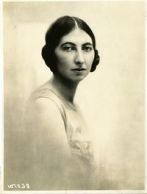
Margaret KennedyAbout the Author

Margaret Kennedy (1896 – 1967) was an English novelist and playwright. Born in April 1896, she attended Cheltenham Ladies’ College, where she began writing, and then went up to Somerville College, Oxford in 1915 to read history. Her first publication was a history book, A Century of Revolution (1922) but her most famous book is the novel, The Constant Nymph, published in 1924.  Margaret Kennedy was married to the barrister David Davies. They had a son and two daughters, one of whom was the novelist Julia Birley. (Photo/bio credit: Goodreads author page)