
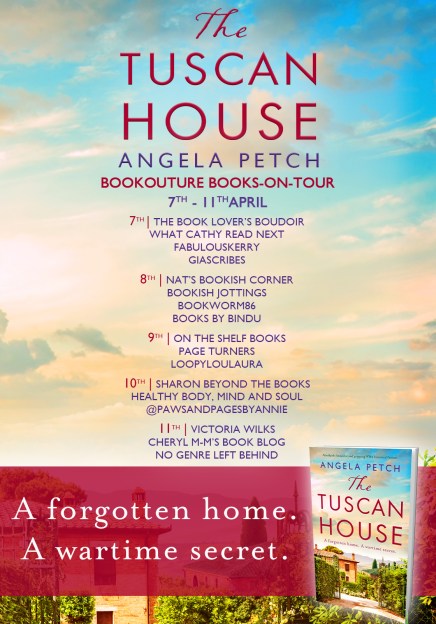
#BookReview The Tuscan House by Angela Petch @bookouture

Blog Tour - The Tuscan House

I’m delighted to welcome you to the opening day of the blog tour for The Tuscan House by Angela Petch. My thanks to Sarah at Bookouture for inviting me to take part in the tour and for my digital review copy via NetGalley.
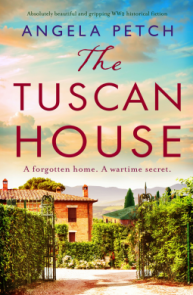

The Tuscan HouseAbout the Book

Corbello, Italy, 1947. A woman and a little boy stagger into the ruins of an old house deep in the forest, wild roses overwhelming the crumbling terracotta walls. Since the war, nowhere has been safe. But they both freeze in shock when a voice calls out from the shadows…

For young mother Fosca Sentino, accepting refuge from ex-British soldier Richard – in Tuscany to escape his tragic past – is the only way to keep her little family safe. She once risked everything to spy on Nazi commanders and pass secret information to the resistenza. But after a heartbreaking betrayal, Fosca’s best friend Simonetta disappeared without trace. The whole community was torn apart, and now Fosca and her son are outcasts.

Wary of this handsome stranger at first, Fosca slowly starts to feel safe as she watches him play with her son in the overgrown orchard. But her fragile peace is shattered the moment a silver brooch is found in the garden, and she recognises it as Simonetta’s…

Fosca has always suspected that another member of the resistenza betrayed her. With Richard by her side, she must find out if Simonetta is still alive, and clear her own name. But how did the brooch end up at the house? And with a traitor hiding in the village, willing to do anything to keep this secret buried, has Fosca put herself and her young son in terrible danger?

Format: Paperback (384 pages ) Publisher: Bookouture
Publication date: 31st March 2021 Genre: Historical Fiction

Find The Tuscan House on Goodreads

Purchase links
Hive | Amazon UK
Links provided for convenience only, not as part of an affiliate programme


My Review

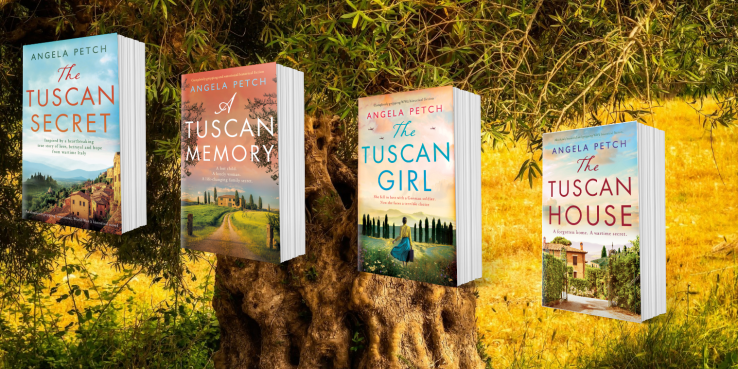
Although a standalone novel rather than part of a series, The Tuscan House is the fourth book by Angela Petch to be set in her beloved Tuscany. The author’s love of Italy and its culture is clear to see, not least in the delicious descriptions of its landscape: ‘cypress-lined avenues meandering up to hilltop villages perched on ridiculously steep rises, churches and little chapels holding ancient treasures, simple shrines by the side of the road.’ And talking of delicious, surely only in Italy could a meal such this be served by monks in a monastery: ‘A first course of home-made tagliolini pasta, with a source made from slivers of truffle sourced from the woods was followed by tripe… tender, succulent slices flavoured with tomatoes, olive oil and herbs’.

Alternating between 1947 and the final years of the war, the story is told from the perspective of three characters – Richard, Fosca and Simonetta.

Haunted by memories of what he witnessed during the war serving as a non-combatant in the Friends Ambulance Unit, Richard’s return to Corbello represents the opportunity for a new start, a way of wiping the slate clean and leaving behind the grey skies of England. I liked the way his project to renovate an old tobacco factory acted as a metaphor for his own physical and mental recovery. That recovery is echoed in the return to life in the surrounding landscape, with poppies blooming where there were once trenches and fields cleared of mines returning to cultivation.  However, the impact of the war still remains, not just in the damaged buildings but in the fractured minds of people, the rifts that persist between families, the recriminations for actions taken, and the witch-hunts against those suspected of collaborating with the enemy.

The parts of the book told from the perspectives of Fosca and Simonetta powerfully depict the horrific realities of war, such as the harsh winters when food and fuel was in short supply, and the village was cut off from the outside world by deep snow on the perilous mountain roads.  The dangers of working for the resistenza, or even assisting its members by offering shelter or gathering information, become all too apparent and will have lasting repercussions, especially when not everyone can be trusted.  Fosca’s and Richard’s search for answers to the mystery of Simonetta’s disappearance is sure to keep readers glued to the book until the very last page.

The Tuscan House is a skilfully crafted story demonstrating that not only does courage come in many forms but so does love.

In three words: Emotional, immersive, dramatic

Try something similar: The Secret by Katharine Johnson

Follow this blog via Bloglovin
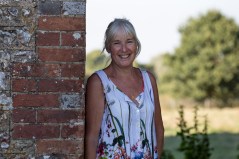

Angela PetchAbout the Author

Angela writes: “I’m an award winning writer of fiction – and the occasional poem. Every summer I move to Tuscany for six months where my husband and I own a renovated watermill which we let out. When not exploring our unspoilt corner of the Apennines, I disappear to my writing desk at the top of our converted stable. In my Italian handbag or hiking rucksack I always make sure to store notebook and pen to jot down ideas. The winter months are spent in Sussex where most of our family live. When I’m not helping out with grandchildren, I catch up with writer friends.

Connect with Angela
Blog | Twitter | Facebook
The Tuscan House

#BookReview The Rose Code by Kate Quinn @fictionpubteam @RandomTTours

The Rose Code Graphic 1

Welcome to today’s stop on the blog tour for The Rose Code by Kate Quinn. My thanks to Anne at Random Things Tours for inviting me to participate in the tour and to Harper Collins for my digital review copy via NetGalley.


The Rose CodeAbout the Book

1940. Three very different women answer the call to mysterious country estate Bletchley Park, where the best minds in Britain train to break German military codes. Vivacious debutante Osla is the girl who has everything – beauty, wealth, and the dashing Prince Philip of Greece sending her roses – but she burns to prove herself as more than a society girl, and puts her fluent German to use as a translator of decoded enemy secrets. Imperious self-made Mab, product of East End London poverty, works the legendary code-breaking machines as she conceals old wounds and looks for a socially advantageous husband. Awkward local girl Beth, whose shyness conceals a brilliant facility with puzzles beneath her shy exterior.

1947. As the royal wedding of Princess Elizabeth and Prince Philip whips post-war Britain into a fever, three friends-turned-enemies are reunited by a mysterious encrypted letter – the key to which lies buried in the long-ago betrayal that destroyed their friendship and left one of them confined to an asylum. A mysterious traitor has emerged from the shadows of their Bletchley Park past, and now Osla, Mab, and Beth must resurrect their old alliance and crack one last code together…

As the nation prepares for the royal wedding they must race against the clock to save one of their own.

Format: Hardcover (656 pages)       Publisher: Harper Collins
Publication date: 18th March 2021 Genre: Historical Fiction

Find The Rose Code on Goodreads

Purchase links
Bookshop.org
Disclosure: If you buy a book via the above link, I may earn a commission from Bookshop.org, whose fees support independent bookshops

Hive | Amazon UK
Links provided for convenience only, not as part of an affiliate programme


My Review

The book opens in 1947 on the eve of of the royal wedding between Princess Elizabeth and Prince Philip. It coincides with the arrival of a coded plea for help from the inmate of an asylum to two former friends. It’s a while before the identity of the inmate is confirmed, although readers may have reached their own conclusions some time before that. What takes longer to discover is the cause of the rift between the three friends and the reason for the confinement of one of them.

At over 600 pages, The Rose Code is a chunky read but I was quickly drawn into the stories of Osla, Mab and Beth. Reflecting their different backgrounds and life experiences, the author creates a distinctive character for each of them. Whilst Osla may have attended glittering high society parties and been romanced by Prince Philip (yes, that Prince Philip), she’s surprisingly unworldly in other respects. Conversely, Mab has experienced life’s darker side. I found Beth the most intriguing character because of her very different way of looking at the world, seeing patterns where others do not, making it easy to appreciate why her potential for code-breaking work might have been spotted. And I sure I’m not the only reader to give a little cheer when Beth eventually ‘pokers up’ (as Osla would say) to her mother, the tyrannical Mrs. Finch.

I particularly enjoyed the parts of the book set at Bletchley Park and found myself enthralled by the details about the secret code-breaking work carried out there, how it was organised, and the various machines and decryption methods used. The highly confidential nature of the work carried out at Bletchley Park required the utmost level of secrecy with those involved unable to discuss their work with anyone outside their own section, let alone family or friends. As we now know, many of those who worked at Bletchley Park in real life never talked about their work, taking their secrets with them to the grave.

The author does a great job of conveying both the insular atmosphere this demand for secrecy created and the psychological toll imposed on those involved in the work, aware their success or failure could mean the difference between life and death, even the outcome of the war itself. I can only imagine the pressure of possessing information about the progress of the war – good or bad – and being unable to share any inkling of that knowledge with anyone else. But, on the other hand, the thrill of achievement whenever a breakthrough is made.

Perhaps it’s no wonder those employed at Bletchley Park seek any opportunity for amusement whether that’s a game of rounders on the lawn or membership of the various societies that exist, such as the book club set up by Osla and Mab – christened The Mad Hatter’s Tea Party.  In the author’s imagination, Bletchley Park even has its own scandal sheet, Bletchley Bletherings, occasional excerpts from which are scattered throughout the book. (Unfortunately, the formatting of my digital copy of the book was not kind to these.)

There are walk-on parts for several well-known historical figures who either worked at or visited Bletchley Park, such as Alan Turing and Winston Churchill. (At the online book launch, Kate revealed there was nearly an appearance by James Bond author, Ian Fleming, another real life visitor to Bletchley Park. Sadly, this had to be left on the literary equivalent of the cutting room floor.) I wasn’t familiar with Dilly Knox before reading the book but came to appreciate what a vital role he played in the breakthroughs in code-breaking.

In the second half of the book, the focus is more on the personal lives of the three women; like many others who lived through this time, it involves both love, loss and a need to apportion blame or assuage personal feelings of guilt. As the book reaches its gripping climax, there’s one last reunion of The Mad Hatter’s Tea Party in an effort to bring to justice the traitor who, unsuspected, lived and worked beside them at Bletchley Park.

Although the mystery of the identity of the traitor was absorbing, the most compelling element of The Rose Code for me was the fascinating insight it provided into the work undertaken at Bletchley Park during the Second World War. Thanks to the author’s evocative descriptions it didn’t take too much imagination for me to picture myself there alongside Beth, Mab and Osla working around the clock at their deciphering work or snatching the odd break. ‘It was two-thirty in the morning, middle of the night shift, and the converted dining room smelled of Brylcreem, stale fat and kidneys on toast.’

Although the three women in the book are fictional, I felt the story served to shine a spotlight on the important role their real life counterparts played in code-breaking but whose contribution up until now has perhaps been overshadowed by their more celebrated male colleagues.

In three words: Compelling, authentic, intriguing

Try something similar: The Cypher Bureau by Eilidh McGinness

Follow this blog via Bloglovin


Kate Quinn Author PicAbout the Author

Kate Quinn is a native of southern California. She attended Boston University, where she earned a Bachelor’s and Master’s degree in Classical Voice. A lifelong history buff, she has written four novels in the Empress of Rome saga, and two books in the Italian Renaissance detailing the early years of the infamous Borgia clan. All have been translated into multiple languages. She and her husband now live in Maryland with two black dogs names Caesar and Calpurnia.

Website | Twitter | Facebook | Instagram

The Rose Code BT Poster