#BookReview Yours Cheerfully by A J Pearce @PanMacPublicity

Yours CheerfullyAbout the Book

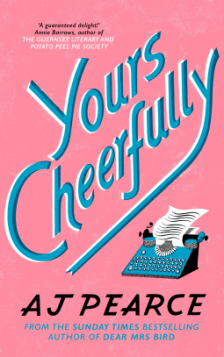
London, November 1941. Following the departure of the formidable Henrietta Bird from Woman’s Friend magazine, things are looking up for Emmeline Lake as she takes on the challenge of becoming a young wartime advice columnist. Her relationship with boyfriend Charles (now stationed back in the UK) is blossoming, while Emmy’s best friend Bunty, still reeling from the very worst of the Blitz, is bravely looking to the future. Together, the friends are determined to Make a Go of It.

When the Ministry of Information calls on Britain’s women’s magazines to help recruit desperately needed female workers to the war effort, Emmy is thrilled to be asked to step up and help. But when she and Bunty meet a young woman who shows them the very real challenges that women war workers face, Emmy must tackle a life-changing dilemma between doing her duty and standing by her friends.

Format: Hardcover (352 pages)    Publisher: Picador
Publication date: 24th June 2021 Genre: Historical Fiction

Find Yours Cheerfully on Goodreads

Purchase links
Bookshop.org
Disclosure: If you buy a book via the above link, I may earn a commission from Bookshop.org, whose fees support independent bookshops

Hive | Amazon UK
Links provided for convenience only, not as part of an affiliate programme


My Review

I loved Dear Mrs Bird, the book that first introduced readers to Emmeline Lake and also to the inimitable Henrietta Bird. Henrietta has departed to pastures new and Emmeline, known to most as Emmy, is getting used to her new role with greater responsibility for answering letters sent to Woman’s Friend magazine by readers seeking advice on their problems. Not only has the ‘Henrietta Helps’ column become ‘Yours, Cheerfully’ but it’s become much less judgmental as well.

I loved sitting in on the Woman’s Friend editorial meetings, chaired by the magazine’s new editor, Mr Collins, and listening to the contributions of the people who make up the team. For example, Mr Newton’s report that Hartley’s Jams are taking out a series of advertisements telling people there wasn’t any, or Mr Collins’ mention of rumours he’d heard about ‘something big coming up for blancmange’.

The war is an ever present backdrop to events especially once Woman’s Friend is invited by the Ministry of Information to join the campaign to increase the number of women volunteering for war work such as working in munitions factories. As Mr Collins says, “Let’s show the Ministry what our readers can do, and let’s look after our readers while they’re doing it!”

As Emmy gets to know more about the realities of working in a munitions factory, thanks to a chance encounter on a train, she realises the lack of appreciation for the unique challenges women face, such as balancing child-minding, shift work and long hours. She’s aggrieved as well when she finds out the women are paid less than men for doing similar work. When factory management prove uninterested in the women’s difficulties, Emmy embarks on a new campaign that results in some difficult choices and not a little subterfuge.

Although Emmy often underestimates her abilities, luckily her friend Bunty is there to buoy her up. Can I just say at this point that if everyone had a friend like Bunty then the world would be a better place and, that if Bunty was in charge of things, it would probably be a much better organized place as well.

Aside from women’s contribution to the war effort, much of the book focuses on Emmy’s personal life and her relationship with Captain Charles Mayhew, who just happens to be Mr Collins’ half-brother. Like many other women with husbands, sons or boyfriends on active service, she faces the challenge of carrying on whilst all the time dreading the arrival of that telegram reporting him missing or worse. Since plenty of ups and downs lie ahead for Emmy and others, I can’t do better than quote Bunty’s words of wisdom, “I always think that keeping your chin up isn’t that hard. You just need to lift your face. It’s your heart that takes the effort. When it falls over it can be so stubborn about getting back up.”

If Yours Cheerfully isn’t the book for the times we’re living through, I don’t know what is. I thought it was utterly delightful and I certainly finished it with a smile on my face, having shed a few tears along the way.

In three words: Engaging, heart-warming, spirited

Try something similar: There’s No Story There by Inez Holden or A Ration Book Wedding by Jean Fullerton

Follow this blog via Bloglovin


AJ PearceAbout the Author

A J Pearce grew up in Hampshire, England. Her debut novel, Dear Mrs Bird, was a Sunday Times and international bestseller and was shortlisted for the British Book Awards Debut of the Year and the Historical Writers’ Association Debut Crown for best historical debut. Yours Cheerfully is the second novel in The Emmy Lake Chronicles. (Photo/bio credit: Publisher author page)

Connect with A J Pearce
Website | Facebook | Twitter

#BookReview Sword of Bone by Anthony Rhodes @RandomTTours @I_W_M

Sword of Bone BT Poster

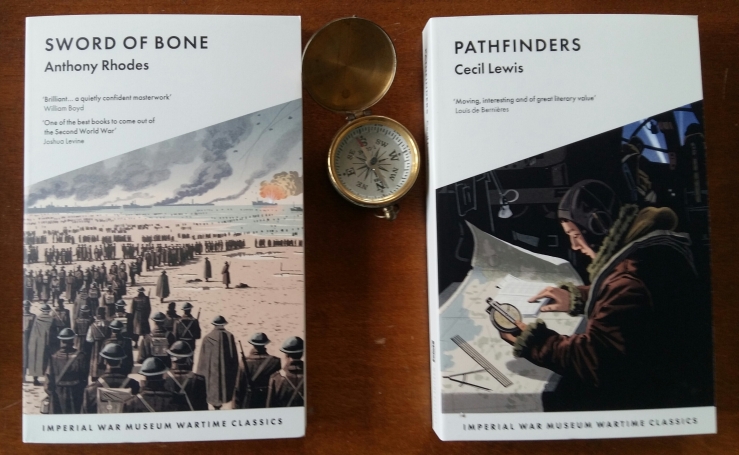
Welcome to today’s stop on the blog tour for Sword of Bone by Anthony Rhodes, one of the latest additions to the Imperial War Museum’s fabulous Wartime Classics series of rediscovered wartime classics. My thanks to Anne at Random Things Tours for finding me a place on the tour and to the Imperial War Museum for my advance review copy.


Sword of Bone CoverAbout the Book

It is September 1939. Shortly after war is declared, Anthony Rhodes is sent to France, serving with the British Army. His days are filled with the minutiae and mundanities of army life – friendships, billeting, administration – as the months of the “Phoney War” quickly pass and the conflict seems a distant prospect.

It is only in the spring of 1940 that the true situation becomes clear; the men are ordered to retreat to the coast and the beaches of Dunkirk, where they face a desperate and terrifying wait for evacuation.

Format: Paperback (236 pages)                 Publisher: Imperial War Museum
Publication date: 20th May 2021 [1942]   Genre: Fiction, WW2

Find Sword of Bone on Goodreads

Purchase links
Bookshop.org
Disclosure: If you buy a book via the above link, I may earn a commission from Bookshop.org, whose fees support independent bookshops

Publisher | Hive | Amazon UK
Links provided for convenience only, not as part of an affiliate programme


My Review

First published in 1942, Sword of Bone is based on the author’s own wartime experiences including the evacuation of Dunkirk which took place between 27th May and 4th June 1940. The evacuation has come to be regarded as a seminal moment in the Second World War; indeed, it is often described as ‘the miracle of Dunkirk’, arguably something of a misnomer since, although hundreds of thousands of men were rescued, thousands more were left behind along with tons of equipment.

As usual, the introduction by Imperial War Museum historian, Alan Jeffreys, provides fascinating background information about the author, the book and its historical context. Describing Sword of Bone as a ‘lightly fictionalised memoir’, he argues the book is very much in the tradition of the war novels published in the 1920s dealing with the First World War, such as Siegfried Sassoon’s Memoirs of an Infrantry Officer.

The first part of the book covers Rhodes’s time in charge of an advance party sent to France with the task of finding quarters and sourcing equipment for the main division of the Royal Engineers which is to follow. Describing his role as ‘buyer, distributor, and journeyman’, he is fortunate to be assigned Georges de Treil as his French liaison officer.  Amongst his many attributes is Georges’s seeming acquaintance with the maître d’hôtel of every restaurant in the area.  As well as enticing Rhodes into some risky escapades, he introduces him to French customs such as the correct way to enjoy cheese and wine.

On 10th May 1940, the ‘Phoney War’ comes to an end as Rhodes learns of the invasion of Belgium and Holland, and the bombing of Arras. Reminding me a little of what has been revealed recently about the UK’s handling of the Coronavirus pandemic, Rhodes is amazed to discover that no plans exist for destroying the bridges across the strategically important River Dyle.  Shortly afterwards he has his first experience of an early morning air raid which leaves him lying naked on the floor of his billet ‘covered in dust and shaving soap’.  From that point on, the reality of war is vividly evoked, including the ‘double speak’ which sees the retreat of British forces described in news reports as ‘a strategic withdrawal according to plan’.

The book really comes alive in the final chapters which describe the chaos and confusion of the evacuation of the British Expeditionary Force from the beaches of Dunkirk, by which time ‘the Boche are everywhere’. To experience it in visual form, I recommend the film Dunkirk. The 1958 version would be my preference but then I’m a sucker for war films of the 1940s and 1950s. As it happens, given we’re close to the anniversary of the evacuation, the film was shown yesterday (30th May 2021) on BBC2 and is available via the BBC iPlayer for a limited time. There is also a touching moment in the 1942 film In Which We Serve starring Noel Coward (who also wrote the screenplay) when the crew of the fictional H.M.S. Torrin, having taken part in the evacuation, watch the soldiers they have rescued and returned safely to England leave the ship.

Having been picked up by a trawler, Rhodes arrives back in Dover; the line ‘In this way it ended’ from the final chapter perfectly summing up the reportage style of this fascinating book.

In three words: Authentic, detailed, fascinating

Try something similar: The Miracle of Dunkirk by Walter Lord

Follow this blog via Bloglovin


About the Author

Anthony Rhodes (1916–2004) served with the British Army in France during the so-called ‘Phoney War’ and was evacuated from Dunkirk in May 1940 – he based Sword of Bone on these experiences. After the conflict, Rhodes enjoyed a long academic and literary career and wrote on various subjects, including covering the 1956 Hungarian Revolution for the Daily Telegraph and producing well-regarded histories of the Vatican. He died in 2004.

Pathfinders Sword of Bone