#BookReview Kyiv by Graham Hurley @HoZ_Books

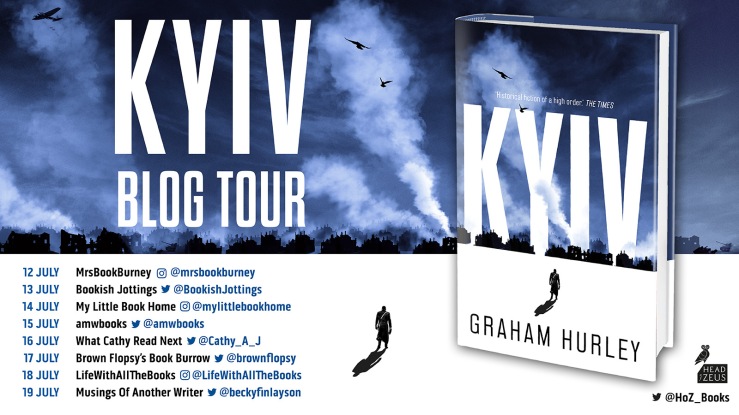
KYIV blog tour banner_V1

Welcome to today’s stop on the blog tour for Kyiv by Graham Hurley, his latest WW2 thriller set against the backdrop of Operation Barbarossa, the German code name for the invasion of Russia. My thanks to Lauren at Head of Zeus for inviting me to take part in the tour and for my digital review copy via NetGalley.
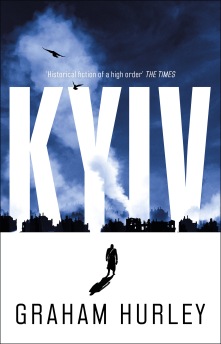

Hurley_KYIV_HBAbout the Book

On Sunday 22nd June 1941 at 03.05, three-and-a-half million Axis troops burst into the Soviet Union along a 1,800-mile front to launch Operation Barbarossa. The southern thrust of the attack was aimed at the Caucuses and the oil fields beyond. Kyiv was the biggest city to stand in their way.

Within six weeks, the city was under siege. Surrounded by Panzers, bombed and shelled day and night, Soviet Commissar Nikita Krushchev was amongst the senior Soviet officials co-ordinating the defence. Amid his cadre of trusted personnel is British defector Bella Menzies, once with MI5, now with the NKVD, the Soviet secret police.

With the fall of the city inevitable, the Soviets plan a bloody war of terror that will extort a higher toll on the city’s inhabitants than the invaders. As the noose tightens, Bella finds herself trapped, hunted by both the Russians and the Germans.

As the local saying has it: life is dangerous – no one survives it.

Format: Hardcover (416 pages) Publisher: Head of Zeus
Publication date: 8th July 2021 Genre: Historical Fiction, Thriller

Find Kyiv on Goodreads

Purchase links
Bookshop.org
Disclosure: If you buy a book via the above link, I may earn a commission from Bookshop.org, whose fees support independent bookshops

Hive | Amazon UK
Links provided for convenience only, not as part of an affiliate programme


My Review

I really enjoyed Last Flight to Stalingrad, the first book in Graham Hurley’s Spoils of War series. Although part of the same series, Kyiv can definitely be read as a standalone.

The setting is the city we today know as Kiev, the capital of Ukraine, and once again the author blends historical fact and fiction into the storyline. For example, Kim Philby, who it’s clear knows how to bowl a googly, makes an early appearance and Guy Burgess turns up soon afterwards. However, the two main characters, Isobel (Bella) Menzies and Tam Moncrieff are fictional.

In alternating chapters, the book charts events over the course of several weeks starting in September 1941. We follow Bella as she travels to Kiev alongside Ilya Glivenko (known as The Pianist) who is overseeing the transport of a mysterious cargo to that city from Britain. And we witness the attempts by Bella’s lover, intelligence officer Tam, to unearth more information about Bella. In the process, he uncovers evidence, in true John le Carré style, about possible moles at the heart of the British intelligence operation.

With the benefit of hindsight, the reader won’t find it hard to identify likely individuals, but for Tam it means following his instincts. There’s a terrific scene that put me in mind of the exploits of Richard Hannay, the hero of John Buchan’s adventure novels, in which Tam attempts to surreptitiously follow a man he suspects may be a traitor through the streets of London. ‘Moncrieff had spent many years stalking deer in the mountains… the subtle arts of staying upwind, of moving carefully from cover to cover, of closing on the prey’. Despite this experience, Tam finds himself outfoxed and, it becomes apparent, in danger.  Indeed, as Bella observes at one point, “The world is always more complicated than you think”.

For Bella, her time in Kyiv is one of new experiences including being hustled from one safe place to another in order to escape the attentions of Stalin’s secret police, and adopting a new identity courtesy of the enigmatic Larissa. Unfortunately, once Russian forces quit the city and are replaced by a German army of occupation, Bella experiences first-hand what the SS are capable of although, to provide balance, the author demonstrates that not every German supported the extreme acts of violence perpetrated by the Nazi regime. There is one scene in particular that, as a woman, I found hard to read and another that is shocking because of its sheer scale. It’s as Yuri, one of Bella’s Ukranian contacts, had warned: “…everything will change. Everything. Here. In the city. Everywhere. We love the Russians going, but we should be careful what we wish for.”

It’s clear the depth of research that has gone into the book, whether that’s recreating the club-like atmosphere of MI5’s Central Registry in St. Albans, the discomfort of an overnight flight aboard a Halifax, or the streets of the besieged Kyiv as German bombs rain down.

In Kyiv, the author has created an unflinching picture of the chaos, confusion and horror of war, and its long legacy – physical, emotional and psychological – for those who live through it.

In three words: Compelling, authentic, powerful

Try something similar: Hitler’s Secret (Tom Wilde #4) by Rory Clements

Follow this blog via Bloglovin
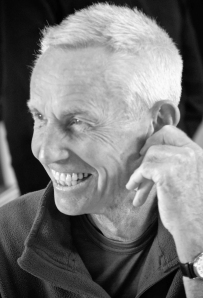

Graham Hurley
Photo credit: Laura Muños

About the Author

Graham Hurley is the author of the acclaimed Faraday and Winter crime novels and an award-winning TV documentary maker. Two of the critically lauded series have been shortlisted for the Theakston’s Old Peculier Award for Best Crime
Novel. The first Wars Within novel, Finisterre, was shortlisted for the Wilbur Smith Adventure Writing Prize.

Connect with Graham
Website | Twitter | Goodreads

#BookReview Those I Have Lost by Sharon Maas @Bookouture

Those I Have Lost - BT Poster

Welcome to day one of the blog tour for Those I Have Lost by Sharon Maas which is published today. My thanks to Sarah Hardy for inviting me to take part in the tour and to Bookouture for my digital review copy via NetGalley.


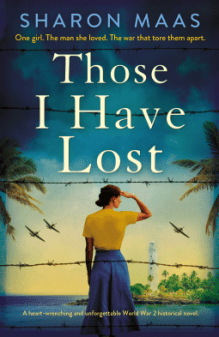
Those I Have LostAbout the Book

A family on a faraway island. Seas crawling with Japanese spies. A terrible war creeping ever closer…

1940. When Rosie loses her mother and is sent to Sri Lanka to live with her mother’s friend Silvia and her three sons, her world changes in a heartbeat. As she is absorbed into the bosom of a noisy family, with boys she loves like brothers, she begins to feel at home.

But the war in Europe is heading for Asia. Searching for comfort from the bleak news and the bombings, Rosie meets a heroic soldier on leave, and falls in love for the first time. Yet the war will not stop for passion; he must move on, and she must say goodbye, knowing she might never see him again. She is left with just a memory.

Meanwhile, one by one, the men she considers brothers leave to fight for their island paradise. As she waits in anguish for letters that never come, tortured by stories of torpedoed ships and massacres of innocent families, she realises that she, too, must do her bit. Rosie volunteers to work in military intelligence, keeping secrets that will help those she loves and protect her island home. But then two telegrams arrive with the chilling words ‘missing believed captured’ and ‘missing believed dead’. Who of those that she loves will survive the devastating war, and who will she lose?

Format: ebook (430 pages)        Publisher: Bookouture
Publication date: 9th July 2021 Genre: Historical Fiction

Find Those I Have Lost on Goodreads

Purchase links
Amazon UK
Link provided for convenience only, not as part of an affiliate programme


My Review

The early parts of the book deal with Rosie’s childhood, first in Madras and then in Sri Lanka (known at the time as Ceylon) where she is sent to live on the tea plantation owned by her late mother’s friend, Silvia (who Rosie refers to as Aunt Silvia) and her husband Henry.  Rosie spends time with the two younger sons of the family, Victor and Andrew. (The eldest son, Graham, is away at boarding school in England.) She finds the two brothers very different in character. Whilst Andrew is ‘soft and gentle’, Victor is all ‘hard, tight-balled muscle and rough in manner’.

Since the brothers are away at boarding school for much of the time, initially it’s not quite the new family situation Rosie imagined when she left her grief-stricken father behind in Madras. However, she takes comfort in knowing she’s following the wishes of her late mother and in her friendship with a Tamil girl, Usha, the daughter of the family’s housekeeper. Even though their social positions are very different, Rosie has inherited the unusually enlightened views of her parents and their ‘sharp and disapproving eye for racial arrogance’. Unfortunately, things becomes complicated when Rosie can’t stop herself from interfering in affairs of the heart. She clings to the hope that one day she will have an opportunity to put things right.

Although I found the sections of the book covering Rosie’s childhood and early adolescence interesting, it was the outbreak of war in Europe that really brought the story alive for me. When its impact eventually reaches Ceylon it means big changes for all the family, including Rosie. The book description above gives you a pretty good idea how events unfold from this point on but I won’t spoil your reading enjoyment by answering the questions it poses at the end. Safe to say, in war nothing is certain, and grief and loss are only a telegram away. A section of the book I particularly enjoyed was one towards the end which focuses on Rosie’s war work, including an unexpected reunion.

The book’s prologue remained in the back of my mind throughout, making me wonder how the events it described would connect to Rosie’s story. Have patience, because eventually the different strands of the story do come together; in fact, fragments of the picture are revealed before that.

The author skilfully handles the multiple storylines whilst at the same time bringing to life the culture of both India and Sri Lanka through the descriptions of food, clothing and daily domestic life. Although a fairly chunky read, the book’s setting, the wartime backdrop and the element of romance means Those I Have Lost offers plenty for readers to enjoy.

In three words: Emotional, detailed, eventful

Follow this blog via Bloglovin


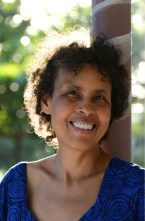
Sharon Maas Author PhotoAbout the Author

Sharon Maas was born into a prominent political family in Georgetown, Guyana, in 1951. She was educated in England, Guyana, and, later, Germany. After leaving school, she worked as a trainee reporter with the Guyana Graphic in Georgetown and later wrote feature articles for the Sunday Chronicle as a staff journalist. Her first novel, Of Marriageable Age, is set in Guyana and India and was published by HarperCollins in 1999. In 2014 she moved to Bookouture, and now has ten novels under her belt. Her books span continents, cultures, and eras. From the sugar plantations of colonial British Guiana in South America, to the French battlefields of World War Two, to the present-day brothels of Mumbai and the rice-fields and villages of South India, Sharon never runs out of stories for the armchair traveller.

Connect with Sharon
Website | Twitter