
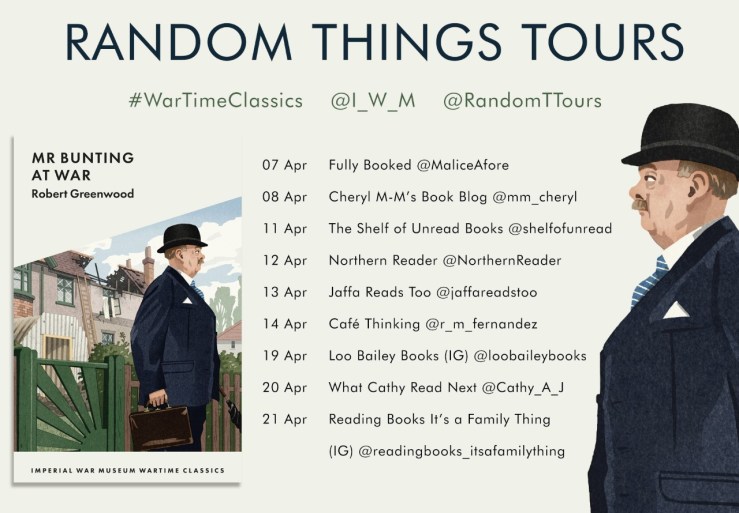
 Welcome to today’s stop on the blog tour for Mr Bunting at War by Robert Greenwood. My thanks to Anne at Random Things Tours for inviting me to take part in the tour and to the Imperial War Museum for my review copy.
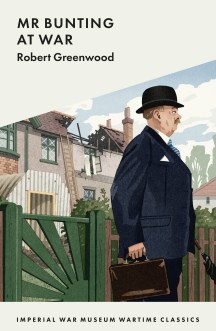 About the Book
George Bunting, businessman, husband and father, lives a quiet life at home in Laburnam Villa in Essex, reading about the progress of the war in his trusty newspaper and heading to work every day at the same warehouse where he has been employed for his entire adult life. Viewed with an air of amusement by his children, Mr Bunting’s war efforts subsist mainly of ‘digging for victory” and erecting a dugout in the garden.
But as the Second World War continues into the summer of 1940, the Battle of Britain rages in the skies and the bombs begin to rain down on London, this bumbling ‘everyman’ is forced to confront the true realities of the conflict. He does so with a remarkable stoicism, imbuing him with a quiet dignity.
Format: Paperback (256 pages) Publisher: Imperial War Museum
Publication date: 21 April 2022 Genre: Modern Classics
Find Mr Bunting At War on Goodreads
Purchase links
Bookshop.org
Disclosure: If you buy a book via the above link, I may earn a commission from Bookshop.org, whose fees support independent bookshops
Publisher | Hive | Amazon UK
Links provided for convenience only, not as part of an affiliate programme
My Review
I have enjoyed every book I’ve read in the Imperial War Museum’s Wartime Classics series but Mr Bunting At War is my new favourite and I am offically in love with Mr Bunting. As with all the books in the series, it has a fascinating introduction examining the historical context of the book but it does contain a spoiler so I would recommend reading it after finishing the book.
Mr Bunting has a quiet stoicism and a detemination to put on a brave face for the sake of his family. ‘However disheartened he felt, he always remembered to pull himself together as he reached home. He looked upon it as a duty.’
I loved all the little details of domestic life in the Bunting household – Mr Bunting’s perpetual war on waste, his love of a good sausage roll, his incomprehension at his daughter Julie’s vegetarianism, Mrs Bunting’s meticulous approach to laundry. Although the book has plenty of humour, especially in the Bunting children’s gentle teasing of their father, it doesn’t shy away from depicting the terrible impact of German bombing raids on London and surrounding areas. The destroyed houses and businesses, the streets littered with debris, the loved ones wounded, missing or dead. There are moments of hope, such as the wartime wedding of Mr Bunting’s son, Ernest, but also moments of great sadness. I was moved by the way Mr and Mrs Bunting face up to things when adversity strikes, each drawing on the strength and support of the other. ‘We’ve got to go through the dark days together. It helps when you’ve got somebody.’ Oh dear, I think I have something in my eye. In a way, their determination to carry on, even in the face of personal tragedy, exemplifies the courage of a nation whose freedom and very existence is threatened.
Yes, the book could be viewed as a propaganda piece intended to maintain public morale – there were plenty of films made during the Second World War designed to do just that – but who doesn’t need something uplifting during a time of crisis, something to raise the spirits and keep hope alive? And now that Europe faces a new aggressor, there’s something prophetic about the observation, ‘All the warnings of past years, all the unheeded prophecies, were now the facts of the moment, a nightmare made true and visible’. And I found myself agreeing with Mr Bunting’s observation, ‘It was a pity there weren’t more people like himself, particularly on the Continent. The more Buntings, the fewer Hitlers he considered’. I have a feeling there are quite a few Mr Buntings in Ukraine at the moment.
It will be pretty clear by now that I loved this book. It made me laugh, it made me cry and above all it made me marvel once again at the courage of those who lived through the Second World War and found the strength to carry on.
‘He was not brilliant, nor heroic, but there was one thing he could do – endure.’ This for me summed up the charm of Mr Bunting, the earnest, dogged and steadfast hero of this wonderful book.
In three words: Eloquent, tender, moving
Try something similar: Mrs Miniver by Jan Struther
Follow this blog via Bloglovin
About the Author
Robert Greenwood (1897 – 1981) was a novelist and writer. His first novel depicted the family and working life of the eponymous Mr Bunting (1940). His next novel, Mr Bunting at War (1941), continued this story in the first two years of the Second World War. Mr Bunting at War was made into a film the following year entitled Salute John Citizen (1942), which proved tremendously popular at the box office. Greenwood’s other novel about the war was The Squad Goes Out (1943), which depicted the work of a voluntary ambulance squad during the London Blitz. Greenwood wrote eleven novels in total as well as a number of short stories, including Mr Bunting in the Promised Land (1949) which tells the story of the Bunting family in the immediate aftermath of the Second World War. He died in 1981.

 About the Book
 About the Author
 What Cathy Read Next...