
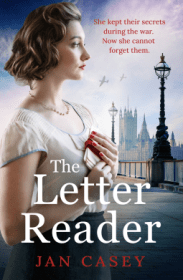
 About the Book
She read their secrets during the war. Now she cannot forget them…
1941. London. Keen to do her bit in the war, Connie Allinson joins the WRNS and is posted as a letter censor. Her task: to read and alter correspondence to ensure no sensitive information crosses enemy lines. At first, she is not sure she’s up to it, but is soon drawn in by the letters she reads, and their secrets…
1967. Doncaster. Bored of her domestic life, Connie desperately wants a job, but her controlling husband Arthur won’t hear of it. Looking for an escape, and plagued by memories of letters she read during the war, she makes a bid for freedom and starts secretly tracking down their authors. Will uncovering their past give Connie the key to her present? And will she be able to find them all before Arthur discovers what she is keeping from him?
Format: eARC (384 pages) Publisher: Aria
Publication date: 11th May 2023 Genre: Historical Fiction
Find The Letter Reader on Goodreads
Purchase links
Bookshop.org
Disclosure: If you buy a book via the above link, I may earn a commission from Bookshop.org, whose fees support independent bookshops
Hive | Amazon UK
Links provided for convenience only, not as part of an affiliate programme
My Review
I found the details of Connie’s war work absolutely fascinating and obviously the product of extensive research by the author. Of course, I was aware of the censorship of mail but I was unaware of the meticulous processes that lay behind it and the extent of the training censors undertook in order to be able to spot many different types of codes that could be hidden in ordinary seeming correspondence. I could completely understand Connie’s joy whenever she spotted something suspicious. And I felt Connie’s sadness as she read letters with gossip from home that often, one sensed, hid the reality of daily deprivations and danger. And, of course, the possibility that the intended recipients of the letters might no longer be around to receive them. Some of the letters leave a lasting impression on her. ‘She’d agonised about all of them during the war; worried about each of their dilemmas; been privy to their deepest, darkest thoughts and most hopeful moments.’
Connie’s wartime activities threw up some potentially interesting secondary characters – Dotty and the mysterious Angelique spring to mind – although they disappear quite quickly from the story, perhaps illustrating the transience of relationships during wartime.
Another of the standout elements of the book for me was the way the author recreated the 1960s, a period of many new things – in fashion (miniskirts and white boots) and music (the Monkees and the Beatles) – but also still with many remnants of the old. As a child of the 60s, the mention of watching Z Cars on the television and eating pineapple upside-down cake evoked early memories.
It was sad to see Connie’s transformation from practical and resourceful woman to subservient wife, ground down by her husband Arthur’s controlling attitude and obsession for routine, even in their sex life. Theirs has become a stale, empty marriage full of regret and dashed hopes. ‘It was as if they were ground down by each other in a way that bombs and blackouts and rations had never been able to achieve.’ Personally, I found it hard to see what Connie ever saw in Arthur. It seemed to me the warning signs were there from early on: his reluctance to allow Connie to become involved in war work at all and his vetoing of a wonderful opportunity she is offered, all dressed up as a desire to keep her safe. Although he writes at one point that he wants to be ‘her haven, her refuge and her sanctuary’, he ends up being almost her jailer, acting more like a husband from the 1860s than the 1960s. Today, we would recognise some of his actions as coercive control. There were moments later in the book when I had slight sympathy for him but this was countered by the thought that his actions had all come too late and were motivated more by self-pity than a genuine change of heart. I did wonder, however, if knowing more about his experiences during the war might have shed light on his actions and attitudes, especially his need for routine and control.
It was joyful to follow Connie’s attempts to break free from the shackles of her marriage, even if her search for the individuals whose letters she had read during the war seemed a little like obsession. Perhaps, more generously, it was a need to deal with ‘unfinished business’ or to find that life had been kinder to the correspondents than to her. Incidentally, I loved the way her brother and sister-in-law supported and encouraged her.
Jan Casey’s previous book, The Woman with the Map, was one of my top ten favourite books of 2022. For me, The Letter Reader didn’t have quite the same emotional heft but I really liked the fascinating detail about postal censorship and the focus on the contribution made by women to the war effort.
I received an advance review copy courtesy of Aria via NetGalley.
In three words: Emotional, authentic, fascinating
Try something similar: The Girl from Bletchley Park by Kathleen McGurl
 About the Author
Jan Casey’s novels, like her first – The Women of Waterloo Bridge – explore the themes of how ordinary people are affected by extraordinary events during any period in history, including the present. Jan is fascinated with the courage, adaptability and resilience that people rise to in times of adversity and for which they do not expect pay, praise or commendation. Jan is also interested in writing about the similarities, as opposed to the differences, amongst people and the ways in which experiences and emotions bind humans together.
Jan was born in London but spent her childhood in Southern California. She was a teacher of English and Drama for many years and is now a Learning Supervisor at a college of further education. When she is not working or writing, Jan enjoys yoga, swimming, cooking, walking, reading and spending time with her grandchildren.
Before becoming a published author, Jan had short stories and flash fictions published.
Connect with Jan
Twitter

 About the Book
 About the Author
 What Cathy Read Next...