
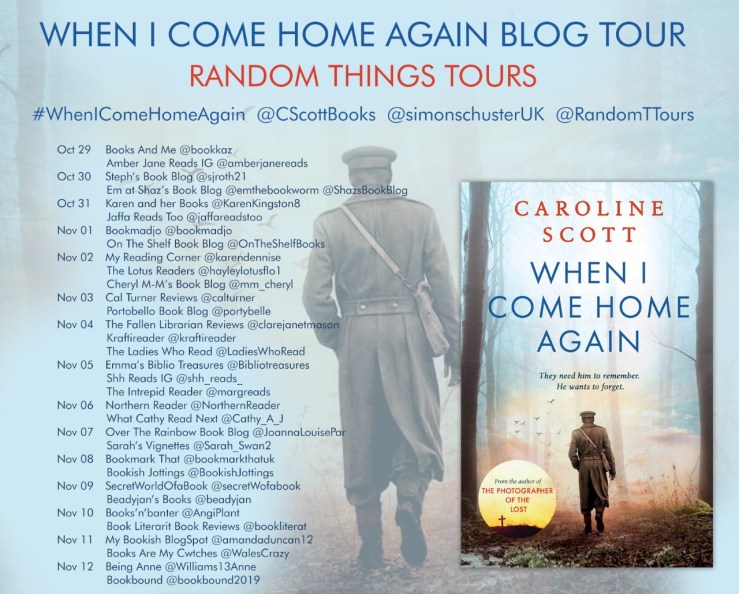
Welcome to today’s stop on the blog tour for When I Come Home Again by Caroline Scott. My thanks to Anne at Random Things Tours for inviting me to take part and to Simon & Schuster for my digital review copy via NetGalley. Do also check out the post by my tour buddy for today, Joules at Northern Reader.
 About the Book
How can you know who you are, when you choose to forget who you’ve been?
November 1918. On the cusp of the end of the First World War, a uniformed soldier is arrested in Durham Cathedral. It quickly becomes clear that he has no memory of who he is or how he came to be there. The soldier is given the name Adam and transferred to a rehabilitation home where his doctor, James, tries everything he can to help Adam remember who he once was. There’s just one problem. Adam doesn’t want to remember.
Unwilling to relive the trauma of war, Adam has locked his mind away, seemingly for good. But when a newspaper publishes Adam’s photograph, three women come forward, each just as certain that Adam is their relative and that he should go home with them.
But does Adam really belong with any of these women? Or is there another family waiting for him to come home?
Based on true events, When I Come Home Again is a deeply moving and powerful story of a nation’s outpouring of grief, and the search for hope in the aftermath of the First World War.
Format: Hardcover (496 pages) Publisher: Simon & Schuster
Publication date: 29th October 2020 Genre: Historical Fiction, Romance
Find When I Come Home Again on Goodreads
Purchase links*
Amazon UK | Hive (supporting UK bookshops)
*link provided for convenience not as part of an affiliate programme
My Review
I loved Caroline Scott’s book, The Photographer of the Lost, so I was prepared for an emotional story and beautiful writing in this, her second book; I wasn’t disappointed. Once again the focus is the period after the First World War and the long-lasting effect of the conflict on the lives of so many.
Appropriately, as we approach Remembrance Sunday, the opening scenes of the book depict the journey of the coffin containing the body of the Unknown Warrior prior to its interment in Westminster Abbey. For some, the possibility the body may be that of a lost loved one brings solace, pride even. But for others, including the three women featured in the book, it does nothing but add to their fierce conviction that their missing brother, son or husband is not the body in the coffin, is not dead and will return some day. Often this in the face of advice from others to accept their loved one is gone and move on with their lives.
I loved how photographs play a part in the story, providing a link to the author’s first book. There’s the photograph published in the newspaper of the man given the name Adam Galilee that raises such fervent hope in those who have lost loved ones. And there are the photographs cherished by those families – of brothers, sons, husband who went to war and never came back – produced as evidence that Adam belongs with them. Or the photographs of parents, places or children placed in Adam’s hands in the hope of provoking a response, a flicker of recognition or a glimpse of his life before.
The scenes in which the three women who believe that Adam is their husband, son or brother come face to face with him for the first time are full of emotion and anguish. Their certainty, even though they cannot all be right, is heart-breaking to witness. But the author also conveys the emotional impact these encounters have on Adam himself, knowing the disappointment it will bring if they evoke no memories for him. Equally, the reader witnesses the effect on James Haworth, the doctor in charge of Fellside House, whose dogged determination to uncover Adam’s true identity threatens his own peace of mind.
The theme of memory runs through the book. Whether that’s the memories – good and bad – evoked by a particular place, the “muscle memory” of throwing a pot on a wheel or playing a piece by Chopin on the piano, the memory of a face but without the ability to put a name to it, or the act of remembrance in general. As long as someone is remembered, are they ever really lost? The book also poses the question whether memory can always be relied upon or, in wanting something so much to be true, it can become distorted. “Grief and hope are powerful emotions. What we see is sometimes what we want to see.”
When I Come Home Again is a beautifully crafted, emotional story that is also a timely reminder of the damaged minds and bodies that are the legacy of war.
In three words: Tender, insightful, emotional
Try something similar: The Return of the Soldier by Rebecca West
Follow this blog via Bloglovin
 About the Author
Caroline completed a PhD in History at the University of Durham. She has a particular interest in the experience of women during the First World War, in the challenges faced by the returning soldier, and in the development of tourism and pilgrimage in the former conflict zones. Caroline is originally from Lancashire, but now lives in south-west France.
Connect with Caroline
Twitter

 About the Book

 What Cathy Read Next...