#BlogTour #BookReview The Mirror Game by Guy Gardner @RandomTTours @BookGuild

The Mirror Game BT PosterWelcome to today’s stop on the blog tour for The Mirror Game by Guy Gardner. My thanks to Anne at Random Things Tours for inviting me to take part in the tour and to The Book Guild for my digital review copy.
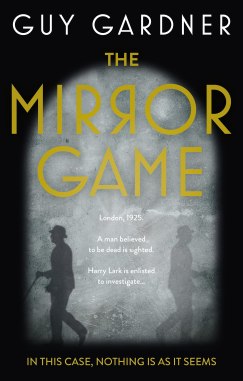

The Mirror Game CoverAbout the Book

London 1925. When Adrian Harcourt, a politician and captain in the army believed dead with his company on the battlefield of Flanders, is sighted looking like he’s been living rough, Harry Lark, a war veteran and journalist, is enlisted by his friend and benefactor Lady Carlise to investigate.

As he becomes drawn further into the case and the deaths mount up, he can see that things don’t add up. Where has Adrian been for so many years? Why can’t he remember parts of his past?

Looking further into Adrian’s previous life, even as his own dark past and addiction to laudanum threatens to overwhelm him, Harry begins to fall for Lady Carlise’s beautiful daughter Freddy, who was also Adrian’s fiancé.

Chasing the leads as they continue to unravel, can Harry solve the mystery behind what really happened to Adrian before it’s too late?

Format: Paperback (296 pages)         Publisher: The Book Guild
Publication date: 28th January 2022 Genre: Historical Fiction, Crime

Find The Mirror Game on Goodreads

Purchase links
Bookshop.org
Disclosure: If you buy a book via the above link, I may earn a commission from Bookshop.org, whose fees support independent bookshops

Hive | Amazon UK
Links provided for convenience only, not as part of an affiliate programme


My Review

Reading the description of The Mirror Game suggests it has all the ingredients to make an enjoyable historical crime mystery – and it certainly succeeds on that score – but using the aftermath of the First World War as a backdrop to the story adds an additional element of interest, a darker tone if you like.

The lasting impact of the war is evident in many way, not just on those who survived or were injured but on the families of those who never returned or were reported missing in action. As Harry Lark says, ‘What did the hell did we expect to happen after it was over? We’d go on quietly living our lives, never minding the horror we were part of?’  Harry himself is a troubled man. He sustained physical injuries in the war which still cause him pain but it’s the mental scars more than anything that see him turn to laudanum to help him to forget the things he witnessed.

He finds a welcome new purpose in life when asked to investigate the mysterious reappearance of Adrian Harcourt after an absence of seven years. His journalistic instincts raise a series of questions in his mind. Why would someone who survived the war disappear and not return home? Where have they been for all that time? Why reappear now? What has caused the apparent change in them? I suspect I’m not the only reader to share Harry’s curiosity.

Harry makes a resourceful, resilient and feisty hero, and it soon becomes clear he will need all his wits about him (not to mention his fists) because the deeper he delves the more trouble seems to come his way – and anyone else he’s called upon for help. Why, he wonders, are people so anxious to stop him getting to the truth and what really happened in the battlefield incident during which Adrian Harcourt supposedly lost his life? Is there a cover-up aimed at hiding details of some atrocity or is something more sinister going on?

Alongside Harry’s investigation there’s a touching side story as he wrestles with his attraction to gifted musician Ferderica, the fiancé of the man he’s searching for. They seem simpatico but if he finds Adrian, won’t she want to pick up with him where they left off and what does Harry have to offer her anyway? When he looks in the mirror what does he see? A man fighting an addiction to laudanum, with no job and scarred by a previous relationship that ended in tragedy. Those who love a tortured hero will be urging Ferderica to go for it anyway – at least I was!

The plot moves along in double quick time and has more twists and turns than a corkscrew. Trust me, if you think you’ve got the solution to the mystery all worked out before the final pages you’ve probably got it wrong.

The Mirror Game is an extremely well-crafted, ingenious historical crime mystery. I don’t know if the author has more books featuring Harry Lark planned but I think he would make a great character to build a historical crime series around.

In three words: Intriguing, suspenseful, dramatic

Try something similar: Two Storm Wood by Philip Gray

Follow this blog via Bloglovin


Guy Gardner Author PicAbout the Author

Guy Gardner is a professional jazz pianist, and has played both at home and around Europe in venues such as The National Theatre, Pizza Express Soho, the 02 and The Royal Albert Hall.

Having earned his degree in Music at Dartington College of Arts, he went on to gain a PGCE in teaching, which he used to teach in a prison for a time. Currently, he combines his writing with teaching piano in Dorset, where he lives with his wife, two young sons and dog.

Connect with Guy
Twitter

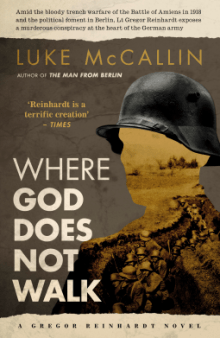
#BookReview Where God Does Not Walk (Gregor Reinhardt #4) by Luke McCallin @noexitpress

Where God Does Not WalkAbout the Book

The Western Front, July 1918. Gregor Reinhardt is a young lieutenant in a stormtrooper battalion on the Western Front when one of his subordinates is accused of murdering a group of officers, and then subsequently trying to take his own life. Not wanting to believe his friend could have done what he is accused of, Reinhardt begins to investigate. He starts to uncover the outline of a conspiracy at the heart of the German army, a conspiracy aimed at ending the war on the terms of those who have a vested interest in a future for Germany that resembles her past.

The investigation takes him from the devastated front lines of the war, to the rarefied heights of Berlin society, and into the hospitals that treat those men who have been shattered by the stress and strain of the war. Along the way, Reinhardt comes to an awakening of the man he might be. A man freed of dogma, whose eyes have been painfully opened to the corruption and callousness all around him. A man to whom calls to duty, to devotion to the Fatherland and to the Kaiser, ring increasingly hollow…

Format: Hardcover (432 pages)            Publisher: Oldcastle Books
Publication date: 9th December 2021 Genre: Historical Fiction, Thriller

Find Where God Does Not Walk ( Gregor Reinhardt #4) on Goodreads

Purchase links
Bookshop.org
Disclosure: If you buy a book via the above link, I may earn a commission from Bookshop.org, whose fees support independent bookshops

Hive | Amazon UK
Links provided for convenience only, not as part of an affiliate programme


My Review

I’ve been a fan of this series ever since I read the The Man From Berlin in 2016. I then read, in quick succession, the next two in the series, The Pale House and The Ashes of Berlin. And that’s where, much to my disappointment, it seemed the adventures of Gregor Reinhardt might end. (I’ll admit to having developed a bit of a crush on Reinhardt by that time.) So you can imagine how thrilled I was to learn there was a new book on the way and that it was a prequel as I love a good prequel.

A prequel obviously presents both opportunities and challenges for an author. The main challenge is that the author can’t change what will happen in later, already written, books.  So it’s no spoiler to say the reader knows that, however dangerous the situations in which he finds himself – and they are often extremely dangerous – Reinhardt isn’t going to die in Where God Does Not Walk.  But, of course, he doesn’t know that and thanks to the skilful writing of the author, Reinhardt’s many dices with death don’t lose any of their impact, tension or excitement.

On the other hand, the main opportunity presented by a prequel is the ability to delve more deeply into the past of the main character, to explain the background to decisions or actions they may take in later books, and to fill in more of their back story.  Where God Does Not Walk does that in spades, taking the reader back to the First World War and introducing us to a young Gregor Reinhardt, only nineteen years old but already battle-hardened. From the off, he shows early signs of the intelligence, curiosity and, let’s face it, rather dismissive attitude to authority he displays in later books. However, what he also shows is a fierce loyalty towards the soldiers he commands, a strong sense of justice as well as a remarkable ability to survive the most perilous of situations.  I also loved the first appearance of small details, such as a watch, that readers who’ve read the previous books may recognise.

If you’ve ever wondered what it must have been like to serve in the frontline in the First World War then this book will leave you under no illusion that it was hell on earth. The descriptions of the result of artillery and machine gun fire on human bodies leave little to the imagination. In one memorable scene an appalled Reinhardt, looking around at the severely injured soldiers in a casualty clearing station, wonders at ‘such a butchery of men’. However, if anything, the most shocking thing is the seemingly casual attitude of those who put soldiers into situations where they know few will survive intact, if at all. ‘Men die in all kinds of ways, for all kinds of reasons. Some of them are avoidable. Some of them are accidental. Many of them are stupid. Many are unthinkable’. The book also explores the psychological effects of war, exposing some of the crude treatments inflicted on those suffering from what we would today recognise as post-traumatic stress.

It’s clear a massive amount of amount of research has gone into the book and from time to time I did find I needed to refer back to the list of characters at the beginning of the book to remind myself who was who and what position they occupied in the military hierarchy.

Of course, Where God Does Not Walk also incorporates an astonishingly complex mystery that had me perplexed for most of the time – as was Reinhardt too for a large proportion of the book.  As he becomes involved in the investigation of a series of gruesome murders, Reinhardt lurches from one violent confrontation to another as he attempts, in any way he can, to tease the truth from those reluctant, or too afraid, to reveal it. As hints of a conspiracy emerge that may involve some in the highest level of the country’s institutions, there are also signs of a nascent anti-Semitism.

If you’re new to the series, Where God Does Not Walk is the perfect place to start, although I warn you you’ll probably be adding the other books to your wishlist by the time you finish it.  And it gets better because the author promises us this is just the start of a new cycle of books taking Reinhardt from where we leave him in this book up to the point we meet him in The Man From Berlin.

Where God Does Not Walk is both a complex thriller and a stark and, at times, unflinching exposition of what it was like in the frontline during the First World War. As one character observes, ‘No man survives a war and is the same man he was at its beginning’. Welcome back, Reinhardt.

I received an advance review copy courtesy of No Exit Press via NetGalley.

In three words: Dark, intense, compelling

Try something similarTwo Storm Wood by Philip Gray

Follow this blog via Bloglovin


LukeMcCallinAbout the Author

Luke McCallin was born in Oxford, grew up around the world and has worked with the United Nations as a humanitarian relief worker and peacekeeper in the Caucasus, the Sahel, and the Balkans. His experiences have driven his writing, in which he explores what happens to normal people – those stricken by conflict, by disaster – when they are put under abnormal pressures. (Photo/bio: Goodreads author page)

Connect with Luke
Website | Facebook | Goodreads