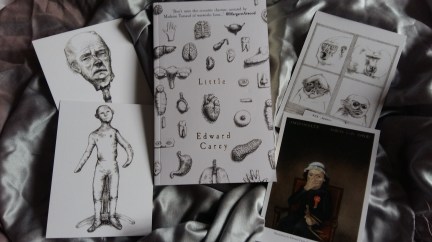
 About the Book
In 1761, a tiny, odd-looking girl named Marie is born in a village in Switzerland. After the death of her parents, she is apprenticed to an eccentric wax sculptor and whisked off to the seamy streets of Paris, where they meet a domineering widow and her quiet, pale son. Together, they convert an abandoned monkey house into an exhibition hall for wax heads, and the spectacle becomes a sensation.
As word of her artistic talent spreads, Marie is called to Versailles, where she tutors a princess and saves Marie Antoinette in childbirth. But outside the palace walls, Paris is roiling: The revolutionary mob is demanding heads, and… at the wax museum, heads are what they do.
Format: Paperback (430 pages) Publisher: Gallic Books
Publication date: 4th October 2018 Genre: Historical Fiction
Find Little on Goodreads
Purchase links
Bookshop.org
Disclosure: If you buy a book via the above link, I may earn a commission from Bookshop.org, whose fees support independent bookshops
Hive | Amazon UK
Links provided for convenience only, not as part of an affiliate programme
My Review
I’ve been meaning to pick up this book for ages, ever since the lovely people at Gallic Books sent me a review copy. I’m now kicking myself that it’s taken me so long to read it because I thought it was brilliant – and I’m not alone. Longlisted for the Walter Scott Prize for Historical Fiction in 2019, Little has received many plaudits, described as being ‘the wry, macabre, unforgettable tale of an ambitious orphan in Revolutionary Paris’ and ‘a darkly endearing cavalcade of a novel’. I agree.
Little tells the story of (Anne) Marie Grosholtz who joins the household of the eccentric Doctor Curtius, a sculptor of wax replicas of body parts. Later Curtius moves into creating wax heads, being particularly interested in the heads of murderers and Little begins to learn the art of taking plaster casts and assisting in the creation of the heads.
One of the visitors to Curtius’s workshop is the similarly eccentric Louis-Sébastien Mercier whose obsession is walking the streets of Paris and making notes on the people he sees. ‘So many different sentences of streets have my shoes walked me’. Noting Marie’s short stature, it is Mercier who coins the name by which she will become known.
‘Aren’t you, little boldness’ – this he called me, and, very pleased with his own observation, he went on, not caring for a moment how I might take his words – ‘little ill-facedness, little minor monster in a child’s dress . . . little thing . . . little howl . . . little crumb of protruding flesh . . . little statement on mankind . . . little . . . little? he concluded, not certain in the end of what I was, only that I was little, a little of something.’
It is Mercier who introduces the increasingly penniless Curtius to the Widow Picot who becomes his landlady. Widow Picot takes an instant dislike to Little banishing her to the kitchen to perform the role of servant and hurling insults at her at every turn. Unfortunately Curtius lacks the courage to challenge Widow Picot and Little finds herself unable to continue to work alongside him. Gradually she forms a friendship with the Widow Picot’s son, Edmond, a quiet and withdrawn young man.
As the book progresses, Little encounters many curious characters, including the locksmith she meets whilst lost in the maze of corridors in the Palace of Versailles during her employment as tutor in wax sculpture to Princess Élisabeth, the sister of King Louis XVI. What Little doesn’t know is that her time at Versailles (even if she is expected to sleep in a cupboard) is shortly to come to an end as the bloody events of the French Revolution engulf Paris.
I loved Little for her determination, her sly wit, her kindness towards Edmond and the compassion she shows to the Widow Picot, the woman who made her life such a misery. In the final chapters, Little recounts the events of her later years, including how exactly she became Madame Tussaud.
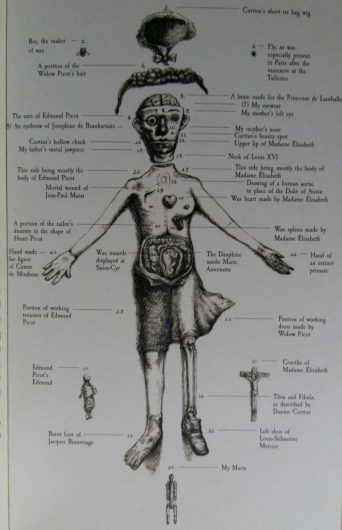 It’s impossible to write a review of the book without mentioning the wonderful illustrations by the author that accompany the text. These include examples of the waxwork replicas of body parts and internal organs crafted by Doctor Curtius, likenesses of the characters who feature in the book and some of the waxwork heads exhibited for the paying public in the Great Monkey House. Amongst my particular favourites were Marie’s sketch of Edmond’s ears and of Florence the pug. The drawing that makes up the inside back cover of the book (pictured right) gives you a flavour of the illustrations.
Little is one of those books whose inventiveness and originality is difficult to convey in words. By turns it’s macabre, funny, dramatic, dark and a little grotesque. It’s also rather moving at times. For example, I got a little teary at comments by Edmond such as ‘Very convenient premises, apply within’ or when Little and Edmond explore The Celestial Bed. (I’m afraid you’ll have to read the book to understand the context.)
Little is really quite fabulous, highly recommended for historical fiction fans looking for something a bit different, and definitely one of my favourite books of 2021.
In three words: Quirky, imaginative, engaging
Try something similar: The Doll Factory by Elizabeth Macneal
Follow this blog via Bloglovin
 About the Author
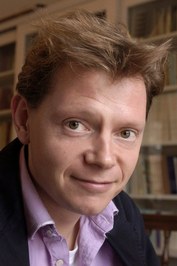
Edward Carey is a novelist, visual artist and playwright. He is the author of two acclaimed novels, Observatory Mansions and Alva and Irva. His YA series The Iremonger Trilogy is published in thirteen countries and has been optioned for film adaptation. Born in England, he teaches at the University of Austin, Texas. (Photo: Goodreads author page)
Connect with Edward
Website | Twitter | Facebook | Instagram

 The longlist for The Walter Scott Prize for Historical Fiction 2022 was revealed on 7th February. As an avid reader of historical fiction I like to think I have my finger on the pulse when it comes to books likely to appear on the list but, as usual, it provided some surprises. You can read more about the longlisted books here. Congratulations to all the authors and publishers of the books on the longlist.
 I’ve divided the thirteen novels on the list into three parts: those I’ve read and reviewed, those I own but have yet to read, and those that are completely new to me and, I suspect, many other readers.


 What Cathy Read Next...