About the Book
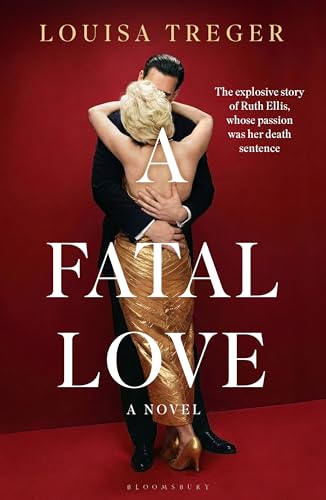
It is Easter Sunday in 1955 and a young man lies face-down on the ground covered in blood. A woman, blonde and petite, stands over him with a gun in her hand. This is the story of Ruth Ellis as never told before…
As Ruth awaits her trial in Holloway Prison, she recollects growing up in England during the Second World War and the events that led to the death of her lover, David Blakely.
Meanwhile, Kitty Carrington – the assistant to Ruth’s trial lawyer – tries to forge her own path through the male-dominated legal world of the 1950s and ensure that Ruth receives a fair trial.
Navigating secrets, betrayal and a broken justice system, Ruth and Kitty try to take control of their own lives and narratives. But do we ever really know the full story?
Format: Hardcover (240 pages) Publisher: Bloomsbury
Publication date: 27th August 2026 Genre: Historical Fiction, True Crime
Find A Fatal Love on Goodreads
Preorder/Purchase A Fatal Love from Bookshop.org [Disclosure: If you buy books linked to our site, we may earn a commission from Bookshop.org, whose fees support independent bookshops]
My Review
A Fatal Love is the story of an addiction. Not to drugs or drink, although those do play a part, but to a person. That person was David Blakely, a man with whom Ruth Ellis was passionately in love despite his frequent infidelity and violence towards her.
The author takes the reader inside the mind of a woman who has had to fend for herself from an early age, to struggle to make a life for herself. A woman who has had to overcome the stigma of having a child out of wedlock, a failed marriage that ended in divorce, and working as a hostess in night clubs. But Ruth proves herself to be brilliant at the latter. Always gorgeously turned out, she knows just how to charm the male clientele to ensure the drinks, and the money, keep flowing. Ruth’s no angel. In return for a roof over her head she’s expected by the club’s owner to have sex with many of the men who frequent the club, even while her young son Andy sleeps in the next room.
Then one night, Ruth meets racing driver David Blakely. The physical attraction is instant and overwhelming. It’s the first step on a path that will destroy them both.
Blakely comes across as a needy, duplicitous waster – and that’s putting it kindly. It’s heartbreaking to see Ruth so in thrall to him, unable to resist letting him back in her life after each lie, each broken promise, each act of betrayal. ‘He was light and oxygen to her. There were times when it seemed she could not breathe outside his presence.’ At the same time as recognising the hold he has over her, she sees the impossibility of her ever having the strength to break free from him.
What she does on that Easter Sunday 1955 is an act of desperation and a kind of madness, enabled by another who was never held responsible.
The author introduces a fictional character, Kitty, assistant to John Bickford, the solicitor appointed to represent Ruth. I didn’t think Kitty’s back story contributed much but she did provide an important perspective on the conduct of Ruth’s trial. We see that Ruth was failed by everyone. The psychiatrist who interviewed her but failed to find evidence of mental illness. Her barrister who rejected provocation as a potentially successful line of defence. The presiding judge whose partial summing-up contributed to the jury’s guilty verdict. The Home Secretary who refused a request for clemency.
But perhaps a woman like Ruth could never have overcome the misogyny of 1950s society. As Kitty observes to Bickford during the trial, ‘Ruth is a threat to the social order. They’re out to break her… The police, the newspapers, even your colleagues. She was too ambitious. No respect for the boundaries of sex and class – broke every rule. To them that’s the real offence.’
The final section of the book describes in unflinching detail the period Ruth Ellis spent in Holloway Prison after her trial and before her execution. In the condemned cell she is never left alone and is only footsteps away from where she will be executed. The details of her final hours, the meticulous preparations for her execution, are distressing to read.
As the author sets out in the Afterword, Ruth’s actions had a lasting impact on her family, especially her son Andy, as well as for others involved in the case. But her case also fuelled the campaign to end the death penalty.
I received an advance reader copy courtesy of Bloomsbury via NetGalley. A Fatal Love is book 7 of my 20 Books of Summer 2026.
In three words: Moving, gripping, powerful
Try something similar: The Unspeakable Acts of Zina Pavlou by Eleni Kyriacou
About the Author

Louisa Treger is the critically acclaimed author of four novels – The Lodger (2014), The Dragon Lady (2019), Madwoman (2022) and The Paris Muse (2024) – translated into several languages. Her work has twice been selected as The Times Historical Book of the Month, most recently for Madwoman, which was also a Book of the Month in the Independent.
She has written for numerous publications, including Financial Times, The Times, the Telegraph, Tatler, BBC History Magazine, and English Heritage. Radio appearances include BBC Radio 3’s Free Thinking programme and BBC Radio 4’s Woman’s Hour. She appears regularly at literary festivals and cultural institutions, and is deputy chair of the board of the Oxford Literary Festival. (Photo: Amazon author page)
Connect with Louisa
Website | Instagram