

Throwback Thursday is a weekly meme hosted by Renee at It’s Book Talk. It’s designed as an opportunity to share old favourites as well as books that we’ve finally got around to reading that were published over a year ago. If you decide to take part, please link back to It’s Book Talk.
Today I’m reviewing The Things We Learn When We’re Dead by Charlie Laidlaw, published in January 2017.
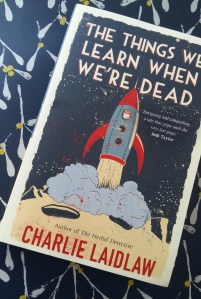 About the Book
With elements of The Wizard of Oz, The Hitchhiker’s Guide to the Galaxy and The Lovely Bones, The Things We Learn When We’re Dead shows how small decisions can have profound and unintended consequences, and how sometimes we can get a second chance.
On the way home from a dinner party, Lorna Love steps into the path of an oncoming car. When she wakes up she is in what appears to be a hospital – but a hospital in which her nurse looks like a young Sean Connery, she is served wine for supper, and everyone avoids her questions. It soon transpires that she is in Heaven, or on HVN. Because HVN is a lost, dysfunctional spaceship, and God the aging hippy captain. She seems to be there by accident… Or does God have a higher purpose after all?
At first Lorna can remember nothing. As her memories return – some good, some bad – she realises that she has decision to make and that maybe she needs to find a way home.
Format: Paperback (501 pp.) Publisher: Accent Press
Published: 26th January 2017 Genre: Fantasy, Science Fiction
Purchase Links*
Amazon.co.uk ǀ Amazon.com ǀ Hive.co.uk (supporting local UK bookshops)
*links provided for convenience, not as part of any affiliate programme
Find The Things We Learn When We’re Dead on Goodreads
My Review
As Lorna adapts to her new surroundings on the spaceship, random objects she sees – M&S underwear, lamb cutlets, even a hamster – trigger memories from her past life. At first these are fragmented, incomplete and often confusing. Some are pleasant memories: childhood holidays, family picnics, games with friends, the first stirrings of interest in the opposite sex. Others are reminders of loss and grief.
Many of Lorna’s memories revolve around exploits with her stylish friend, Suzie, and Lorna’s relationships with men that, it has to be said, have not been entirely successful. I confess to feeling a pang of sympathy for poor sweet, stolid Austin (described at one point as ‘a rather dull dog with very few tricks’). As the book progresses, the reader sees that actions do indeed have consequences, even if unintended, and may set in motion a chain of events that can end tragically.
The book blurb describes The Things We Learn When We’re Dead as having ‘elements of The Wizard of Oz, The Hitchhiker’s Guide to the Galaxy and The Lovely Bones’. Personally, I couldn’t detect that much of a connection with The Lovely Bones and only slight allusions to The Hitchhiker’s Guide to the Galaxy. (I understand these comparisons were the publisher’s decision.) If looking for cultural references, I would say the depiction of the stranded HVN spaceship draws more from Star Trek than anything else with its transporters, holographs and replicators. I enjoyed Lorna’s pleasure at the small, surprising miracles on the spaceship, like the ability of a chilled glass of wine to stay chilled even when drunk in the bath.
When it comes to The Wizard of Oz, certainly there are characters described as lacking courage and not having much of a brain that remind one of the Cowardly Lion and the Scarecrow. However, I think a reader expecting this book to be a straight retelling of The Wizard of Oz may be disappointed. What they won’t be disappointed in is the quality of the writing, the quirky humour and the authenticity with which Lorna’s memories of her childhood and young adult experiences are described.
I really enjoyed The Things We Learn When We’re Dead. As someone who reads very little fantasy and science fiction only occasionally (and then more of the dystopian variety), I wasn’t really disappointed that the extra-terrestrial element takes more of a back seat as the book progresses. The ending left me wishing Lorna well in the future choices she makes.
I received a personally inscribed review copy from the author in return for an honest and unbiased review. I’d like to thank the author for his patience in waiting for his book to reach the top of my review pile.
In three words: Quirky, engaging, imaginative
Try something similar…for more space-based fantasy, Spaceman of Bohemia by Jaroslav Kalfar (click here to read my review)
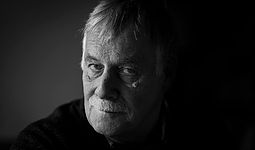 About the Author
Charlie Laidlaw is the author of two novels, The Herbal Detective (Ringwood Publishing) and The Things We Learn When We’re Dead (Accent Press).
Charlie writes: ‘I was born in Paisley, central Scotland, which wasn’t my fault. That week, Eddie Calvert with Norrie Paramor and his Orchestra were Top of the Pops, with Oh, Mein Papa, as sung by a young German woman remembering her once-famous clown father. That gives a clue to my age, not my musical taste. I was brought up in the west of Scotland (quite near Paisley, but thankfully not too close) and graduated from the University of Edinburgh. I still have the scroll, but it’s in Latin, so it could say anything.
I then worked briefly as a street actor, baby photographer, puppeteer and restaurant dogsbody before becoming a journalist. I started in Glasgow and ended up in London, covering news, features and politics. I interviewed motorbike ace Barry Sheene, Noel Edmonds threatened me with legal action and, because of a bureaucratic muddle, I was ordered out of Greece. I then took a year to travel round the world, visiting 19 countries. Highlights included being threatened by a man with a gun in Dubai, being given an armed bodyguard by the PLO in Beirut (not the same person with a gun), and visiting Robert Louis Stevenson’s grave in Samoa. What I did for the rest of the year I can’t quite remember.
Surprisingly, I was approached by a government agency to work in intelligence, which just shows how shoddy government recruitment was back then. However, it turned out to be very boring and I don’t like vodka martini. Craving excitement and adventure, I ended up as a PR consultant, which is the fate of all journalists who haven’t won a Pulitzer Prize, and I’ve still to listen to Oh, Mein Papa.
I am married with two grown-up children and live in East Lothian.’
Connect with Charlie

 About the Book
 About the Author
 What Cathy Read Next...