Throwback Thursday: The Biographies of Ordinary People, Volume 1 by Nicole Dieker

ThrowbackThursday

Throwback Thursday is a weekly meme created by Renee at It’s Book Talk.  It’s designed as an opportunity to share old favourites as well as books that we’ve finally got around to reading that were published over a year ago.

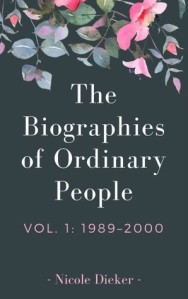
Today I’m revisiting a book I reviewed in December last year – The Biographies of Ordinary People, Volume 1 by Nicole Dieker.  Published in May 2017, The Biographies of Ordinary People is a two volume series about the fictional Gruber family that’s been described as a millennial era Little Women.  It covers the period from July 1989 to November 2016, with volume one focusing on the years 1989 to 2000.

I’m delighted to say that the second volume, covering the years 2004 to 2016, is due to be published on 22nd May 2018.  The Biographies of Ordinary People, Volume 2 is available for pre-order from Amazon.  Watch out for my review of volume two next week.

TheBiographiesofOrdinaryPeopleAbout the Book

The Biographies of Ordinary People is the story of the Gruber family: Rosemary and Jack, and their daughters Meredith, Natalie, and Jackie. The two-volume series begins in July 1989, on Rosemary’s thirty-fifth birthday; it ends in November 2016, on Meredith’s thirty-fifth birthday.  When the Grubers move to a small Midwestern town so Jack can teach music at a local college, each family member has an idea of who they might become. Jack wants to foster intellectual curiosity in his students. Rosemary wants to be “the most important person in her own life for the length of an afternoon.” Meredith wants to model herself after the girls she’s read about in books: Betsy Ray, Pauline Fossil, Jo March. Natalie wants to figure out how she’s different from her sisters—and Jackie, the youngest, wants to sing.  Set against the past thirty years of social and cultural changes, this story of family, friendship, and artistic ambition takes us into intimately familiar experiences: putting on a play, falling out with a best friend, getting dial-up internet for the first time. Drinking sparkling wine out of a paper cup on December 31, 1999 and wondering what will happen next.

Format: ebook (435 pp.)                Publisher:
Published: 23rd May 2017            Genre: Literary Fiction

Purchase Links*
Amazon.co.uk  ǀ  Amazon.com  | Barnes and Noble
*links provided for convenience, not as part of any affiliate programme

Find The Biographies of Ordinary People, Volume 1 and The Biographies of Ordinary People, Volume 2 on Goodreads


My Review

In her guest post published on my blog in July 2017 (click here to read it), Nicole talked about her inspiration for The Biographies of Ordinary People and her reason for focussing on the lives of just one family.  She illustrated this with a quote from volume two in which Meredith asks:

“There are all these biographies of famous people and how they lived their lives, but most of us aren’t going to be famous. It’s like we’ve gotten these models for life that aren’t applicable…We’ve learned about all of these well-known artists and how they did their work, but we don’t ever study how the rest of us do it. Where are the biographies of ordinary people?”

The Biographies of Ordinary People has been described as, ‘a millennial-era Little Women’ but don’t think that this means it is at all sentimental, preachy or twee (not that I’m suggesting Little Women deserves those descriptions either).  I saw a one-star review that said (summarising) “not much happens” and feel that the reviewer missed the point of the book really.  Yes, there are no dramatic events like murders, violent deaths, family break-ups, etc. but then those things are not a feature of normal family life for most of us, unless you’re really unlucky.

Things do happen in The Biographies of Ordinary People but they’re the things that make up everyday domestic life and reflect the experience of most of us growing up: making up games for entertainment on car journeys, starting school, making new friends, moving to a new town, going to the swimming pool, visiting the video store, attending your first prom.  In the case of the Gruber girls, their experiences also reflect the period covered by the book so it’s videos not DVDs or streaming, video games not apps on your phone.  There are also the sad events that unfortunately occur in any family over time.

Meredith is the character that resonated most strongly with me.  She’s clever, thoughtful, bookish, protective towards her younger sister, competitive but perhaps over-absorbed by the desire to get things right and, in this respect, can come across as mature beyond her years.  At one point she muses, “I wonder if I am good at anything that I haven’t practiced”.  Meredith seems absolutely real as a character with the good points and flaws that make up all humans and I think this is the author’s chief accomplishment that in this book she has created truly realistic characters that you feel you could meet in the street or the local shop.

I found the Gruber parents – Rosemary and Jack – really interesting although not altogether likeable.  They seem so careful and controlled in their parenting and in bringing up their girls so that this carefulness becomes ingrained in Meredith, in particular.  In fact, at the town’s annual Easter Egg Hunt, Rosemary does seem to recognise this.

‘Rosemary often didn’t know how to feel about her daughter; certainly there was a sense of pride and love and accomplishment in the idea that she had raised a child who would hold back, whose sharp, smart eyes would case the room for eggs and then help her younger sisters find them.  But she also felt a little sad, watching this, because she saw her daughter growing up and doing exactly what she and Jack had taught her, think before you speak and before you act – and she worried that Meredith thought too much.’

I really liked the contrast made with the arrangements in the household of Meredith’s best friend, Alex.

[Meredith] had never known anyone like Alex, who walked down the sidewalks saying hello to everyone, who climbed up on a library stepstool without asking, who ran towards her father every evening shouting “Daddy, daddy, daddy!”  Mike MacAllister was big and red-headed and he would lift Alex off the ground or tousle her tangled hair.  When Meredith went back to her own home she said “Hello” and whichever parent was in the living room said “Hello” and asked how her visit had been…’

‘That was one of the reasons Meredith and Alex were best friends.  They talked, in Alex’s bedroom, about the Gruber way and the MacAllister way.’

I received a review copy courtesy of the author in return for an honest and unbiased review.   I really enjoyed the first volume of The Biographies of Ordinary People and I’m looking forward to reading the second volume covering the years 2004 to 2016 and seeing what life has in store for Meredith, her siblings and friends.

Follow my blog with Bloglovin

In three words: Intimate, realistic, engaging

NicoleDiekerAbout the Author

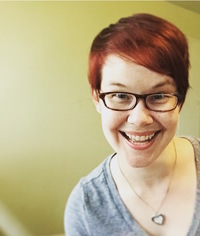
Nicole Dieker is a freelance writer, a senior editor at The Billfold, and a columnist at The Write Life. Her work has appeared in Boing Boing, Popular Science, Scratch, SparkLife, The Freelancer, The Toast, and numerous other publications. The Biographies of Ordinary People is her debut novel, if you don’t count the speculative fiction epic she wrote when she was in high school.

Connect with Nicole

Website ǀ   Twitter  ǀ Instagram Goodreads

Throwback Thursday: Fortune’s Wheel (The Meonbridge Chronicles #1) by Carolyn Hughes

ThrowbackThursday

Throwback Thursday is a weekly meme started by Renee at It’s Book Talk.  It’s designed as an opportunity to share old favourites as well as books that we’ve finally got around to reading that were published over a year ago.

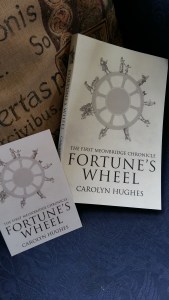
Today I’m revisiting a book I reviewed in December 2017 – Fortune’s Wheel by Carolyn Hughes.  Published in November 2016, Fortune’s Wheel is the first book in The Meonbridge Chronicles series.  The second book, A Woman’s Lot, is due to be published on 4th June 2018, and I was delighted to take part in the cover reveal for A Woman’s Lot earlier today.  Do look out for my review of A Woman’s Lot as part of the blog tour in June.

You can also read my review of Maiden’s Chance, an as yet unpublished novella by Carolyn featuring some of the Meonbridge characters.  Carolyn will send it to subscribers to her newsletter so, if you fancy joining her support team, sign up here.


FortunesWheelAbout the Book

June 1349. In a Hampshire village, the worst plague in England’s history has wiped out half its population, including Alice atte Wode’s husband and eldest son. The plague arrived only days after Alice’s daughter Agnes mysteriously disappeared, and it prevented the search for her. Now the plague is over, the village is trying to return to normal life, but it’s hard, with so much to do and so few left to do it. Conflict is growing between the manor and its tenants, as the workers realise their very scarceness means they’re more valuable than before: they can demand higher wages, take on spare land, and have a better life. This is the chance they’ve all been waiting for. Although she understands their demands, Alice is disheartened that the search for Agnes is once more put on hold. When one of the rebels is killed, and then the lord’s son is found murdered, it seems the two deaths may be connected, both to each other and to Agnes’s disappearance.

Format: ebook, paperbook (270 pp.)    Publisher: SilverWood Books
Published: 7th November 2016              Genre: Historical Fiction

Purchase Links*
Publisher | Amazon.co.uk  ǀ  Amazon.com  ǀ Hive.co.uk (supporting local UK bookshops)
*links provided for convenience, not as part of any affiliate programme

Find Fortune’s Wheel on Goodreads


My Review

Carolyn Hughes has chosen to set Fortune’s Wheel, the first in her Meonbridge Chronicles series, in the aftermath of The Black Death (referred to by the villagers as the ‘mortality’). This is a time of terrible bereavement – husbands have lost wives, wives have lost husbands, couples have lost children, children have been orphaned and, in some tragic cases, whole families have perished. Fields lie untended, cottages lie empty and the surviving villagers face straitened times and an uncertain future. Not least because if the ‘mortality’ was indeed sent by God to punish sinners, as their priests tell them, what’s to say it might not return? But, if it was sent by God, why were some known to be sinners spared and others – innocent babes, godly men and pious women – taken?

I really felt I became part of the village of Meonbridge and totally immersed in the lives of the villagers. There are a lot of characters to get to know initially so I appreciated the helpful list at the beginning of the book. However, it would be an unusual and rather uninteresting village if it didn’t have a varied population and, since the story has three main protagonists, I never felt overwhelmed. The three protagonists are all female and I really enjoyed the independence of spirit they shared, given the constraints of society’s expectations at that time. There is Alice, sadly widowed by the ‘mortality’ but determined not to remarry and to retain her independence. There is Eleanor, a freewoman thrust into the role of managing her own lands by the death of her parents and resolved to remain unmarried until she is ready for matrimony. And there is Lady Margaret, wife of the Lord of the Manor, who subtly seeks to mitigate the stern justice meted out by her husband on the tenants and workers of the manor.

As the inhabitants of Meonbridge struggle to overcome the ravages of the ‘mortality’ and rebuild their lives, Alice and her son, John, continue to be troubled by the disappearance of Alice’s daughter, Agnes, shortly before the ‘mortality’ struck. They’re both convinced that others know more about Agnes’ disappearance than they are saying. Is she dead, or alive and, if she still lives, why did she run away?

The ‘mortality’ is bringing other changes to the village, with some using the economic realities of a reduced population to challenge the feudal system that has ruled their lives for so long. However, there are those whose position would be threatened by any change in the balance of power.  Who knows to what lengths they will go to protect the status they currently enjoy?

One of the many interesting things I learned from Fortune’s Wheel was that there was a hierarchy amongst the peasantry as well as between the peasants and the landowners. The book contains fascinating detail about the feudal system: the obligations demanded with limited rights offered in return, the restrictions with few freedoms given in exchange and the many payments that could be demanded with refusal risking loss of home, property or livelihood.  The book also really brought home to me how little the ordinary villagers knew of life outside the confines of the village, often living and dying without ever travelling more than a few miles from their birthplace.

I loved all the detail of village life which gave the story such an authentic feel. Clearly, the author has done an incredible amount of research, introducing me to new terms – merchet, legerwite, heriot – and the many different roles necessary to village life – bailiff, steward, reeve and (my favourite) ale-taster. A glossary would be a fantastic addition to the book and I’d also love to have a map of the village.  There are many fascinating articles on Carolyn’s blog, including this one about life after The Black Death.

As you can probably tell, I really enjoyed Fortune’s Wheel and thought it was an accomplished, fascinating historical fiction novel – and an impressive debut. I was thrilled to learn the author is working on a second book in the series, A Woman’s Lot, and that this is due for publication in 2018. I’ll certainly look forward to reading more about the lives of the people of Meonbridge.

I received a copy of Fortune’s Wheel in a giveaway organised by Brook Cottage Books. I’d like to thank Carolyn for providing the book as a prize and for signing my copy.

Follow my blog with Bloglovin

In three words: Well-researched, engaging, mystery

Try something similar… The Last Hours by Minette Walters (click here to read my review)


Carolyn HughesAbout the Author

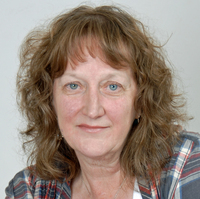
Carolyn Hughes was born in London, but has lived most of her life in Hampshire. After a first degree in Classics and English, she started her working life as a computer programmer, in those days a very new profession. It was fun for a few years, but she left to become a school careers officer in Dorset. But it was when she discovered technical authoring that she knew she had found her vocation. She spent the next few decades writing and editing all sorts of material, some fascinating, some dull, for a wide variety of clients, including an international hotel group, medical instrument manufacturers and the Government.

She has written creatively for most of her adult life, but it was not until her children grew up and flew the nest, several years ago, that creative writing and, especially, writing historical fiction, took centre stage in her life. She has a Masters in Creative Writing from Portsmouth University, and a PhD from the University of Southampton.

Connect with Carolyn

Website  ǀ  Blog | Facebook  | Twitter ǀ  Goodreads