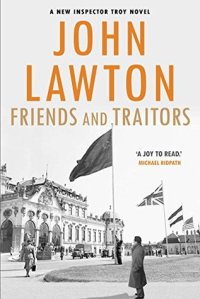
Book Review: Friends and Traitors (Inspector Troy #8) by John Lawton

Friends and TraitorsAbout the Book

It is 1958. Chief Superintendent Frederick Troy of Scotland Yard, newly promoted after good service during Nikita Khrushchev’s visit to Britain, is not looking forward to a Continental trip with his older brother, Rod. Rod was too vain to celebrate being fifty so instead takes his entire family on ‘the Grand Tour’ for his fifty-first birthday: Paris, Sienna, Florence, Vienna, Amsterdam. Restaurants, galleries and concert halls. But Frederick Troy never gets to Amsterdam.

After a concert in Vienna he is approached by an old friend whom he has not seen for years – Guy Burgess, a spy for the Soviets, who says something extraordinary: ‘I want to come home.’ Troy dumps the problem on MI5 who send an agent to de-brief Burgess – but the man is gunned down only yards from the embassy, and after that, the whole plan unravels with alarming speed and Troy finds himself a suspect.

As he fights to prove his innocence, Troy finds that Burgess is not the only ghost who returns to haunt him.

Format: ebook, hardcover (343 pp.) Publisher: Grove Press
Published in UK: 5th April 2018        Genre: Historical Fiction, Crime, Thriller

Purchase Links*
Amazon.co.uk ǀ  Amazon.com ǀ Hive.co.uk (supporting UK bookshops)
*links provided for convenience, not as part of any affiliate programme

Find Friends and Traitors on Goodreads


My Review

I seem to be making a habit recently of coming in at an advanced stage of a series. As a case in point, Friends and Traitors is book eight in John Lawton’s Inspector Troy series.  (However, it’s not quite as bad as a book I’m shortly to read – Prussian Blue by the late lamented Philip Kerr – which is number twelve in his Bernie Gunther series.)

As a sign of how far we are into the series, Inspector Troy is now a Chief Superintendent in charge of the Murder Squad.   However, the author is kind to readers like myself who haven’t read previous books in the series, because the first part of Friends and Traitors takes us back to when Troy was a young man and to his first meeting with Guy Burgess at a family dinner party.  Over the next few years, Troy has a number of memorable encounters with Burgess, one of which will prove to be crucial to events later in the book.

The Guy Burgess of Friends and Traitors is the louche, sexually promiscuous, heavy drinking risk-taker that I remember from Alan Bennett’s television play, An Englishman Abroad (with the inimitable Alan Bates playing Burgess).  However, he’s also terrifically entertaining. ‘It occurred to Troy that Burgess was the kind of bloke who’d never leave a party until physically thrown out.’ The author gives Burgess some great lines: ‘Two things an Englishman should never go abroad without – Jane Austen and a badger-hair shaving brush.’   There is also a brilliant section after Burgess’ defection where he lists at length all the things he misses about England, including ‘the bloke in the pub in Holborn who could fart the national anthem’, Mantovani, his flannelette stripy pyjamas and ‘jellied eels and a bit of rough’. (There’s a lot more.)

Talking of risk takers, Troy is a bit of one himself.  Clever, well-read and resourceful, he nevertheless gets himself into some scrapes, many of them involving women.  And every so often in Friends and Traitors, the author drops in a nugget of sometimes quite surprising information about Troy’s past.     Troy’s family contain some characters as well, especially his sisters who also have a chequered history when it comes to relationships (with men and booze).

The book did feel a little fragmented at times as if a number of different stories had been melded together.  For instance, there is section in which Troy joins members of his family on a ‘Grand Tour’ of European capitals whose main purpose seems to be to place Troy in Vienna at a pivotal moment.  And the murder of the agent mentioned in the book description and Troy’s subsequent investigation of it doesn’t happen until around half way through the book.

However, I really enjoyed Friends and Traitors and the fragments of information about Troy’s previous exploits have made me keen to read earlier books in the series.  Who knows, I might even break with habit and start from the beginning!  As a fan of espionage stories, including John le Carré, I found the sections of the book about Guy Burgess really fascinating.   I recommend reading the author’s Afterword which includes details of his research and key sources.

I received an advance reader copy courtesy of NetGalley and publishers Grove Press in return for an honest and unbiased review.

Follow my blog with Bloglovin

In three words: Suspenseful, mystery, intriguing

Try something similar…Tightrope by Simon Mawer (click here to read my review)


John LawtonAbout the Author

John Lawton is a producer/director in television who has spent much of his time interpreting the USA to the English, and occasionally vice versa. He has worked with Gore Vidal, Neil Simon, Scott Turow, Noam Chomsky, Fay Weldon, Harold Pinter and Kathy Acker. He thinks he may well be the only TV director ever to be named in a Parliamentary Bill in the British House of Lords as an offender against taste and balance. He has also been denounced from the pulpit in Mississippi as a `Communist,’ but thinks that less remarkable.

He spent most of the 90s in New York – among other things attending the writers’ sessions at The Actors’ Studio under Norman Mailer – and has visited or worked in more than half the 50 states. Since 2000 he has lived in the high, wet hills of Derbyshire England, with frequent excursions into the high, dry hills of Arizona and Italy.

He is the author of 1963, a social and political history of the Kennedy-Macmillan years, eight thrillers in the Troy series and a stand-alone novel, Sweet Sunday.  In 1995 the first Troy novel, Black Out, won the WH Smith Fresh Talent Award. In 2006 Columbia Pictures bought the fourth Troy novel Riptide. In 2007 A Little White Death was a New York Times notable.

In 2008 he was one of only half a dozen living English writers to be named in the London Daily Telegraph‘s `50 Crime Writers to Read before You Die.’ He has also edited the poetry of DH Lawrence and the stories of Joseph Conrad. He is devoted to the work of Franz Schubert, Cormac McCarthy, Art Tatum and Barbara Gowdy.

Connect with John

Website  ǀ  Goodreads

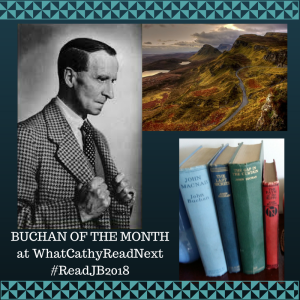
Buchan of the Month: Mr. Standfast by John Buchan

Buchan of the Month

JohnBuchanThrillersAbout the Book

“First we must go through the Valley of the Shadow…And there is the sacrifice to be made…the best of us.”

It is 1917 and Richard Hannay is brought out of the battlefield to perform the desperate task of tracking down and destroying a network of German spies.  Hannay’s opponent is Moxon Ivery, the bland master of disguise, who seeks to outwit Hannay and he and his agents are pursued through England, Scotland, France and Switzerland.

For its pace and suspense, its changes of scene, and thrilling descriptions of the last great battles against the Germans, Mr Standfast offers everything that has made its author so enduringly popular.

Format: Paperback (354 pp.)        Publisher: Oxford University Press
Published: 1993 [1919]                  Genre: Thriller, Adventure

Purchase Links*
Amazon.co.uk  ǀ  Amazon.com  ǀ Hive.co.uk (supporting UK bookshops)
*links provided for convenience, not as part of any affiliate programme

 Find Mr. Standfast on Goodreads


My Review

Mr. Standfast is the third book in my Buchan of the Month reading project.  For a spoiler-free introduction to Mr. Standfast, including details of its first publication and context, click here.  To find out more about the project and my reading list for 2018, click here.

Before I say any more, I’ll confess that Mr. Standfast is a book I’ve read many times before and it happens to be one of my favorite Buchan books (alongside Sick Heart River, which I shall be reading later this year).  For me, it has everything: a mystery, some thrilling set pieces, great characters, numerous locations, a touch of romance and some chilling scenes on the battlefields of World War One France.  I always get a bit tearful at the end.  As well as being a very entertaining book, Mr. Standfast explores some serious themes – courage, fortitude, sacrifice.

Since the title refers to one of the characters in John Bunyan’s The Pilgrim’s Progress, it’s probably no surprise that Mr. Standfast has a number of allusions and references to Bunyan’s work.  The Pilgrim’s Progress was an important text for Buchan and it informs many of the themes in Mr. Standfast mentioned above.  Full disclosure: my dissertation for my MA in English from The Open University was on the subject of the influence of The Pilgrim’s Progress on John Buchan’s books.  Don’t worry, I’m not going to test your patience by quoting from it extensively.  However, just a few thoughts on the connections between the two texts…

In his autobiography Memory-Hold-The-Door, Buchan attributes his regard for The Pilgrim’s Progress to ‘its picture of life as a pilgrimage over hill and dale, where surprising adventures lurked by the wayside, a hard road with now and then long views to cheer the traveller and a great brightness at the end of it’.   The reference to the journey being ‘over hills and dales’ acknowledges that life brings moments of difficulty and challenge as well as ease, involving either physical or mental effort. The  journey features ‘surprising adventures’ – the use of the word ‘adventures’ rather than ‘experiences’ suggesting that these will be exciting episodes – but these ‘lurk’ by the wayside.  There is a sense of the unexpected, of danger in the choice of the word ‘lurk’.  All of these elements I feel are apparent in Mr. Standfast.

As well as having thematic influences, The Pilgrim’s Progress, as a physical object, plays a role in Mr. Standfast.  It acts variously as a prize, a code-book and a source of moral comfort.

For example, The Pilgrim’s Progress is one of Peter Pienaar’s few cherished possessions; with the Bible, it acts as a source of comfort during his captivity in a German prisoner-of-war camp.  Pienaar, one of the most endearing characters in Mr. Standfast, is described as ‘puzzling over it’, using it as one of his ‘chief aids in reflection’ and for ‘self-examination’.  Peter searches The Pilgrim’s Progress for examples that he can apply to his own predicament.  Charmingly, Peter takes everything in The Pilgrim’s Progress literally and talks about the character Mr. Standfast ‘as if he were a friend’.  Arguably, Peter’s identification with the characters in The Pilgrim’s Progress in part inspires his actions at the end of the book.

For Richard Hannay, The Pilgrim’s Progress has a more practical and utilitarian function; he describes it as one of his ‘working tools’.  For example, it alerts Hannay to the fact that someone has searched his belongings as he observes ‘a receipted bill which I had stuck in The Pilgrim’s Progress to mark my place had been moved’.  Later, it provides a method of authenticating the character Hannay has adopted (he likes his disguises!).  Producing his copy of The Pilgrim’s Progress to the old postmistress of a Highland village, it creates a shared cultural connection between them as she comments, ‘I got it for a prize in the Sabbath School when I was a lassie’.

One of the most notable roles for The Pilgrim’s Progress in Mr. Standfast is as a means of communication between Hannay and his comrades.  This discourse operates at two levels: as a common language to express feelings, anxieties and hopes and, at a practical level, as a code for secret communications between the characters.  In particular, The Pilgrim’s Progress becomes a key part of the burgeoning relationship between Mary Lamington and Hannay.   At one point, Hannay sends a message of reassurance for Mary: ‘If you see Miss Lamington you can tell her I’m past the Hill Difficulty.  I’m coming back as soon as God will let me’.

There is a lot more I could say on the links between the two texts but I’ll just close by saying that Mr. Standfast is a great story even if you have no knowledge of The Pilgrim’s Porogress.  If, however, you are familiar with Bunyan’s work, you’ll have fun spotting other references and allusions.  I think Mr. Standfast is the best of Buchan’s Richard Hannay adventures and one of the finest books he wrote.

Follow my blog with Bloglovin

In three words: Thrilling, action-packed, moving


John BuchanAbout the Author

John Buchan (1875 – 1940) was an author, poet, lawyer, publisher, journalist, war correspondent, Member of Parliament, University Chancellor, keen angler and family man.  He was ennobled and, as Lord Tweedsmuir, became Governor-General of Canada.  In this role, he signed Canada’s entry into the Second World War.   Nowadays he is probably best known – maybe only known – as the author of The Thirty-Nine Steps.  However, in his lifetime he published over 100 books: fiction, poetry, short stories, biographies, memoirs and history.

You can find out more about John Buchan, his life and literary output by visiting The John Buchan Society website.