
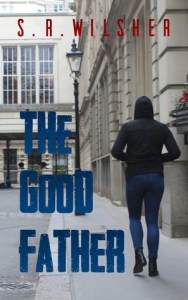
Book Review: The Good Father by S. R. Wilsher

TheGoodFatherAbout the Book

In 1994, nine year old Effie and her twelve year old brother Ajan, endure the horrors of life in the besieged city of Sarajevo after the loss of their parents. Desperate to help preserve their city, Ajan becomes involved with a criminal gang among the makeshift defenders. When Effie is forced to flee alone, she must survive long enough to reach those outside of the city who have come to help. But the influence of those pursuing her is such that not even the soldiers of the UN might be able to save her. Any hope of a future for Effie eventually lies with only one man, Captain Nathan Lane.

It is 2017, and an attempt is made on the life of Foreign Secretary, Caroline Hardy. As the Security Services hunt for her attacker, the reality she is only a bit part player in the affair doesn’t occur to anyone. Not until her daughter, Mia goes missing and is implicated in the disappearance of a well-connected lawyer. As the focus switches to Mia, a secret that Caroline has kept hidden for a long time threatens them both, until there becomes only one place she can turn, to the man who shares her secret.

Format: ebook (434 pp.)                   Publisher:
Published: 27th April 2017               Genre: Contemporary Fiction, Thriller

Purchase Links*
Amazon.co.uk  ǀ  Amazon.com
*links provided for convenience, not as part of any affiliate programme

Find The Good Father on Goodreads


My Review

Recent events in Syria have brought to the fore the legitimacy and efficacy of countries intervening in conflicts in another sovereign state, even if only for humanitarian reasons.    This came to mind as I was reading the opening scenes of the book set in the Bosnian conflict in the 1990s, during which terrible atrocities were committed.  The author convincingly portrays the devastation wrought by the bombing of Sarajevo and the effect on the population: the constant risk from snipers, homes reduced to rubble, public services including hospitals destroyed, and those inhabitants who remain struggling to find enough food and shelter to keep themselves alive.

‘Each season throws up its impossible challenges.  People die from cold in the winter.  While in summer they die from complacency. Food and water and shelter are issues every day irrespective of where the sun sits in the sky.  The snipers and the artillery are indifferent to the time of year.  Death enjoys every day.’  

In particular, the story focuses on the children affected by the conflict, many of them orphans left to fend for themselves or join feral gangs, open to exploitation.  If they survive it’s because they have learned to steal, trust no-one and fight for their lives if necessary.  It’s a chilling picture of stolen youth brought vividly to life through the characters of Effie and her brother, Ajan.

The action moves ahead twenty-three years and, in what initially seems to be a separate storyline, an assassination attempt is made on British Foreign Secretary, Caroline Hardy.  Both she and her daughter, Mia, who was in the car at the time it was forced off the road, escape with their lives although Mia is injured.  When a further incident occurs, Caroline begins to wonder if she was actually the intended target or if the answer lies in secrets from the past.  Some people, it seems, have long memories and, as the saying goes, revenge is a dish best served cold.

Caroline enlists the investigative assistance of Nathan Lane, a former army officer, who shares her secret.   It’s not long before Nathan realises the case is more complex than it first appeared and the would-be assassin is not the only person motivated by revenge for past events.  As well as following Nathan’s investigation, the reader is given an insight into Mia’s life in the weeks leading up to the assassination attempt.  The book builds to an action-packed conclusion by which time I was convinced that if I’m ever in trouble, I want a Nathan Lane in my life. (And not only if I’m in trouble, I confess.)

I feel bad it’s taken me so long to get round to reading The Good Father, not only because the author has been patiently awaiting my review but because I’ve deprived myself of a really entertaining thriller.  The Good Father also scores points for having the first mention of Brexit and its implications I’ve come across in a book. You can read the interview I conducted last year with S. R. Wilsher about the book and his writing journey here. 

Thank you to the author for my review copy in return for an honest and unbiased review. 

Follow my blog with Bloglovin

In three words: Compelling, action-packed, suspenseful

Try something similar…The Last Train by Michael Pronko (click here for my review)


SRWilsherAbout the Author

S. R. Wilsher writes: “I began writing when I was twenty, even though I was uncertain that I had a book in me. And I was so afraid of being a failed writer that, for a very long time, nobody knew I wrote. I’ve dealt with that fear of failing by always continuing to write. I figure that if I keep going I’ve not failed yet.

I resisted self-publishing for years, having grown up in an era where the only alternative to traditional publishing was vanity publishing. But, eventually, I decided to stop hiding inside a bubble of rewriting based only on second-guessing rejection letters, and accepted that the traditional route was closed to me. The thirty years of rejections might have been trying to tell me something, but they rarely spelled out whether I should write or not. I hoped self-publishing would supply that answer. That’s why I’m always grateful for reviews, as they encourage me to keep trying.

However, I continue to write for no other reason than I enjoy it deeply. I like the challenge of making a story work. I get a thrill from tinkering with the structure, of creating characters that I care about, and of manipulating a plot that unravels unpredictably yet, hopefully, logically. I like to write myself into a corner and then see how I can escape. To me, writing is a puzzle I like to spend my time trying to solve. Publication is the deep sigh of setting the completed puzzle aside. The marketing bit beyond that is something else entirely!”

Connect with S. R. Wilsher

Website  ǀ  Twitter  ǀ  Goodreads

Blog Tour/Q&A: The Picture by Roger Bray

I’m delighted to be co-hosting today’s stop on the blog tour for The Picture by Roger Bray and thrilled that Roger has agreed to answer some of my questions about the book, its inspiration and his writing journey.

Do check out the reviews of The Picture by my co-hosts, Whispering Stories and Books, Life and Everything.

Follow my blog with Bloglovin


The PictureAbout the Book

A warehouse in Japan used as an emergency shelter in the aftermath of the 2011 Tsunami. A distraught, young Japanese woman in dishevelled clothes sits on a box, holding her infant daughter. Ben, a US rescue volunteer, kneels in front of her offering comfort. They hug, the baby between them. The moment turns into an hour as the woman sobs into his shoulder; mourning the loss of her husband, her home, the life she knew.

A picture is taken, capturing the moment. It becomes a symbol; of help freely given and of the hope of the survivors. The faces in the picture cannot be recognised, and that is how Ben likes it. No celebrity, thanks not required.  But others believe that being identified as the person in the picture is their path to fame and fortune. Ben stands, unknowingly, in their way, but nothing a contract killing cannot fix.

Format: ebook, paperback (364 pp.) Publisher:
Published: 13th April 2018                  Genre: Thriller

Pre-order/Purchase Links*
Amazon.co.uk  ǀ  Amazon.com
*links provided for convenience, not as part of any affiliate programme

Find The Picture on Goodreads


Interview: Roger Bray, author of The Picture

Welcome, Roger, to What Cathy Read Next.  Without giving too much away, can you tell me a bit about The Picture?

The Picture tells the story of Ben Davis, a retired Portland Oregon Police officer who volunteers in disaster rescue.  His group is asked to assist in Japan in the aftermath of the 2011 Tōhoku earthquake and tsunami.  While he is there he helps a young Japanese mother and her baby daughter and the eponymous picture is taken of the encounter.  It becomes a symbol of the suffering of the people but also of hope as the world rallied to aid them.  Although the picture becomes famous neither Ben nor the girl can be recognized, which he is happy about because he does not want to gain celebrity or fame on the back of suffering.  There is conjecture as to who the male is and a conman uses the picture for his own ends pretending to be Ben.  The need to use the picture becomes more urgent as a potential reality TV show is offered to him.  Legal means are tried to gain the copyright of the picture, together with a gag order, which Ben refuses so the conman and his business partner decide that Ben must be killed and try to organise an accidental looking death for him.

How did you get the idea for the story?

I had half an idea for a story about vacuous celebrity and the lengths these people will go to to get into and stay in the limelight, and to make money.  I was then standing on my veranda one cloudy, grey morning when a bean of sunlight broke through, very tight and focussed on a small piece of the courtyard.  The moment stayed with me and I imagined how that moment could be adapted into a story line.  I had the picture scene, and the who, where, how and why, set in my mind within a couple of days.  I considered my ‘celebrity’ idea and thought the picture the perfect catalyst as a symbol of hope being corrupted through greed

To what extent is what happens to Ben a reflection of how social media is transforming the way news travels?

Jonathan Swift wrote in The Examiner, Nov. 9, 1710: “Falsehood flies, and the truth comes limping after it” and that is a good reflection of the power and corruption of social media.  If something is repeated sufficiently it enters the social hive mind as the truth.  People take things for granted; accept what is said without the need for verification.  Before social media, what happened to Ben could probably not have occurred.  Since social media the truth is governed by a slick advertising campaign rather than facts.

The Picture explores what people will do for fame and fortune.  What is it about this that interests you?

There is a narcissistic trait in all of us, on, I guess, a sliding scale from imperceptible to governing behaviour.  Celebrity driven people, and I am talking about celebrity for its own sake without any talent like a certain Armenian family whose discernible talents are best described in a Parks and Recreation out-take.  When you add a sociopathic overlay to that you find people who will do anything and trample on anyone to achieve celebrity.  This is not new but social media and myriad cable TV channels have taken the concept to a whole new level.  I find the whole situation absurd, what is important in life, what people should care about is being buried under a mountain of celebrity driven effluent.

Were there particular scenes in the book you found especially challenging – or rewarding – to write?

I was particularly happy with the scene from which the titular picture came from but also the extended scenes of the devastation and survival of the young Japanese woman Ben encounters.

Do you have a favourite place to write or any writing rituals?

No.  I do like to set aside blocks of days to write.  I find my writing benefits from being able to immerse myself in the story to date before continuing.   My favourite place is wherever my wife and her overly cute cat are, although he can make writing difficult when he decides the keyboard is the perfect place for a nap.

What’s your favourite and least favourite part of the writing process?

I enjoy all of the writing process.  I can get frustrated if I hit a block but have found that continuing to write through breaks that.  Don’t expect perfection all the time, just keep the words flowing.  My least favourite part, and it is still part of the writing process, is between typing ‘The End’ and publication.  I have a great editor and the process with her is always a learning experience but the time to publication seems to take forever for all the other things that have to be done: cover proposals, e-books and the like.

Which authors do you admire and enjoy reading?

I like Robert Harris as his novels never cease to entertain.  He is not locked into a genre so each one is new and fresh.  Tom Sharpe is a favourite; I think his books are genius, turning the most absurd situations into hilarity.  Some of his funniest moments could easily be the truth and that makes them all the funnier.  I also enjoy Stuart McBride, Sebastian Faulks and Louis de Bernières, among many others

You describe your life as having been ‘an endless adventure’. What have been some of the highlights?

Normal things I suppose: my marriage to my wife of now 30 + years, the birth of our children.  I served in the Navy as an aircraft armourer and was in the Falklands War on the blunt end of a civilian container ship hastily converted into a helicopter carrier.  I have travelled the world in the Navy from the Arctic to the Great Australian Bight and many places between.  I was a Police Officer for many years and saw the best, and worst, that society can offer.  I lived in Germany for a couple of years, which I loved, and took the opportunity to travel in Europe as much as possible.  I survived a serious spinal injury, because of which I was medically retired from the police, went to University and gained a couple of degrees.  I believe life is about experiences and I am giving it the best go I can.  [Hmm, that doesn’t sound ‘normal’ to me!]

What are you working on next?

I am currently working on a novel, also based in Oregon about a young woman who has fought against her institutionalised upbringing to make something of herself.  She finds that there are people along the way who will help her and some who won’t.  Past events to which she is unknowingly connected are catching up with her and she has to find the truth of them before it too late.

Thanks very much for having me on your blog and giving me the opportunity to answer your interesting questions.

Thank you, Roger, for your fascinating and illuminating answers.


Roger BrayAbout the Author

Roger writes: ‘I have always loved writing; putting words onto a page and bringing characters to life. I can almost feel myself becoming immersed into their lives, living with their fears and triumphs. Thus, my writing process becomes an endless series of questions. What would she or he do, how would they react, is this in keeping with their character? Strange as it sounds, I don’t like leaving characters in cliffhanging situations without giving them an ending, whichever way it develops.

My life to date is what compels me to seek a just outcome, the good will overcome and the bad will be punished. More though, I tend to see my characters as everyday people in extraordinary circumstances, but in which we may all find ourselves if the planets align wrongly or for whatever reason you might consider. Of course, most novels are autobiographical in some way. You must draw on your own experiences of life and from events you have experienced to get the inspiration.

My life has been an endless adventure. Serving in the Navy, fighting in wars, serving as a Police officer and the experiences each one of those have brought have all drawn me to this point, but it was a downside to my police service that was the catalyst for my writing. Medically retired after being seriously injured while protecting a woman in a domestic violence situation I then experienced the other side of life. Depression and rejection. Giving truth to the oft said saying that when one door closes another opens I pulled myself up and enrolled in college gaining bachelor and master degrees, for my own development rather than any professional need. The process of learning, of getting words down onto the page again relit my passion for writing in a way that I hadn’t felt since high school.

So here we are, two books published and another on track.

Where it will take me I have no idea but I am going to enjoy getting there and if my writing can bring some small pleasure into people’s lives along the way, then I consider that I will have succeeded in life.’

Connect with Roger

Website ǀ  Facebook  ǀ  Twitter ǀ  GoodreadsThe Picture Full Banner