
 About the Book
When the top American diplomat in Tokyo, Bernard Mattson, is killed, he leaves more than a lifetime of successful Japan-American negotiations. He leaves a missing manuscript, boxes of research, a lost keynote speech and a tangled web of relations.
When his alluring daughter, Jamie, returns from America wanting answers, finding only threats, Detective Hiroshi Shimizu is dragged from the safe confines of his office into the street-level realities of Pacific Rim politics.
With help from ex-sumo wrestler Sakaguchi, Hiroshi searches for the killer from back alley bars to government offices, through anti-nuke protests to military conspiracies. When two more bodies turn up, Hiroshi must choose between desire and duty, violence or procedure, before the killer silences his next victim.
Format: Paperback, ebook (339 pp.) Publisher: Raked Gravel Press
Published: 30th September 2018 Genre: Crime, Thriller, Mystery
Purchase Links*
Amazon.co.uk ǀ Amazon.com
*links provided for convenience, not as part of any affiliate programme
Find The Moving Blade (Detective Hiroshi #2) on Goodreads
My Review
“A moving blade is unseen, hidden in the blur of motion, felt but not perceived.”
The Moving Blade is the second book in the Detective Hiroshi series, the sequel to The Last Train which I really enjoyed when I read it at the end of last year. I was thrilled to be offered an advance review copy of The Moving Blade by the author and I’m delighted to report that it was just as enjoyable as its predecessor.
What I really liked about The Last Train was the insight it gave the reader into Japanese culture and its depiction of Tokyo life in all its variety. I’m pleased to say this is equally the case in The Moving Blade, a result, no doubt, of the author’s experience of living and working in Tokyo for some years and of learning to navigate the intricacies of Japan’s social customs.
Like its predecessor, the book reveals the fascinating mix of old and new that makes up Japanese society: high-speed bullet trains and mobile phones alongside ceremonial swords and ancient Japanese woodprints. Once again, I loved the insight into small details of Japanese social customs, such as bowing (‘the most fundamental Japanese ritual’) and the exchange of meishi name cards when meeting someone new. Or the fact that surprises are something largely alien to Japanese culture: ‘In Japan, the details for everything – a meeting, a conference, even a visit with friends – were worked out far in advance.’
Not forgetting, of course, the mouth-watering descriptions of food such as this account of a trip to a ramen shop: ‘Jamie cracked open her chopsticks and surveyed the nori seaweed, chasu pork slices, green scallions and seasoned egg swimming in steaming broth.’ Plus I loved this portrayal of the district of Tokyo that sounds like a book lover’s Paradise. ‘Along the main street of Jinbocho, store windows displayed journals, textbooks, magazines, manga, chapbooks, maps and prints – each store with its own speciality. Library carts, fold-up tables and string-tied stacks of used books spilled onto the sidewalk. Everywhere, people stood reading.’
Of course, alongside all this, there is a deliciously compelling crime mystery at the heart of The Moving Blade with Detective Hiroshi and his colleagues once again facing a ruthless killer. However, this time, Hiroshi’s investigation takes him into a world of political conspiracy and corruption that increasingly seems to encompass the highest levels of power. Along the way, the reader gets a fascinating history lesson about American-Japanese relations since the 1950s and the impact of realpolitik on the decisions governments make. At one point, Hiroshi observes, “I never imagined the past could be so dangerous” and receives the astute response, “Nothing more dangerous”.
Last, but not least, the book presents Hiroshi with an opportunity to renew old friendships and make what might be promising new ones. It also leaves him with some difficult choices about his career and personal life. Oh, and he gets a bit battered and bruised along the way.
The Moving Blade is a compelling crime mystery that vividly brings to life contemporary Tokyo and also provides a fascinating insight into Japanese life and culture. I can’t wait to read the third book in the series, promised for 2019.
I received an advance review copy courtesy of the author.
In three words: Compelling, immersive, suspenseful
Try something similar…The Last Train by Michael Pronko (read my review here which also contains a link to my Q&A with Michael )
 About the Author
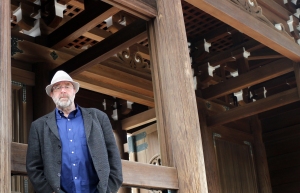
Michael Pronko is the author of three award-winning collections of writings about life in Tokyo: Beauty and Chaos, Tokyo’s Mystery Deepens, and Motions and Moments. His debut novel, The Last Train, a Tokyo mystery, came out in 2017, winning several awards. The follow-up in the Hiroshi series, The Moving Blade, will be released in 2018.
He has written about Japanese culture, art, jazz, society and politics for Newsweek Japan, The Japan Times, Artscape Japan, Jazznin, and ST Shukan. He has appeared on NHK and Nippon Television and runs his own website, Jazz in Japan. A professor of American Literature and Culture at Meiji Gakuin University in Tokyo, after class he wanders Tokyo contemplating its intensity.
Connect with Michael
Website ǀ Facebook ǀ Twitter ǀ Goodreads

 About the Book
 About the Author

