
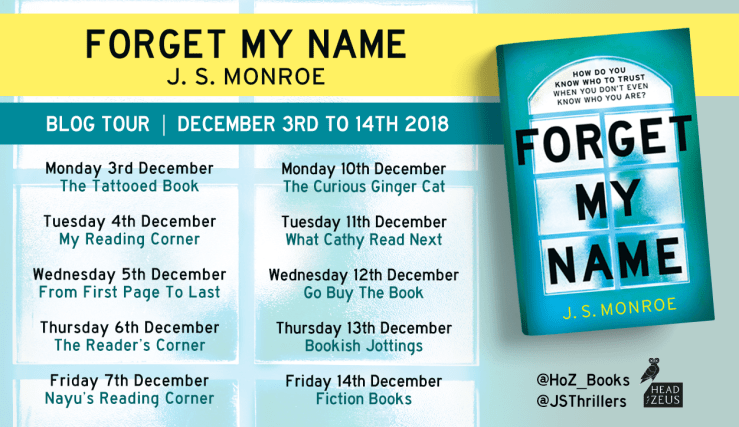
I’m delighted to be hosting today’s stop on the blog tour for Forget My Name by J. S. Monroe. It’s described as ‘a dazzling psychological thriller full of unexpected twists, topped by a savage climax’. Thanks to Jade at Head of Zeus for inviting me to take part in the tour.
I have an absolutely fascinating Q&A with the author in which, among other things, he reveals the secrets to keeping a reader reading, what he’s been reading recently and what he’s working on next. (Fans of Find Me and Forget My Name, you really need to read the answer to that question!)
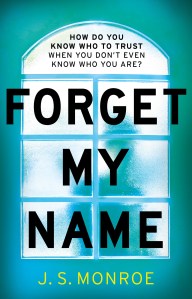 About the Book
How do you know who to trust……when you don’t even know who you are?
You are outside your front door.
There are strangers in your house.
Then you realise. You can’t remember your name.
She arrived at the train station after a difficult week at work. Her bag had been stolen, and with it, her identity. Her whole life was in there – passport, wallet, house key. When she tried to report the theft, she couldn’t remember her own name. All she knew was her own address.
Now she’s outside Tony and Laura’s front door. She says she lives in their home. They say they have never met her before.
One of them is lying.
Format: Hardcover, ebook (416 pp.) Publisher: Head of Zeus
Published: 4th October 2018 Genre: Thriller, Suspense
Purchase Links*
Amazon.co.uk ǀ Amazon.com ǀ Hive.co.uk (supporting UK bookshops)
*links provided for convenience, not as part of any affiliate programme
Find Forget My Name on Goodreads
Interview with J. S. Monroe, author of Forget My Name
Without giving too much away, can you tell us about your latest thriller, Forget My Name?
Forget My Name is an amnesia thriller. It opens with a young woman arriving off the train in a rural Wiltshire village. She is suffering from stress-induced – psychogenic – amnesia and can’t remember her own name. To make matters worse, she has lost her bag with all her ID in it – her phone, bank cards, driving licence etc. All she knows is that she has a connection with this village – she found a train ticket in her pocket – and thinks that she might live here. But when she knocks on the door of her ‘home’, a couple she’s never met before answer the door… I like to dig myself a nice big hole at the beginning of a thriller and see how I can get out of it.
For you, what are the key elements that make a thriller ‘thrilling’? (If that’s not asking you to give too much away!)
I try to imagine someone reading my book late at night and telling themselves: just one more chapter. My goal is to make sure that they keep saying that all night long. So each chapter should end with something that makes the reader want to keep reading. Pace is important, too, both at a micro and macro level – I mix up the length of sentences as well as the length of chapters. And with thrillers, it’s essential to keep the jeopardy dial on 11. But none of this will make for a good thriller unless you create characters that the reader will want to root for.
Are there particular scenes in Forget My Name you found especially challenging – or rewarding – to write?
Without giving too much away, there is a big scene on a canal in the middle of the book, involving a dangerous psychiatric patient and a police Armed Response Unit. My Wiltshire detective, DI Silas Hart, finds himself in the middle of it and I worked hard to get the scene right: a mixture of procedural accuracy, tension and emotion. The key to the scene comes a few chapters before when an important clue is given by switching the first person narrative to third person. I’m intrigued to know how many people will spot this…
When writing a book, what do you find the most difficult to perfect: the first chapter, the last chapter or some other part?
It used to be the first chapter but I’ve learnt not to sweat or lose too much sleep over it now. I get something down early and then refine it later. A big mistake when you are trying to write a novel is to spend hours – days, weeks, months! – on that first chapter, honing and honing it, only for an editor to come along later and say they’d prefer to start the book at chapter 2…
As well as psychological thrillers like Forget My Name and Find Me, you’ve written a number of spy novels (published under the name Jon Stock). You also wrote a novella set in Cornwall, To Snare A Spy, which has a 15 year-old protagonist. Do you enjoy experimenting with different genres and, if so, where might you venture next?
I am planning to stick with my J .S .Monroe novels for the time being. I’ve just signed a contract with Head of Zeus to write two more of them and they’ll be a hybrid mix of psychological thriller and police procedural. I have only recently introduced police elements to my writing and I’m really enjoying it, but I don’t want to write an all-out police procedural thriller. I also think we are moving away from the pure psychological thriller. Readers are looking for something more and I think that a hybrid model fits the bill.
Having said all that, I haven’t ruled out writing more spy thrillers. Warner Bros. spent five years and a lot of money developing the film of Dead Spy Running, one of my spy thrillers. If that ever gets made, I’ll happily write some more of them.
To Snare A Spy was also great fun to write. I was asked to come up with a ‘cross-generational’ spy thriller by a friend who owns The Nare, a wonderful luxury hotel in Cornwall. (Being writer-in-residence was one of the best gigs I’ve ever had!) He wanted it set in and around the hotel, which is on the Roseland Peninsula. I’m very proud of the result. I also ate too many cream teas.
Forget My Name was published on 4th October. Do you have any publication day rituals?
Launch dates are fairly nebulous things these days. 4th October was interesting as it was Super Thursday. Forget My Name was published with 750 other books. Some years I’ve had a launch party but this time I just had a dinner with some local friends and raised a glass to Jemma, the amnesic woman who arrives in a village not dissimilar to where I live…
You have a background in journalism. What impact has that had on your writing? For example, do you find it easier to work to deadlines?
I think that’s very true – publishers seem to like hacks as we are used to hitting deadlines. We are also very familiar with the day-to-day discipline of writing. Once I’ve started a new book, I set myself a target of 1,000 words a day. I also do a lot of research, particularly in the realm of neuroscience, and I think my journalism background helps when I’m interviewing doctors and scientists.
Diane Setterfield, author of The Thirteenth Tale, has said she is ‘a reader first, a writer second’. Is that a view you share?
I’m a reader when I’m not writing a book, but I find it more difficult to read widely once I’m underway on a thriller. During the research stage of a novel, I’ll catch up on other people’s thrillers – I’ve just read and really enjoyed Under The Ice by Rachael Blok – but I tend to read outside my genre when I’m writing, and only in small doses. Short, literary books such as The Lesser Bohemians by Eimear McBride, for example. I’m enjoying that at the moment. I don’t want to be too influenced by fellow thriller authors while I’m actually writing!
What’s your favourite and least favourite part of the writing process?
The actual business of putting 1,000 words down on a page each day is a bit like running. I love it when it’s over! Some days it’s very hard work, and I wonder how and why I’ve ended up earning my living this way. At other times, when the words are flowing, I feel a life-affirming euphoria, but that’s very rare. I also enjoy the polishing process, after all the hard, coal-face work has been done. I used to work in an office and commute four hours every day. I know I’m extremely lucky to be working from home now, and doing something that I love.
What are you working on next?
My next thriller is a modern, high-tech take on an old trope: the doppelgänger. A woman wakes up one morning and is convinced that the man sleeping next to her is not her partner but an imposter… A truly terrifying form of infidelity.
 About the Author
J. S. Monroe read English at Cambridge, worked as a freelance journalist in London and was a regular contributor to BBC Radio 4. Monroe, the author of five other novels, was also a foreign correspondent in Delhi for the Daily Telegraph and was on its staff in London as Weekend editor. He lives in Wiltshire.
Connect with J. S. Monroe
Website ǀ Facebook ǀ Twitter ǀ Instagram ǀ Goodreads

 About the Book
 About the Author


