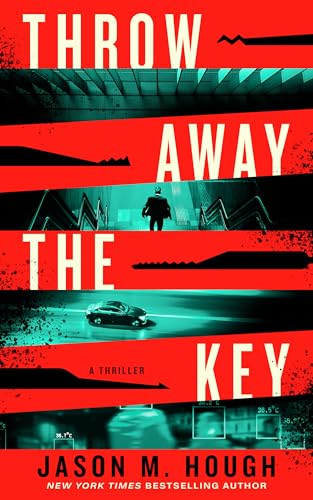
Book Review – Throw Away the Key by Jason M. Hough @crookedlanebks #20BOS26

About the Book

Lars Bergman is no ordinary janitor. He’s the CIA’s locksmith. 

Formerly part of the CIA’s infamous Surreptitious Entry Team, Lars is now responsible for every padlock, safe, and secure door across the CIA headquarters. He’s never met a lock he couldn’t pick…except one, which he tried and failed to open during a botched mission in Warsaw at the end of the Cold War. 

Cruising toward retirement, Lars’s life is upended when a senior CIA official dies and he’s called upon to open the safe in her office. Inside the safe is a clue only Lars would notice, left by someone he’d worked with in his heyday. As he investigates, Lars soon realizes that his failed Warsaw operation has come back to haunt him and perhaps give him another chance at picking the one lock that’s ever eluded him. 

What Lars doesn’t realize is that what the lock is protecting could have dire ramifications for the organization he has spent his whole adult life safekeeping.

Format: Paperback (320 pages) Publisher: Crooked Lane Books
Publication date: 14th July 2026 Genre: Thriller

Find Throw Away the Key on Goodreads

Preorder/Purchase Throw Away the Key from Bookshop.org [Disclosure: If you buy books linked to our site, we may earn a commission from Bookshop.org, whose fees support independent bookshops]

My Review

Cryptic clues – a photograph and a seemingly innocuous document – found in the safe of a deceased senior CIA officer whom Lars worked with many years before sets him on a trail that leads back to Warsaw, the location of a failed ‘off the books’ mission back in 1989. It’s a failure that’s stuck in his mind ever since because it involved one of the very few locks he was unable to pick and, worst of all, he left a trace of his attempt to do so.

Disguising his trip as a long overdue vacation, Lars sets out on a private mission to uncover the truth, weaving a trail across Europe aimed at covering his tracks so as not to attract the attention of his bosses. It means using the ‘tradecraft’ he learned while in the field all those years ago, such as how to spot covert surveillence. Along with his exceptional lockpicking skills, he has to use a good deal of ingenuity, constructing lockpicking tools out of virtually nothing, and his ‘sixth sense’ for when something’s not quite right.

There are some terrific set-pieces, including one in a Swiss bank that could have come out of a heist movie, and some narrow escapes. Lars is definitely a character you can’t help rooting for and I liked he was able to call in favours from people he’d helped over the years.

Eventually, the trail leads back to CIA headquarters and some dramatic scenes as a conspiracy years in the making is revealed. It’s here that Lars’ ingenuity really comes to the fore, proving that the weak points in any organisation’s security are usually at the back door and come with a High Vis jacket.

It’s clear the book is the result of extensive research, especially into locks and lockpicking. I’m not sure I could unpick a lock using the descriptions in the book but that’s my failing not the author’s. However I could bandy around terms such as ‘wiper tension bar’ and ‘shim’. And I now know there is such a thing as competitive lockpicking and that there’s an annual LockCon conference attended by lockpicking experts from across the world.

Throw Away the Key is a really entertaining, well-paced spy thriller. Think the love child of Tinker, Tailor, Soldier, Spy and Mission Impossible.

I received a digital advance reader copy courtesy of Crooked Lane Books. Throw Away the Key is book 8 of my 20 Books of Summer 2026.

In three words: Clever, compelling, pacy
Try something similar: The Scarlet Papers by Matthew Richardson

About the Author

Jason M. Hough (pronounced ‘Huff’) is the New York Times bestselling author of ten novels, including The Dire Earth Cycle, Instinct, and the near-future spy thriller Zero World, which Publisher’s Weekly said is “a thrilling action rampage that confirms Hough as an important new voice in genre fiction.

In a former life he was a 3D artist, animator, and game designer (Metal Fatigue, Aliens vs. Predator: Extinction, and many others). He has worked in the fields of high-performance cluster computing and mobile user interfaces, and is named as co-inventor on three patents related to mobile content and licensing.

He lives near Seattle, Washington with his family. When not writing, reading, or hanging out with his kids, he spends his time chasing espresso perfection (with mixed results), and taking long road trips in his electric car.

Connect with Jason
Website

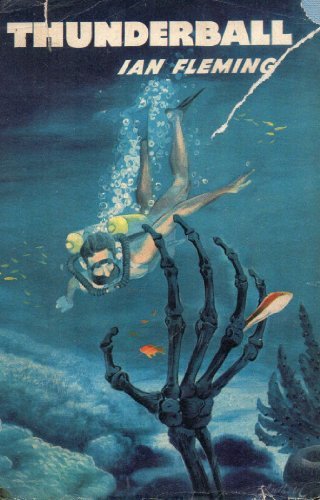
Book Review – Thunderball by Ian Fleming #1961Club

About the Book

James Bond is in disgrace. His monthly medical report is critical of the high-living that is ruining his health, and M packs him off for a fortnight in a nature-cure clinic to be tuned-up to his former pitch of exceptional fitness.

Furiously, Bond undergoes the shame of the carrot-juice and nut-cutlet regime – and thereby minutlely upsets the plans of S.P.E.C.T.R.E, a new adversary, more deadly, more ruthless even than Smersh.

What is S.P.E.C.T.R.E? What are its plans? Alas, the organisation is all too realistically described, its plans all too contemporary for comfort. This, the latest James Bond adventure, casts a long and terrible shadow.

Format: Hardcover (191 pages) Publisher: Jonathan Cape
Publication date: March 1961 Genre: Thriller

Find Thunderball on Goodreads

Purchase Thunderball from Bookshop.org [Disclosure: If you buy books linked to our site, we may earn a commission from Bookshop.org, whose fees support independent bookshops]

My Review

Thunderball is the book I read for the #1961Club, the reading event hosted by Simon at Stuck in a Book and Kaggsy’s Bookish Ramblings that ends today. It’s also one of the books on my second Classics Club list.

Thunderball is the ninth book in Ian Fleming’s spy thriller series starring James Bond. I only know James Bond from the film versions, expecially the classic ones starring Sean Connery, so I was surprised by how closely events in the book resemble the film. As I discovered, there’s a reason for this because the novel is based on an at the time unpublished screenplay that was a collaboration between Ian Fleming and four other people. When it was published under Ian Fleming’s name only a legal case followed.

Thunderball introduces Bond’s future arch-enemy Enrst Stavro Blofeld and his crime organisation S.P.E.C.T.R.E. (the Special Executive for Counter-intelligence, Terrorism, Revenge and Extortion). Blofeld runs S.P.E.C.T.R.E with ruthless fanaticism, despatching members who disappoint him in inventive ways. The book also sees the return of Bond’s friend Felix Leiter, seconded back into the CIA. This is where it can get confusing if you’ve only seen the films because Leiter is bearing the physical evidence of a deadly encounter in an earlier book.

The plot concerns the theft of two atomic bombs by S.P.E.C.T.R.E in a plan to extort a huge ransom from the UK and US governments or risk the bombs being detonated in unnamed locations. The location of the airplane which carried the bombs is unknown but Bond’s boss M has a hunch it might be the Bahamas. Bond’s not so sure but resigns himself to being posted there. After all, there are worse places to be sent. ‘He would get himself a good sunburn, and watch the show from the wings.’ It will come as no surprise that Bond finds himself not on the sidelines but in the thick of it.

The man in charge of S.P.E.C.T.R.E’s plan on the ground is Blofeld’s second-in-command Emilio Largo whose super-yacht, the Disco Volante, is the operation’s headquarters. Aboard the yacht is Largo’s girlfriend, Domino, with whom Bond – naturally – becomes involved. Unknown to Domino she has a connection to S.P.E.C.T.R.E.’s plan and, when she discovers it, she agrees to help Bond, with unpleasant consequences.

Thunderball was a lot of fun. Yes, some of it is dated but I actually found Bond less misogynistic than I expected. There’s actually a quite tender scene at the end. The plot cleverly feeds in to contemporary concerns about nuclear weapons and introduces some great villains. There are exciting underwater scenes, especially towards the end of the book.

You get the sense Fleming’s Bond possesses many of the characteristics of his creator. A heavy smoker, a connoisseur of cocktails, thoroughly at home at the gaming table and with a taste for fast cars.

In three words: Exciting, glamorous, suspensful

About the Author

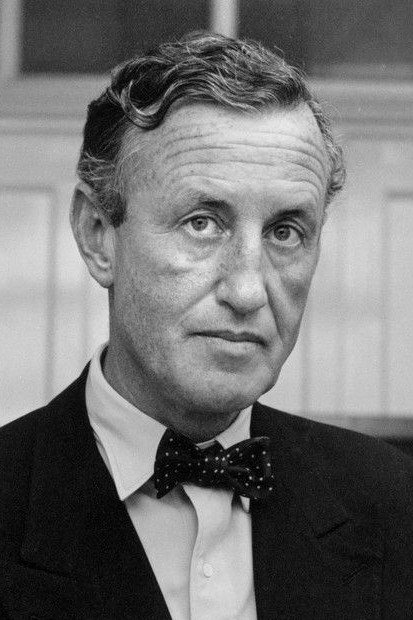
Ian Fleming was born in 1908. Best known for his post-war James Bond series of spy novels, he came from a wealthy family. Educated at Eton, Sandhurst, and, briefly, the universities of Munich and Geneva, Fleming moved through several jobs before he started writing. He worked for Britain’s Naval Intelligence Division during the Second World War, drawing from his wartime service and career as a journalist for much of the background, detail, and depth of his James Bond novels. Fleming wrote his first Bond novel, Casino Royale, in 1952. It was a success and eleven Bond novels and two collections of short stories followed between 1953 and 1966. Fleming was a heavy smoker and drinker for most of his life and succumbed to heart disease in 1964 at the age of 56. Two of his James Bond books were published posthumously; other writers have since produced Bond novels. Fleming’s creation has appeared in film twenty-seven times, portrayed by six actors in the official film series.