
My guest today on What Cathy Read Next is Miles Joyner. His debut novel Bazaar will be published on 24th March 2025 by World Castle Publishing. It’s been described by one reviewer as a ‘high stakes action story’ and ‘a gangland technothriller’ whilst another has praised the author’s ability to ‘balance pulse-pounding action with social commentary’.
I’m delighted to bring you an extract from Bazaar which is available to pre-order now from Amazon UK.
About the Book
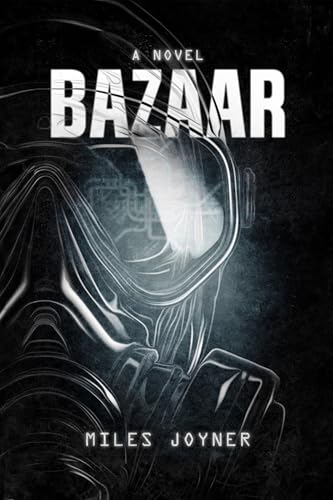
A high-profile homicide of a former ambassador’s son in the nightlife district of the nation’s capital gets connected to an assassination market on the dark web, turning the DC area into a battlefield over a new generation of class warfare.
When the ex-diplomat, Chiedu Attah, hires an elite executive protection team headed by siblings Yemi and Karen Uzunma to guarantee his safety, the security firm realizes they are going up against a young, inventive contract killer who is determined to finish off the political VIP by any means necessary.
Find Bazaar on Goodreads
Extract from Bazaar by Miles Joyner
Aaron looked around from the back passenger seat as the early 2000s Camry passed through an automatically opened gated fence. The “O.G.” lived in a three-floor playboy manor with a fully lit pool on a street that made Aaron’s old neighborhood look like the one he was just kidnapped from. The blocks weren’t lined with cookie-cutter McMansions like where his father had purchased a house for the Williams family. White oak trees flourished across the acres between the houses and each home design seemed like they had their own distinct architect. Qasim walked Aaron up the marble steps, and Aaron stared at the stone lions in the front yard.
A man in his late 40s opened the front door. He was 6’2, with a well-combed lion mane of a beard against a dark complexion, and he wore a red flight jacket issued by the DC Department of Health. He was probably the fastest linebacker in high school or competed for some type of golden gloves despite his gut. He was grinning at first, happy to see Aaron.
“Hello—” The man suddenly got a whiff of Qasim’s marijuana habit and immediately reversed the direction on his face. The kid’s eyes were bloodshot red off a blunt ride the whole trip from Temple Hills. “Inside. Now.”
A spiral staircase greeted them in the living room. The interior solidified that it was the highest-priced house Aaron had ever stepped into. Paintings of resistance leaders ranging from Haitian revolutionary L’Touissant Overture to Queen Nanny of the Maroons hung on the walls.
“Q, how many times are we going to have this conversation?” The tone was frustrated and angry but disappointed more than anything.
“Yo look—”
“Don’t bring up how it’s legal again. That’s irrelevant. I don’t want to embarrass you in front of your crew.” Qasim’s gulp popped the inflated ego that had been floating on top of his neck the whole day. “If I haven’t already.”
“I’m—” Qasim had to take a breath as if to cool his head from reacting with an outburst. “I’m sorry.”
“It’s okay.” The man placed his hand on the shoulder of Qasim, as if to assure the young man he was still held in high regard.”We are in a new direction now. With what I have planned…”
Aaron took his attention away from the lecture and noticed a 7-foot wall of books behind one of the goons. Everyone seemed to have figured Aaron wasn’t a threat at that point, and they let him through. He scoped the library. Marx, Kropotkin, Chomsky, Guevara, Fanon, even from the other side of the revolutionary spectrum like Rothbard and Sowell plus the combat theory gods like Sun Tzu and Machiavelli. All authors that Doug would tell him to read. He then saw the more technical-based books around military concepts as well as historical titles covering wars they never mentioned in history class in places like southeast Asia, Eastern Europe, Africa, and South America in the 20th century. One book, The OODA Loop and Other Theories of John Boyd, caught Aaron’s attention. He remembered Doug sending him the pdf file. He never imagined the hard copy print version.
“Observe, orient, decide, act,” the man in the jacket said after he finished his conversation with Qasim. There was a strong hint of admiration in his voice. “The OODA loop, remember?”
“Yeah.” Aaron wasn’t in the mood to entertain long, drawn-out philosophical conversations. The brief answer got the man to take notice, but his body language showed that he would cater to Aaron’s decision to keep the topic strictly business.
“Respect, respect. Aaron, right?”
“Yup. What’s up?” Rold could not help but laugh at the tension built into Aaron. Qasim wasn’t amused, though, and his owl eyes were back on Aaron. But Aaron realized the ball was probably in his court, and he was no longer defenseless prey. He’d keep things quick, but he certainly wouldn’t mind trolling Qasim if he could.
“Relax, my brother. Name is Rold. Rold Jenkins.” Rold stuck out his hand. Aaron gave a relaxed shake, enough to keep respect from Rold but also enough for Qasim to think the opposite. Rold took notice of the hostility. “He had to flash the chrome to get you to come, huh? Stubbornness is the sign of a true revolutionary.”
“Revolutionary?” Aaron shook his head, chuckling to himself. “I don’t play games of ideological crusades.”
“I understand. But at the end of the day, I know it felt good to put that envelope in your momma’s lap.” Damn, Aaron thought, Danny told them everything. Aaron didn’t take kindly to people knowing about his personal life. “That’s the last time you will bring up my mother.”
Qasim wasn’t going to tolerate this kind of disrespect anymore. “Alright,” he said as he quickly drew the gun from his waistband. “I’ve heard enough out of this pussy ass ni—”
“Q. At ease, soldier,” demanded Rold. Qasim had dealt with enough embarrassment in the last ten minutes, and Aaron knew a bullet in his forehead would put Qasim’s mind at ease, but the nozzle stayed pointed to the ground. Qasim relented and put the gun away, but he refused to take his eyes off Aaron. “I saw you looking at my library. Clearly, this is about more than money for me.”
“What is?” asked Aaron. Rold chuckled slightly at Aaron playing ignorant, but he decided to go along with it.
“The Bazaar. It’s a paradigm shift in human interaction with control over the society we’re forced to live in. Crowdsourcing every little dime from whoever wishes to shake up the status quo. The political elite already take dollars out of our wallets and spend it on their spoiled children to shove us off our own blocks for condos and coffee shops. But now, watch pissed-off constituents collect their pocket change together and put the scumbags on the free market with a six-figure price tag on their head. It’s the beauty of democracy and the expression of the individual in one.”
“And this gets you out of the drug dealing business, right?” Aaron casually asked.
“I gave these kids opportunities, but nobody in this room is going to die selling that shit to our community. Yes, we make a profit but not without real gains to our liberty. We’re entrepreneurs in the spirit of our freed ancestors. “
“So,” Aaron said as he put the book back. “You placed a bid?”
“I did, and others did too. Others who are paying for the operation. I’ve reached out to several interested parties, and after talks, I have gotten funding for our team and whatever we need to pull it off. Body armor, compact assault weapons, escape routes, you name it.”
“I’ll take a guess these donors are not the constituents from the sermon you just gave about exercising their democracy.” A chuckle from Rold, although Qasim was still tired of Aaron’s tone throughout the discussion.
“They are internationals who don’t know your name or have any idea what you look like, yet they worship you like a rock star. Mentioning the fact that someone who shares my area code pulled off the first successful dark net assassination got me the deal in the first place and why everyone here is going to be well off after October first.”
“I haven’t agreed to anything.”
“Aaron. I know you can’t resist going after that ambassador. The Lord knows he has it coming, but there’s already word that someone may have leaked the date to intelligence officials. We’re lucky he’s not backing down from the speech, but best believe he’ll have a detail attached to his every move.”
“I work alone.”
“Look around you. These are soldiers ready to go to war. The State isn’t ready for an attack this sophisticated. We can strike while the iron is hot without the risk that will be forthcoming once the system starts catching on.” Aaron gave Rold a listen and did a slow 360
turn with his head. They did look battle-hardened from the wars in the streets, but exchanging gunfire with trained bodyguards who are possibly fresh out of Iraq or Afghanistan is a different level than stick-up crews going after their stash of dime bags.
“They’re not soldiers. They’re mercenaries now, just like the ones protecting Attah.”
About the Author

A lifelong fiction writer, Miles turned to penning novels after nearly a decade editing television in the D.C. area. He has had an obsession with the effects technology has on society since being raised by a father who was a computer programmer and a mother who worked as a labor organizer. He still pursues filmmaking in between books and finds that writing in the technothriller genre only enhances that passion even more. Miles is an active member of International Thriller Writers and Novels in Progress DC.
Connect with Miles
Website | Instagram | X


 What Cathy Read Next...