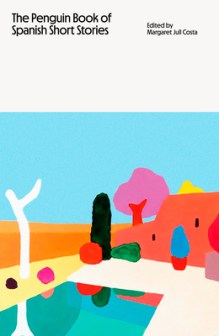
#BookReview The Penguin Book of Spanish Short Stories edited by Margaret Jull Costa @PenguinUKBooks

The Penguin Book of Spanish Short StoriesAbout the Book

This exciting new collection celebrates the Spanish short story, from its modern origins in the nineteenth century to the remarkable work being written today. Featuring over fifty stories selected by revered translator Margaret Jull Costa, it blends hidden gems and old favourites, surprising new voices and giants of Spain’s literary culture, from Emilia Pardo Bazán and Leopoldo Alas, through Mercè Rodoreda and Manuel Rivas, to Javier Marías. Brimming with romance, horror, history and farce, and showcasing alluring hairdressers, war defectors, vampiric mothers, and talismanic mandrake roots, the daring and entertaining assortment of tales in The Penguin Book of Spanish Short Stories will be a treasure trove for readers.

Format: Hardcover (416 pages)    Publisher: Penguin Classics
Publication date: 24th June 2021 Genre: Short Stories, Literature in Translation

Find The Penguin Book of Spanish Short Stories on Goodreads

Purchase links
Bookshop.org
Disclosure: If you buy a book via the above link, I may earn a commission from Bookshop.org, whose fees support independent bookshops

Hive | Amazon UK
Links provided for convenience only, not as part of an affiliate programme


My Review

I cannot recall having read much literature by Spanish writers and, to be completely honest,  all the authors whose stories are included in this collection were previously unknown to me. I also learned it’s too simplistic to say the stories are translated from Spanish because, as the book’s editor Margaret Jull Costa explains in her introduction, they were originally written in one of Spain’s four languages – Basque (euskara), Castilian Spanish (castellano), Catalan (català) and Galician (gallego). Each story is accompanied by a brief biographical note about the author.

The stories are arranged in chronological order of the author’s birth, the earliest being 1843. I was struck by how much of an impact the Spanish Civil War had, either on the lives of the authors themselves – many of whom were forced into exile – or on the subject matter of the stories, especially in the case of the authors featured in the first half of the book.

In her introduction, Costa offers the advice not to read one story after the other but to treat the collection like a box of Belgian chocolates, savouring and pondering the stories ‘one or, at most, two at a time’. I did my best to follow this advice even if it meant showing considerably more restraint than I would if presented with an actual box of Belgian chocolates!

Margaret Jull Costa argues that a short story is not a truncated novel but is more akin to poetry and that ‘the best short stories create a world in just a few pages’. Indeed, many of the stories in the book are very short, just a few pages in length. As is often the case with short story collections, I enjoyed some more than others. Quite a few in the collection had a fantasy or supernatural element which is not really to my reading taste, although I can see them appealing to other readers. I’ve picked out some below that I particularly enjoyed.

The Novel on the Tram by Benito Pérez Galdós – one for anyone who’s ever eavesdropped on others’ conversations while travelling by train or bus, or wondered about the lives of their fellow passengers

The Talisman by Emilia Pardo Bazán – reminiscent of M. R. James’ story ‘Casting The Runes’

Duet for Two Coughs by Leopoldo Alas/Clarín– the imaginings of two strangers sharing the same malady

The Reverse Side of the Tapestry by Azorín– in which a poet weaves a story whilst at the same Fate is weaving his

The Boy by Ramón J. Sender– the brutality and senseless nature of war captured in just a few pages

Come Twelve o’ Clock by Ignacio Aldecoa – a mother’s warning to her son turned on its head

Summer Orchestra by Esther Tusquets – a poignant story of a young girl’s growing awareness of the complexities of the adult world

The Fullness of Summer by Quim Monzó – I read this after returning from a family lunch out but we couldn’t compete on the kissing and photographs front, although the author’s characters did have the advantage of being pre-pandemic

The Butterfly’s Tongue by Manuel Rivas – the story of an inspirational teacher that has a sting in its tail

And Shortly After That, There Was Now by Eider Rodríguez – the tale of a journey into the past that has an elegiac quality

My thanks to Matt Hutchinson at Penguin Books for my advance reading copy.

In three words: Imaginative, varied, insightful

Follow this blog via Bloglovin


About the Editor

Margaret Jull Costa has translated the works of many Spanish and Portuguese writers, among them novelists: Javier Marías, José Saramago and Eça de Queiroz, and poets: Sophia de Mello Breyner Andresen, Mário de Sá-Carneiro and Ana Luísa Amaral. Her work has brought her numerous prizes, most recently, the 2018 Premio Valle-Inclán for On the Edge by Rafael Chirbes. In 2014, she was awarded an OBE for services to literature.

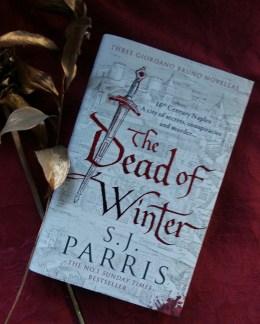
#BookReview The Dead of Winter by S. J. Parris @fictionpubteam

20210117_102213-1About the Book

Three exhilarating novellas following the early adventures of young priest Giordano Bruno in the dramatic days of sixteenth century Italy.

The Secret Dead – During the summer of 1566, a girl’s body is found within the walls of a Neapolitan monastery. Novice monk Giordano Bruno has a habit of asking difficult questions, but this time his investigations may lose him his place in the Dominican Order – or deliver him into the hands of the Inquisition.

The Academy of Secrets – An invitation arrives from a secret society of enlightened philosophers, led by the eccentric Don Giambattista della Porta. Bruno is captivated – even more so when he meets della Porta’s beautiful niece. But keeping these new heretical secrets soon becomes a matter of life or death…

A Christmas Requiem – When Giordano Bruno is told the Pope wants to see him, he fears he may be walking into a trap. The Pope is intrigued by Bruno’s talent for complex memory games, but Rome is a den of intrigue, trickery and blood, and Bruno will be lucky to escape the Eternal City alive.

Format: Hardcover (240 pages)                Publisher: Harper Collins
Publication date: 12th November 2020 Genre: Historical Fiction

Find The Dead of Winter on Goodreads

Purchase links
Bookshop.org
Disclosure: If you buy a book via the above link, I may earn a commission from Bookshop.org, whose fees support independent bookshops

Hive | Amazon UK
Links provided for convenience only, not as part of an affiliate programme


My Review

I’ve read all the books in S. J. Parris’s Giordano Bruno series – Heresy, Prophecy, Sacrilege, Treachery, Conspiracy – with the exception of the latest, Execution. I was therefore delighted to receive The Dead of Winter as a birthday present from my husband. The Dead of Winter comprises three novellas – The Secret Dead, The Academy of Secrets and A Christmas Requiem, along with an excerpt from Execution. Readers should be aware that all three stories have been published individually in ebook format: The Secret Dead in June 2014 and The Academy of Secrets in March 2020. Only A Christmas Requiem is a new story although it is also available separately as an ebook.

The fact the first two novellas are repackaged versions of previously published standalone stories probably accounts for the fact there is some repetition in their opening pages. Also it was only when I consulted Goodreads that I realized I’d already read The Secret Dead back in 2015. Fortunately, given the lapse of time, I didn’t recall much of the story.

Giordano Bruno’s escapades in The Secret Dead and The Academy of Secrets reveal the characteristics that readers of the series will have come to know: his interest in furthering his knowledge of anatomy and science, often only to be found in forbidden texts; his habit of asking questions and challenging the established teaching of the Church; and his impetuous nature.  As he admits, “I already knew what it meant to harbour secret beliefs in your heart, beliefs that could lead you into the flames…”.  The opportunity to gain access to a secret library containing many of those forbidden texts proves irresistible.  As it turns out, it’s not the only thing that proves irresistible.

A Christmas Requiem in which Giordano Bruno is summoned to Rome by Pope Pius V was my favourite of the stories, not only because of the location but also because of its seasonal setting. I enjoyed witnessing Giordano’s wide-eyed reaction to seeing the Eternal City, including the ceiling of the Sistine Chapel. I especially liked the section in which he attends Cardinal d’Este’s Christmas Eve party which, as well as presenting him with temptations of the flesh, allows him to witness the lavish lifestyle of those who preach the virtues of abstinence and self-denial to others. “There were stews of boar, beef and venison; plates of fish and shellfish; fresh pasta stuffed with cheeses and pine nuts; pies and pastries; roasted game birds and songbirds in thick sauces of cream and herbs; seven different kinds of bread.”  Unsurprisingly, Giordano Bruno soon finds himself caught up in the personal rivalries between powerful men – and women. It’s a pattern that will be repeated in years to come.

Although the three novellas are more accounts of the escapades of the young Giordano Bruno than murder mysteries in the manner of the full length novels, for fans of the series they give an insight into the formation of the character they have come to know from the books.  And for new readers, unsure about whether to embark upon the series, they provide a tasty appetizer.

In three words: Entertaining, lively, assured

Follow this blog via Bloglovin


S. J. ParrisAbout the Author

No.1 Sunday Times bestseller S. J. Parris is the pseudonym of the author and journalist Stephanie Merritt. It was as a student at Cambridge researching a paper on the period that Stephanie first became fascinated by the rich history of Tudor England and Renaissance Europe. Since then, her interest has grown and led her to create this series of historical thrillers featuring Giordano Bruno.

Stephanie has worked as a critic and feature writer for a variety of newspapers and magazines, as well as radio and television. She has also written the contemporary psychological thriller While You Sleep under her own name. She currently writes for the Observer and the Guardian, and lives in Surrey with her son. (Photo credit: Goodreads author page)

Connect with Stephanie
Website | Twitter | Facebook

Giordano Bruno S. J. Parris