
Welcome to today’s stop on the blog tour for Liberty Terrace by Madeleine D’Arcy. My thanks to Francesca at MidasPR for inviting me to take part in the tour and for my digital review copy.
 About the Book
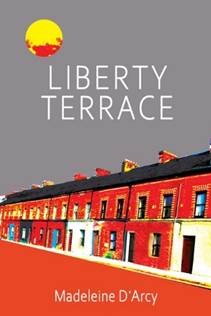
Liberty Terrace features a bevy of characters who reside in a fictional area of Cork City in the period 2016 to 2020. The inhabitants of Liberty Terrace come and go, and their lives occasionally intersect in stories that are sometimes funny, sometimes dark, often both.
The cast of characters includes retired Garda Superintendent Deckie Google, a young homeless squatter, the mother of an autistic child working part-time as a Census Enumerator, the dysfunctional Callinan family, an ageing rock star, a trio of ladies who visit a faith healer, a philandering husband, as well as a surprising number of cats and dogs.
These stories shed light on how we lived before and during the Covid-19 pandemic, on what we care about and on what, if anything, we can truly count on.
Format: Paperback (200 pages) Publisher: Doire Press
Publication date: 28th October 2021 Genre: Contemporary Fiction, Short Stories
Find Liberty Terrace on Goodreads
Purchase links
Publisher | Amazon UK
Links provided for convenience only, not as part of an affiliate programme
My Review
One of my favourite kind of short story collections is those where the stories are interconnected, with characters from one story turning up in another one, albeit often only briefly. Liberty Terrace fulfils that requirement completely. Not only is it fun spotting names you recognise from an earlier story but often it provides additional insight into a character you’ve met before.
In a short story collection there are usually some stories that resonate more than others and Liberty Terrace is no exception. Often they are not necessarily the stories that you enjoy so much as admire for their craft. ‘Quality Time’ is one of the darker stories in which the tables are turned and a man experiences what it is like to be powerless. The theme of power manifests itself again in ‘Dignity’ in which a woman becomes determined to exercise control over what remains of her life. There’s humour as well such as in ‘The Silence of the Crows’ in which a woman conducts a silent war against the crows that disturb her sleep and is rewarded by them depositing ‘random splats of grey-white bird poop’ on her car. Unfortunately, as it turns out that’s the least of her worries as a doorstep encounter will prove.
Another story I liked was ‘Milo’s Book of Feelings’ in which the mother of an autistic child receives an unexpected and inspiring gift. My absolute favourite story was ‘Ezinna’s Flamboyant Tree’ in which a recent immigrant to the country buys a small tree because it reminds her of the colourful trees in her birth country. The tree in its too small pot becomes a metaphor for how she feels – constrained and living in an environment in which she feels she cannot prosper. However, when she finds the right place for the tree, she discovers friendship and a new sense of belonging. The final story in the book, ‘The Great Lockdown Rescue’, not only brings things full circle by featuring characters who appeared in the book’s opening story but sees Liberty Terrace inhabitants coming together to perform a daring rescue, evoking the real-life community spirit evidenced in many places during the Covid-19 lockdown.
By the end of the book I felt I could walk along Liberty Terrace and recognise the people I passed in the street, know whose door I could knock on for a cup of tea – and whose I should avoid. Liberty Terrace is a fascinating collection of well-crafted stories that span the spectrum from dark to light and, I think, offer something for everyone.
In three words: Assured, insightful, imaginative
Try something similar: The Wooden Hill by Jamie Guiney
Follow this blog via Bloglovin
 About the Author
Madeleine D’Arcy was born in Ireland. She spent thirteen years in the UK, where she worked as a criminal legal aid solicitor and as a legal editor in London. She returned to Ireland in 1999 and lives in Cork City with her husband and son.
Madeleine began to write fiction in 2005. In 2010 she received the Hennessy Literary Award for First Fiction and the overall Hennessy Literary Award for New Irish Writer. Her debut short story collection, Waiting for the Bullet (Doire Press, 2014), won the Edge Hill Readers’ Choice Prize 2015 (UK). She holds an MA in Creative Writing from University College Cork, and has been awarded bursaries by the Arts Council of Ireland and by Cork City Council.
Together with Danielle McLaughlin, she co-hosts Fiction at the Friary, a free monthly fiction event held in Cork City since 2017. (Photo credit: Publisher author page)
Connect with Madeleine
Website | Twitter |

 About the Book
 About the Author
 What Cathy Read Next...