
Book Review – Mania by Lionel Shriver

About the Book

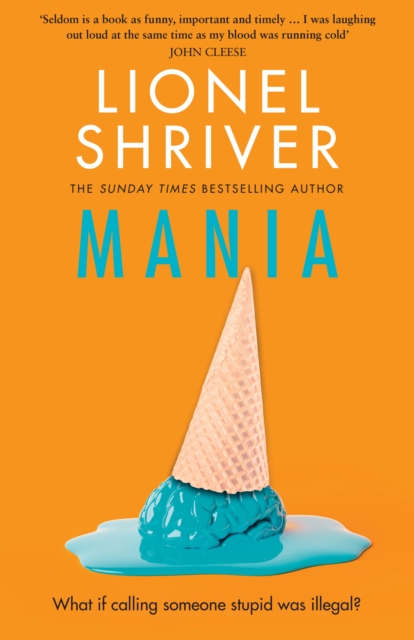
Book cover of Mania by Lionel Shriver

What if calling someone stupid was illegal?

In a reality not too distant from our own, where the so-called Mental Parity Movement has taken hold, the worst thing you can call someone is ‘stupid’. Everyone is equally clever, and discrimination based on intelligence is ‘the last great civil rights fight’.

Exams and grades are all discarded, and smart phones are rebranded. Children are expelled for saying the S-word and encouraged to report parents for using it. You don’t need a qualification to be a doctor.

Best friends since adolescence, Pearson and Emory find themselves on opposing sides of this new culture war. Radio personality Emory – who has built her career riding the tide of popular thought – makes increasingly hard-line statements while, for her part, Pearson believes the whole thing is ludicrous.

As their friendship fractures, Pearson’s determination to cling onto the ‘old, bigoted way of thinking’ begins to endanger her job, her safety and even her family.

Format: Hardcover (288 pages) Publisher: The Borough Press
Publication date: 11th April 2024 Genre: Alternate History, Satire

Find Mania on Goodreads

Purchase Mania from Bookshop.org [Disclosure: If you buy books linked to our site, we may earn a commission from Bookshop.org, whose fees support independent bookshops]


My Review

My initial thought as I read Mania was, ‘Go on Lionel, get it all off your chest’. In the author’s envisioned world, the Mental Parity Movement means discrimination on the basis of intelligence is forbidden. No more tests or entry qualifications, no more calling someone dumb (the ‘D-word’) or, equally, calling them smart (the ‘S-word’), no more suggesting you’re better at doing something than someone else, even if you are. Using long words is frowned upon so in this alternate history Barack Obama doesn’t get a second term as US President because he’s too eloquent; Joe Biden is elected instead. The fact you don’t have to know anything about a subject to be appointed to a position, even in the higher reaches of government, has geopolitical consequences too.

From the beginning we’re made aware that Pearson is a person with defiance in her DNA. It started in childhood growing up as a Jehovah’s Witness. (I guess the author chose this as an example of a religion requiring strict adherence to its doctrines rather than any particular hostility towards it.) Pearson rebels against its constraints and is taken in by the family of her friend, Emory.

Pearson finds the Mental Parity Movement ridiculous and is vocal in her disdain for it. She believes Emory holds similar views and is dismayed when she discovers that’s not the case. The irony is that Pearson might be considered an example of everything the Mental Parity Movement set out to dismantle. Her first two children were conceived by artificial insemination by a donor she deliberately selected for their high IQ and she is gratified that Darwin and Zanzibar turn out to be exceptionally bright. She’s equally dismayed that her daughter Lucy, by her husband Wade, is not and Pearson sets about trying to correct this with the same relentless zeal her mother imposed on her.

Wade’s an easy-going man generally whose skills are practical in nature. But even his patience is tested by Pearson’s rebellious attitude. ‘What would you sacrifice by giving in? Just – accept. Everyone’s equally smart. Then move on. Get on with your life.’ Ignoring his advice, and in a moment of madness, she deliberately provokes the university where she works as a lecturer by choosing as a set text for her class a novel with a provocative title. It has serious consequences for herself and her family. The author also shows us the danger of overcorrection.

The book is genuinely laugh out loud funny in places. One of my favourite episodes is when Pearson is required to attend a Cerebral Acceptance and Semantic Sensitivity course. The author has a lot of fun here. Words such as ‘dumbstruck’ or ‘dumbbells’ can no longer be used. Fog cannot be described as ‘dense’, a piece of wood cannot be ‘thick’ and rooms with poor lighting can no longer be ‘dim’ and definitely cannot be fitted with a ‘dimmer switch’. Dangerous vocabulary extends into the kitchen; mention of the herb sage is definitely a no-no.

When I read an extract from the book, I wasn’t sure if its satirical premise could sustain a full novel. I think it just about does and I enjoyed it more than I expected. My first experience of Shriver’s writing, Mania is a witty, satirical and at times surreal take on cancel culture and the temptation to conform to the prevailing orthodoxy.

I received a proof copy courtesy of The Borough Press via Readers First.

In three words: Satirical, funny, thought-provoking


About the Author

Author Lionel Shriver
Copyright Jerry Bauer, courtesy of Harper Collins.

Lionel Shriver’s fiction includes Should We Stay or Should We Go; The Motion of the Body Through Space; The Mandibles: A Family 2029-2047; Property; the National Book Award finalist So Much For That; and the New York Times bestsellers The Post-Birthday World and We Need to Talk About Kevin, winner of the Orange Prize and an international bestseller adapted for a 2011 film starring Tilda Swinton.

Her journalism has appeared in The Guardian, The Times, The Daily Telegraph, the New York Times, the Wall Street Journal, Harper’s Magazine, UnHerd, National Review, City Journal and many other publications. She’s a regular columnist for The Spectator.

She lives in London and Brooklyn, New York.

Book Review: Money Power Love by Joss Sheldon

MoneyPowerLoveAbout the Book

Born on three adjacent beds, a mere three seconds apart, our three heroes are united by nature but divided by nurture. As a result of their different upbringings, they spend their lives chasing three very different things: Money, power and love.

This is a human story: A tale about people like ourselves, cajoled by the whimsy of circumstance, who find themselves performing the most beautiful acts as well as the most vulgar.

This is a historical story: A tale set in the early 1800s, which shines a light on how bankers, with the power to create money out of nothing, were able to shape the world we live in today.

And this is a love story: A tale about three men, who fall in love with the same woman, at the very same time…

Format: ebook, paperback (298 pp.)             Publisher:
Published: 7th October 2017                           Genre: Historical/Literary Fiction

Purchase Links*
Amazon.co.uk  ǀ  Amazon.com  ǀ Hive.co.uk (supporting UK bookshops)
*links provided for convenience, not as part of any affiliate programme

Find Money Power Love on Goodreads


My Review

Nominally set in the 1800s,  the author vividly depicts the sights and sounds of the London streets of the time, such as this description of traders taking advantage of the crowd gathered to witness a hanging.  ‘Surrounding this scrimmage, costermongers were selling just about anything which could be eaten, to just about anyone who could eat.  Their rickety barrows were overflowing with ice-cold oysters and burning hot eels; pies and puddings , crumpets and cough-drops, ginger-beer and gingerbread; pea soup, battered fish, sheep’s trotters, pickled whelks, baked potatoes, ice lollies, cocoa, and peppermint water.’ Characters such as Wilkins (surely the literary doppelganger of the Artful Dodger in Oliver Twist) could have come straight out of Dickens, as could many of the character names: Timothy Tyrrell, Bumble Blumstein. There’s even a sneaky reference to a famous opening line from Dickens: ‘They were the best of times.  They were the worst of times.’

Throughout the book, the author’s love of language – at one point a set of steps is described as ‘bodacious’ – and fondness for alliterative pairings is evident (as in the excerpt above).   At the same time, some of the language is deliberately anachronistic – fantabulous, mansplaining.   Readers will either find this amusing or irritating; I was in the former category most of the time.

All three main characters  – Hugo, Archibald and Mayer – have flaws and, despite being friends, their actions don’t always reflect this – especially when it comes to their rivalry for the affections of the same woman. None of the three are especially likeable but then they are really archetypes designed to illustrate the nature versus nurture debate and to demonstrate the consequences of being motivated by love (Hugo), power (Archibald) or money (Mayer).

Arguably, money plays the biggest part in the book as the author explores different forms of exchange that have been used over the centuries: barter, tally sticks, promissory notes.   At one point, Mayer muses: “Why, I’ve already heard of a new invention called ‘Cheques’.  Those could take off.  Maybe one day we’ll create token money, electronic money, or money spent on plastic cards.”   When his partner, Mr Bronze, protests that “money doesn’t grow on a magic money tree”, Mayer responds, “It does, Mr Bronze, and we bankers are its gardeners”.

Each chapter features an epigram from figures ranging from Mark Twain, to Confucius, to Banksy.  The story moves from Georgian London to Manchester, India, Van Diemen’s Land, China and Africa.   Along the way, through the stories of its three main protagonists, the book seeks to shed light on the worst excesses of colonialism and capitalism and to reveal the fragile foundations on which our financial systems are fabricated (note the alliteration please).

The motives of financial institutions and governments are ruthlessly exposed by the author. Here’s Mayer again: “We need charity; it compensates for the worst excesses of capitalism, without challenging the system itself.  It’s an investment which pays dividends; protecting capital from civil unreset.”  And again: “Wars are only ever fought to open up new markets, control resources and amass wealth.  All wars are bankers’ wars.”

Money Power Love is a surreal, satirical romp written with real verve and wit.  By turns funny, challenging, inventive, didactic and thought-provoking, it’s quite unlike any other book I’ve read, which did pose some problems when it came to my ‘Try something similar’ recommendation below*.

Now I’ve finished Money Power Love, I don’t know whether to go and eat some trifle, invest in bitcoins, invade a small country, go mudlarking or buy a backscratcher.  If that sentence intrigues you, why not pick up a copy of the book using one of the purchase links above.

I received a review copy courtesy of the author in return for an honest and unbiased review.

*For some reason I can’t quite put my finger on, while I was reading the book I kept thinking of the film Kind Hearts and Coronets (1949) starring Dennis Price and Alec Guinness.

Follow my blog with Bloglovin

In three words: Imaginative, witty, satirical

Try something (possibly not at all) similar…The History of Tom Jones, a Foundling by Henry Fielding or Orlando by Virginia Woolf


Joss SheldonAbout the Author

Joss Sheldon is a scruffy nomad, unchained free-thinker, and post-modernist radical. Born in 1982, he was brought up in one of the anonymous suburbs which wrap themselves around London’s beating heart. Then he escaped!  With a degree from the London School of Economics to his name, Sheldon had spells selling falafel at music festivals, being a ski-bum, and failing to turn the English Midlands into a haven of rugby league.

Then, in 2013, he ran off to McLeod Ganj; an Indian village which plays home to thousands of angry monkeys, hundreds of Tibetan refugees, and the Dalai Lama himself. It was there that Sheldon wrote his debut novel, Involution & Evolution.  With several positive reviews to his name, Sheldon had caught the writing bug. He travelled to Palestine and Kurdistan, where he researched his second novel, Occupied, a dystopian masterpiece unlike any other story you’ve ever read.

It was with his third novel, The Little Voice, that Sheldon really hit the big time, topping the charts on both sides of the Atlantic, and gaining widespread critical acclaim.  Now Sheldon has returned with his fourth and most ambitious novel yet. Money Power Love is a literary mélange of historical, political and economic fiction; a love story that charts the rise of the British Empire, and the way in which bankers, with the power to create money out of nothing, were able to shape the world we live in today.

Joss’s latest novel, Individutopia, was published in August 2018.

Connect with Joss

Wikipedia | Website  ǀ  Facebook  ǀ  Twitter  ǀ  Blog  ǀ Goodreads