
#BookReview Sword of Bone by Anthony Rhodes @RandomTTours @I_W_M

Sword of Bone BT Poster

Welcome to today’s stop on the blog tour for Sword of Bone by Anthony Rhodes, one of the latest additions to the Imperial War Museum’s fabulous Wartime Classics series of rediscovered wartime classics. My thanks to Anne at Random Things Tours for finding me a place on the tour and to the Imperial War Museum for my advance review copy.


Sword of Bone CoverAbout the Book

It is September 1939. Shortly after war is declared, Anthony Rhodes is sent to France, serving with the British Army. His days are filled with the minutiae and mundanities of army life – friendships, billeting, administration – as the months of the “Phoney War” quickly pass and the conflict seems a distant prospect.

It is only in the spring of 1940 that the true situation becomes clear; the men are ordered to retreat to the coast and the beaches of Dunkirk, where they face a desperate and terrifying wait for evacuation.

Format: Paperback (236 pages)                 Publisher: Imperial War Museum
Publication date: 20th May 2021 [1942]   Genre: Fiction, WW2

Find Sword of Bone on Goodreads

Purchase links
Bookshop.org
Disclosure: If you buy a book via the above link, I may earn a commission from Bookshop.org, whose fees support independent bookshops

Publisher | Hive | Amazon UK
Links provided for convenience only, not as part of an affiliate programme


My Review

First published in 1942, Sword of Bone is based on the author’s own wartime experiences including the evacuation of Dunkirk which took place between 27th May and 4th June 1940. The evacuation has come to be regarded as a seminal moment in the Second World War; indeed, it is often described as ‘the miracle of Dunkirk’, arguably something of a misnomer since, although hundreds of thousands of men were rescued, thousands more were left behind along with tons of equipment.

As usual, the introduction by Imperial War Museum historian, Alan Jeffreys, provides fascinating background information about the author, the book and its historical context. Describing Sword of Bone as a ‘lightly fictionalised memoir’, he argues the book is very much in the tradition of the war novels published in the 1920s dealing with the First World War, such as Siegfried Sassoon’s Memoirs of an Infrantry Officer.

The first part of the book covers Rhodes’s time in charge of an advance party sent to France with the task of finding quarters and sourcing equipment for the main division of the Royal Engineers which is to follow. Describing his role as ‘buyer, distributor, and journeyman’, he is fortunate to be assigned Georges de Treil as his French liaison officer.  Amongst his many attributes is Georges’s seeming acquaintance with the maître d’hôtel of every restaurant in the area.  As well as enticing Rhodes into some risky escapades, he introduces him to French customs such as the correct way to enjoy cheese and wine.

On 10th May 1940, the ‘Phoney War’ comes to an end as Rhodes learns of the invasion of Belgium and Holland, and the bombing of Arras. Reminding me a little of what has been revealed recently about the UK’s handling of the Coronavirus pandemic, Rhodes is amazed to discover that no plans exist for destroying the bridges across the strategically important River Dyle.  Shortly afterwards he has his first experience of an early morning air raid which leaves him lying naked on the floor of his billet ‘covered in dust and shaving soap’.  From that point on, the reality of war is vividly evoked, including the ‘double speak’ which sees the retreat of British forces described in news reports as ‘a strategic withdrawal according to plan’.

The book really comes alive in the final chapters which describe the chaos and confusion of the evacuation of the British Expeditionary Force from the beaches of Dunkirk, by which time ‘the Boche are everywhere’. To experience it in visual form, I recommend the film Dunkirk. The 1958 version would be my preference but then I’m a sucker for war films of the 1940s and 1950s. As it happens, given we’re close to the anniversary of the evacuation, the film was shown yesterday (30th May 2021) on BBC2 and is available via the BBC iPlayer for a limited time. There is also a touching moment in the 1942 film In Which We Serve starring Noel Coward (who also wrote the screenplay) when the crew of the fictional H.M.S. Torrin, having taken part in the evacuation, watch the soldiers they have rescued and returned safely to England leave the ship.

Having been picked up by a trawler, Rhodes arrives back in Dover; the line ‘In this way it ended’ from the final chapter perfectly summing up the reportage style of this fascinating book.

In three words: Authentic, detailed, fascinating

Try something similar: The Miracle of Dunkirk by Walter Lord

Follow this blog via Bloglovin


About the Author

Anthony Rhodes (1916–2004) served with the British Army in France during the so-called ‘Phoney War’ and was evacuated from Dunkirk in May 1940 – he based Sword of Bone on these experiences. After the conflict, Rhodes enjoyed a long academic and literary career and wrote on various subjects, including covering the 1956 Hungarian Revolution for the Daily Telegraph and producing well-regarded histories of the Vatican. He died in 2004.
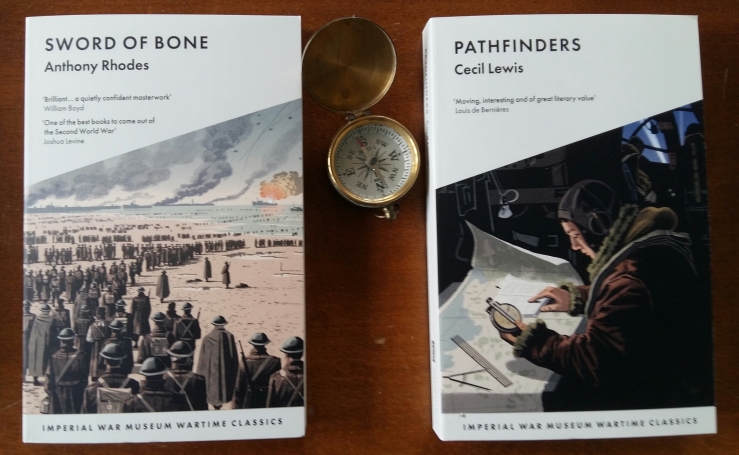
Pathfinders Sword of Bone

My Week in Books – 30th May 2021

MyWeekinBooks

On What Cathy Read Next last week

Blog posts

Tuesday –  This week’s Top Ten Tuesday topic was all about quotations and I shared a list of books whose titles are drawn from other works of literature. I also published my review of This Other Island by Steffanie Edward as part of the blog tour.

Wednesday – WWW Wednesday is the opportunity to share what I’ve just read, what I’m currently reading and what I plan to read next… and to have a good nose around what others are reading. 

Thursday – I shared my review of Love and Miss Harris by Peter Maughan as part of the blog tour. I also joined the celebration of the 15th anniversary of The Reading Agency’s Quick Reads literacy initiative with my review of The Baby Is Mine by Oyinkan Braithwaite.

Friday – I published my review of Everyday Magic by Charlie Laidlaw.

Saturday – I shared my thoughts on A Room Made of Leaves by Kate Grenville, one of the books on the shortlist for The Walter Scott Prize for Historical Fiction 2021.

As always, thanks to everyone who has liked, commented on or shared my blog posts on social media.


New arrivals

The FortThe Fort (City of Victory #1) by Adrian Goldsworthy (ARC, courtesy of Head of Zeus) 

AD 105: Dacia. The Dacian kingdom and Rome are at peace, but no one thinks that it will last. Sent to command an isolated fort beyond the Danube, centurion Flavius Ferox can sense that war is coming, but also knows that enemies may be closer to home.

Many of the Brigantes under his command are former rebels and convicts, as likely to kill him as obey an order. And then there is Hadrian, the emperor’s cousin, and a man with plans of his own.

A Line To KillA Line to Kill (Hawthorne #3) by Anthony Horowitz (ARC, courtesy of Century)

When ex-Detective Inspector Daniel Hawthorne and his sidekick, author Anthony Horowitz, are invited to an exclusive literary festival on Alderney, an idyllic island off the south coast of England, they don’t expect to find themselves in the middle of murder investigation – or to be trapped with a cold-blooded killer in a remote place with a murky, haunted past.

Arriving on Alderney, Hawthorne and Horowitz soon meet the festival’s other guests – an eccentric gathering that includes a bestselling children’s author, a French poet, a TV chef turned cookbook author, a blind psychic, and a war historian – along with a group of ornery locals embroiled in an escalating feud over a disruptive power line.

When a local grandee is found dead under mysterious circumstances, Hawthorne and Horowitz become embroiled in the case. The island is locked down, no one is allowed on or off, and it soon becomes horribly clear that a murderer lurks in their midst. But who?

The Penguin Book of Spanish Short StoriesThe Penguin Book of Spanish Short Stories edited by Margaret Jull Costa (ARC, courtesy of Penguin) 

This exciting new collection celebrates the richness and variety of the Spanish short story, from the nineteenth century to the present day. Featuring over fifty stories selected by revered translator Margaret Jull Costa, it blends old favourites and hidden gems – many of which have never before been translated into English – and introduces readers to surprising new voices as well as giants of Spanish literary culture, from Emilia Pardo Bazán and Leopoldo Alas, through Mercè Rodoreda and Manuel Rivas, to Ana Maria Matute and Javier Marías.

Brimming with romance, horror, history, farce, strangeness and beauty, and showcasing alluring hairdressers, war defectors, vampiric mothers, and talismanic mandrake roots, the daring and entertaining assortment of tales in The Penguin Book of Spanish Short Stories will be a treasure trove for readers.

Agent Running in the Field by John le Carré

Nat, a 47 year-old veteran of Britain’s Secret Intelligence Service, believes his years as an agent runner are over. He is back in London with his wife, the long-suffering Prue. But with the growing threat from Moscow Centre, the office has one more job for him. Nat is to take over The Haven, a defunct substation of London General with a rag-tag band of spies. The only bright light on the team is young Florence, who has her eye on Russia Department and a Ukrainian oligarch with a finger in the Russia pie.

Nat is not only a spy, he is a passionate badminton player. His regular Monday evening opponent is half his age: the introspective and solitary Ed. Ed hates Brexit, hates Trump and hates his job at some soulless media agency. And it is Ed, of all unlikely people, who will take Prue, Florence and Nat himself down the path of political anger that will ensnare them all.

Agent Running in the Field The Girl With the Louding Voice
The Girl With The Louding Voice by Abi Daré

I don’t just want to be having any kind voice… I want a louding voice.

At fourteen, Adunni dreams of getting an education and giving her family a more comfortable home in her small Nigerian village. Instead, Adunni’s father sells her off to become the third wife of an old man. When tragedy strikes in her new home, Adunni flees to the wealthy enclaves of Lagos, where she becomes a house-girl to the cruel Big Madam, and prey to Big Madam’s husband. But despite her situation continuously going from bad to worse, Adunni refuses to let herself be silenced. And one day, someone hears her.

Secret Keeper CoverThe Secret Keeper of Jaipur (The Henna Artist #2) by Alka Joshi (eARC, courtesy of Mira Books) 

It’s the spring of 1969, and Lakshmi, now married to Dr. Jay Kumar, directs the Healing Garden in Shimla. Malik has finished his private school education. At twenty, he has just met a young woman named Nimmi when he leaves to apprentice at the Facilities Office of the Jaipur Royal Palace. Their latest project: a state-of-the-art cinema.

Malik soon finds that not much has changed as he navigates the Pink City of his childhood. Power and money still move seamlessly among the wealthy class, and favors flow from Jaipur’s Royal Palace, but only if certain secrets remain buried. When the cinema’s balcony tragically collapses on opening night, blame is placed where it is convenient. But Malik suspects something far darker and sets out to uncover the truth. As a former street child, he always knew to keep his own counsel; it’s a lesson that will serve him as he untangles a web of lies.


On What Cathy Read Next this week

Currently reading

Planned posts

  • Blog Tour/Book Review: Sword of Bone by Anthony Rhodes
  • Book Review: Miss Pettigrew Lives For A Day by Winifred Watson
  • Top Ten Tuesday
  • Waiting on Wednesday
  • Book Review: Two Women in Rome by Elizabeth Buchan
  • #6Degrees of Separation