
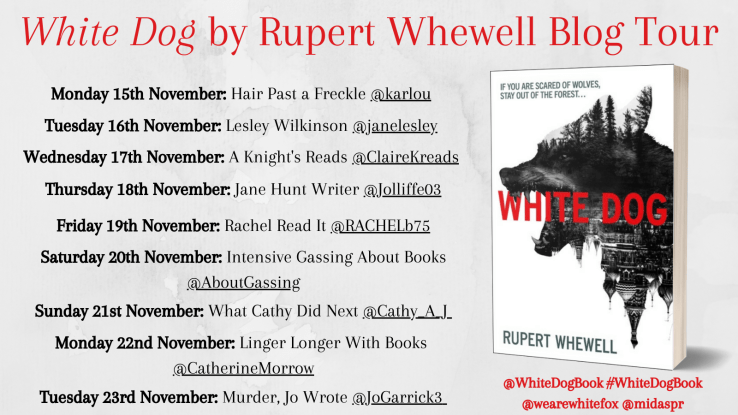
Welcome to today’s stop on the blog tour for White Dog by Rupert Whewell. My thanks to Hannah at Midas PR for inviting me to take part in the tour and for my review copy.
White Dog is the only novel from budding author Rupert Whewell, who sadly lost his life in a tragic climbing accident in the Nanda Devi region of the Himalayas. At the time of his death, the manuscript of White Dog was incomplete, with Rupert’s plans for the book’s ending remaining a mystery. As a tribute to her brother and his love of words, Rupert’s sister Lisa Anson worked closely with renowned author John McDonald to complete White Dog, allowing her to come to terms with Rupert’s unexpected passing.
Lisa says: “This book has been a long time in the making. Rupert always loved writing and talked often about his desire to write a book. Distracted by a full life and being present with his family and friends, it remained in the background, referenced, and variously started without real progress. In his late forties, he started to put pen to paper in earnest and White Dog was born. Rupert was a very special person; not just to me – as a lifelong presence – but to his many friends. His tragic death is something I will never get over and will never forget.
I have taken on the task of finishing and publishing his book, which he left 80 percent complete. It was important to me to see his story through and share his writing. It brought me closer to Rupert and I hope it will keep his memory alive for those that knew him and will entertain others who did not.”
 About the Book
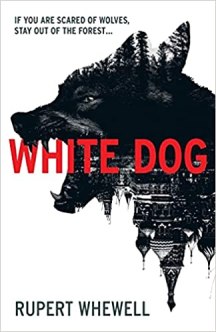
White Dog follows the fortunes of Ryder, a cynical art dealer who aspires to the heights, yet despises the people who populate those realms.
On his way to the top, back down, and back up again, Ryder encounters a picaresque collection of characters and gets drawn into a web of intrigue that involves murder, money-laundering and materialism. But can his new-found fame and fortune ever make up for the loss of the one thing he ever really valued in life?
White Dog will take you on a roller-coaster ride of sex, drugs and art – of violence, blackmail, hedonism and dark politics.
Are you ready to face the wolves?
Format: Paperback (338 pages) Publisher: Whitefox
Publication date: 18th November 2021 Genre: Contemporary Fiction, Thriller
Find White Dog on Goodreads
Purchase links
Hive | Amazon UK
Links provided for convenience only, not as part of an affiliate programme
My Review
White Dog is described as ‘a literary thriller set against the backdrop of the contemporary art world’. In the book, the author forensically dissects the often superficial nature of the art world and explores the role of art. Should a piece of art be considered an ‘expression of the artist’s soul’ or as ‘a type of currency for the wealthy to manipulate’? It’s question that runs throughout the book. The thriller element is not the predominant aspect of the book – which I’d characterise as more of a mystery – it’s drip-fed and only really comes to the fore in the closing chapters (which cleverly references the opening chapter).
The book’s main character, referred to only as Ryder, is not always an easy person to like – but he’s never boring. He’s clearly – very clearly – attractive to women, having more than his fair share of sexual conquests, and he seems to have inexhaustible appetite for alcohol and illegal substances. However, just occasionally the very observant are able to detect there is more than one side to his personality. ‘To her, he was a forgiveable reprobate spaniel, whereas to most people, he was an opportunistic hyena.’ And in one section of the book, he forms a relationship that contains a rare element of tenderness, one which Ryder acknowledges himself is a pairing of ‘a cynical, self-obsessed art dealer and a fey, mercurial gypsy’. However, this relationship is short-lived through his own failure to control his appetites.
Ryder comes across as someone who likes to bask in his own cleverness, with a liking for literary allusions. For example, his rather free rendering of a line from Shakespeare’s Henry V, ‘We few, we happy few – and gentlemen in England still abed shall think themselves lazy bastards’. And he’s never happier than when getting one over on someone else, especially when it comes to art or antique furniture, such as spotting an item potentially more valuable than advertised. ‘Ryder loved a misattribution… Pretension was found out and superior knowledge rewarded.’
Despite – or perhaps because of – being part of it, Ryder has a cynical view of the contemporary art world seeing it as having become a cesspit of commercialism and materialism, that buying art has often become just a cover for laundering dirty money or an act of mindless acquistiveness. He’s similarly dismissive of the motives of those who become benefactors of galleries. ‘They all had their own reasons – to get onto the rungs of the altruistic ladder; to see their name on benefit-dinner guest lists; to rub shoulders with the righteous; to reinvent themselves as Ryder had; to have access to wealth and power; to showcase themselves; to repay some of what they’d stolen.’ As an afterthought he concedes, ‘Of course, there were a few who did it for the love of art’.
The blurb mentions a ‘picaresque collection of characters’ and the book certainly has those in abundance. Ryder often encounters them in ultra-fashionable but rather outlandish clubs in which the clientele represent ‘a splicing together of the profane and the insane – a playpen for the bastard offspring of Hieronymous Bosch and Divine the Drag Queen.’ The word hedonism is almost an understatement for the world Ryder inhabits. Sex and drugs and Rothko, as it were.
In her foreword, Rupert’s sister Lisa writes that her brother had a reputation for being ‘vocabulous’, a word his friends invented to describe his fabulous vocabulary. That fabulous vocabulary is admirably displayed in the book with many words I’d never come across before – neoteric, titubation, eschatological, euphuistic, cynosure – and whose meaning I had to look up. (To save you reaching for the dictionary, you can find definitions at the end of this review.)
The author’s prose style is clearly that of someone with a love of words, who likes to play with them and search for exactly the right one for any situation. Like Ryder, he loves alliteration. And there are some fabulous turns of phrase and striking images. For example, the increasing proliferation of buildings housing financial institutions in London’s Square Mile is likened to the march of ‘obscene chess-men – looming bishops and squared-off rooks and gherkin pawns and shard knights, all clustering around the squat and immobile queen, the old lady of Threadneedle Street’.
I wasn’t expecting to like White Dog as much as I did but I thought it was terrific and a work of someone with a real talent for writing. It’s sad to think there will be no more books from Rupert Whewell but I can safely say his sister’s wish that White Dog would entertain those who did not know him has definitely been fulfilled, for this reader at least.
(For those hoping to become ‘vocabulous’: neoteric – new, modern or recent; titubation – nodding movement of the head or body; eschatological – relating to death, judgement, and the final destiny of the soul and of humankind; euphuistic – an affectedly elegant literary style; cynosure – a person or thing that is the centre of admiration or attention)
In three words: Satirical, witty, provocative
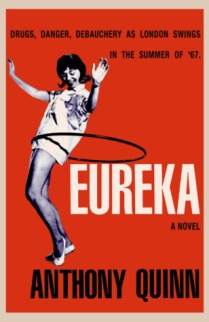
Try something similar: Eureka by Anthony Quinn
Follow this blog via Bloglovin
 About the Author
Rupert Whewell was born in Buckinghamshire in 1969. He graduated with a degree in English Literature from Downing College, Cambridge, before working in advertising in Hong Kong and later as a recruitment consultant. He established his own firm, Bateman Gray – named after the respected names of his two favourite novels – in London, specialising in placing bankers. A keen adventurer, Rupert loved hillwalking, climbing and skiing, counting skiing down Mont Blanc as one of his greatest triumphs.
With his fiftieth birthday looming, he joined a group setting out to climb peaks in the Nanda Devi area of India in May 2019. An avalanche brought about his early death in the Himalayas, together with the loss of his seven climbing companions. He is survived by his mother Elaine, brother Andrew and sister Lisa, having no children of his own. White Dog is his first novel, published posthumously.

 About the Book
 About the Author
 What Cathy Read Next...