
 Welcome to the opening day of the blog tour for Storytellers by Bjørn Larssen. My thanks to Rachel at Rachel’s Random Resources for inviting me to take part in the tour and for my digital review copy.
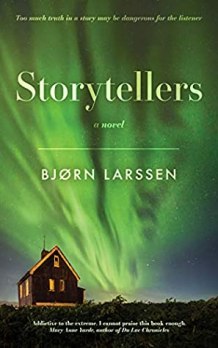 About the Book
Would you murder your brothers to keep them from telling the truth about themselves?
On a long, cold Icelandic night in March 1920, Gunnar, a hermit blacksmith, finds himself with an unwanted lodger – Sigurd, an injured stranger who offers a story from the past. But some stories, even those of an old man who can barely walk, are too dangerous to hear. They alter the listeners’ lives forever… by ending them.
Others are keen on changing Gunnar’s life as well. Depending on who gets to tell his story, it might lead towards an unwanted marriage, an intervention, rejoining the Church, letting the elf drive him insane, or succumbing to the demons in his mind. Will he manage to write his own last chapter?
Bjørn Larssen’s award-winning, Amazon #1 best selling novel is an otherworldly, emotive Icelandic saga – a story of love and loneliness, relief and suffering, hatred… and hope.
Format: Paperback (292 pages) Publisher: josephtailor
Publication date: 28th March 2019 Genre: Historical Fiction, Mystery
Find Storytellers on Goodreads
Purchase links
Bookshop.org
Disclosure: If you buy a book via the above link, I may earn a commission from Bookshop.org, whose fees support independent bookshops
Hive | Amazon UK
Links provided for convenience only, not as part of an affiliate programme
My Review
There are shades of One Thousand and One Nights with Sigurd as a latter day Scheherazade trying to eke out his story in order to give him time to execute a plan, hints of which very gradually emerge. Sigurd’s story is in the tradition of Icelandic sagas told around the fireside. I liked the way the book explored the concept of storytelling, whether as a creative act, for entertainment, to impart a moral message, as a form of self-deception (the stories we tell ourselves) or a means to spread rumour, gossip or disinformation. The inhabitants of Gunnar’s village particularly enjoy the last three.
Throughout the book Gunnar remains an eccentric, solitary and troubled character who experiences moments of extreme mental distress and struggles with addiction. However, his generous nature means he never loses our sympathy and I’m sure I’m not the only reader willing him to resist the lure of those bottles or to share his pleasure in his nice new coat.
There are some nice touches of humour such as Gunnar’s christening of a group of well-meaning ladies whose visits he comes to dread as ‘The Constipated Hags of Iceland’ or Sigurd’s wish that Gunnar leave him alone so he can finish the ‘What Season Actually Suits Your Personality’ quiz in The Women’s Paper. Reading material is in short supply in Gunnar’s village and I think we all suspect Sigurd is definitely a (dead of) winter person. And Gunnar’s initial suggestion for a suitable name for an elf made me laugh out loud.
The author created a good sense of what daily life must have been like in a small village in Iceland in earlier times. Gunnar’s story is set in 1920 although I must say there was very little, apart from the doctor possessing a telephone and Sigurd’s reading matter, to obviously position it in that period. I found some concentration was required so as not to get confused between the characters in Sigurd’s story and Gunnar’s life. As it turns out, I needn’t have worried.
I confess it was curiosity rather than a feeling of suspense that propelled me through the book. It starts quite slowly – indeed I had some sympathy with Gunnar’s frustration at the speed of Sigurd’s storytelling. At one point, Gunnar complains to Sigurd about a lack of action scenes in the story and Sigurd replies, ‘It’s called a build-up… It’s for dramatic effect’. Storytellers would not meet my definition of a page-turner; for me it’s more a character study but no less entertaining for that. And it’s fair to say the book picks up pace in the final chapters with some last minute surprises and reveals.
In three words: Quirky, detailed, tender
Try something similar: A Stranger from the Storm by William Burton McCormick
Follow this blog via Bloglovin
 About the Author
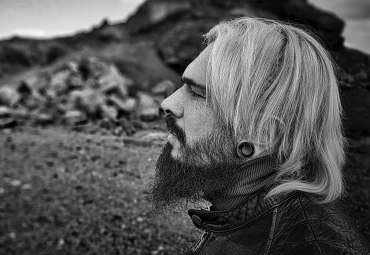
Bjørn Larssen is a Norse heathen made in Poland, but mostly located in a Dutch suburb, except for his heart which he lost in Iceland. Born in 1977, he self-published his first graphic novel at the age of seven in a limited edition of one, following this achievement several decades later with his first book containing multiple sentences and winning awards he didn’t design himself. His writing is described as ‘dark’ and ‘literary’, but he remains incapable of taking anything seriously for more than 60 seconds.
Bjørn has a degree in mathematics and has worked as a graphic designer, a model, a bartender, and a blacksmith (not all at the same time). His hobbies include sitting by open fires, dressing like an extra from Vikings, installing operating systems, and dreaming about living in a log cabin in the north of Iceland. He owns one (1) husband and is owned by one (1) neighbourhood cat.
Connect with Bjorn
Facebook | Twitter | Instagram





 What Cathy Read Next...