
Welcome to today’s stop on the blog tour for The Language of Food by Annabel Abbs. My thanks to Anne at Random Things Tours for inviting me to take part in the tour and to Simon & Schuster for my advance reader copy. Do be sure to check out the posts by my tour buddies for today, Mia at Paradise is a Library and Emma at Biblio Treasures.
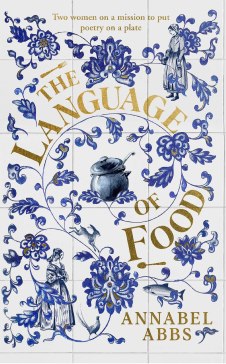 About the Book
Eliza Acton is a poet who’s never boiled an egg. But she’s about to break the mould of traditional cookbooks. And change the course of cookery writing forever.
England 1835. Eliza Acton is a poet who dreams of seeing her words in print. But when she takes a new manuscript to a publisher, she’s told that ‘poetry is not the business of a lady.’ Instead, she’s asked to write a cookery book.
Eliza is horrified but her financial situation leaves her no choice. Although she’s never cooked before, she is determined to learn and to discover, if she can, the poetry in recipe writing. To assist her, she hires seventeen-year-old Ann Kirby, the daughter of local paupers. Over the next ten years, Eliza and Ann change the course of cookery writing forever
Format: Hardcover (416 pages) Publisher: Simon & Schuster
Publication date: 3rd February 2022 Genre: Historical Fiction
Find The Language of Food on Goodreads
Purchase links
Bookshop.org
Disclosure: If you buy a book via the above link, I may earn a commission from Bookshop.org, whose fees support independent bookshops
Hive | Amazon UK
Links provided for convenience only, not as part of an affiliate programme
My Review
The Language of Food is definitely a book for food lovers, perhaps best consumed with a plate of spiced biscuits to hand. It is lavishly sprinkled with descriptions of dishes of all kinds, some of the ingredients being surprisingly exotic – the huge range of different spices, for example – and the pairings of fish and meat with citrus and other fruit quite unusual. The range of game and meat used was also surprising, although some of it didn’t sound that appetising to me and I can’t say I’d ever imagined a recipe which included the ingredient swan’s eggs. The inclusion of a selection of Eliza’s recipes at the end of the book is a nice touch although I don’t think I’ll be attempting her ‘Tonbridge Brawn’ any time soon.
Although there is plenty of historical evidence around which to construct the life of Eliza Acton – albeit with a few elements open to speculation – there is little known about her assistant, Ann Kirby. The author has therefore used her imagination to create a backstory for Ann which I found extremely affecting, if anything more so than Eliza’s. Ann’s family situation is one of extreme poverty and deprivation. Although some of her actions may seem naive, I think it showed how those who expect nothing often get nothing and are open to manipulation by those with ulterior motives. The appalling treatment of Ann’s mother was sickening but unfortunately all too reflective of attitudes towards mental illness at the time. (My ‘Try something similar’ suggestion below reflects this element.)
For me, Ann’s story only emphasised the gulf between her situation and Eliza’s. Although Eliza finds herself, as an unmarried woman, facing a lack of independence and the inability to express her creativity, her experience is nothing compared to that of Ann. This is another reason why I felt more sympathy for Ann. Indeed, I found it difficult to understand why Eliza made so little effort to enquire into Ann’s circumstances and, even when she did find out, contemplated making it the basis of a play seemingly unconcerned about how Ann might feel about the ‘plundering’ of her story, even if with the best of intentions. Indeed, Eliza shows how out of touch she and others of her social class are from the realities of life for the poor when on a visit to Ann’s home she notes, ‘I expected a cottage, with chickens scratching in a small but well-tended vegetable garden, perhaps a munching goat, a decent window at the very least’. Poetic idyll confronts real life, if you will. And, however much Eliza might have been a pioneer of cookery writing – and I’m sure she was – I found the juxtaposition of the lavish ingredients used in Eliza’s recipes with the reliance of Ann and her father on thin gruel and nubs of bread for sustenance rather difficult to stomach (if you’ll pardon the pun).
Although for me, it was a little overshadowed by the emotional power of Ann’s story, The Language of Food is a meticulous account of the life of a woman who transformed the way people wrote about and thought about food. It’s clear Eliza Acton anticipated many of the trends we see today such as a focus on seasonality, the reduction of food waste and an emphasis on healthy nutritious home-cooked food.
In three words: Well-researched, absorbing, illuminating
Try something similar: The Hidden Child by Louise Fein
Follow this blog via Bloglovin
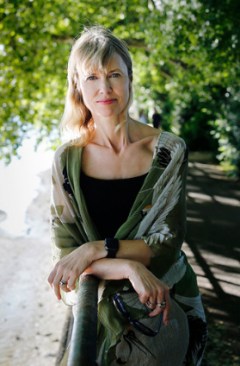 About the Author
Annabel Abbs is the rising star of biographical historical novels. She grew up in Bristol, Sussex and Wales before studying English Literature at the University of East Anglia. Her debut novel The Joyce Girl won the Impress Prize and was a Guardian Reader’s Pick and her second novel Frieda: The Original Lady Chatterley was a Times 2018 Book of the Year. She regularly appears on national and regional media, with recent appearances on Radio 4 Woman’s Hour and Sky News, and is popular on the literary festival circuit. She was longlisted for the Bath Novel Award, the Caledonia Novel Award and the Waverton GoodRead Award. Annabel lives in London with her husband and four children.
Abbs’s third novel, The Language of Food, the story of Eliza Acton, Britain’s first domestic goddess, publishes in the UK in February 2022 and is currently being translated into 14 languages.
Connect with Annabel
Website | Twitter | Facebook



 What Cathy Read Next...